
Hengersberg
Marktpl., 94491 Hengersberg, Deutschland
Marketplace Hengersberg | Weekly Market & Webcam
The Marketplace Hengersberg is much more than an address in the town center. It is the concentrated focal point of a market whose history dates back deep into the Middle Ages, and whose current appearance is shaped by monument preservation, everyday use, and public life. Official sources describe the square as a small, roughly rectangular ensemble with surrounding buildings; at the same time, the community reminds that Hengersberg received market and customs rights as early as 1009, making it the oldest market in Old Bavaria. It is precisely this connection of historical depth and current usability that makes the square appealing. Those who visit the marketplace do not experience just any urban furniture, but a space where market, encounters, local history, and communal identity come together very directly. The weekly market on Wednesdays, the webcam with live impressions, and the event calendar show that the square is not museum-like and remains a vibrant center. ([geodaten.bayern.de](https://geodaten.bayern.de/denkmal_static_data/externe_denkmalliste/pdf/denkmalliste_merge_271125.pdf))
Weekly Market, Webcam, and Current Events at the Marketplace
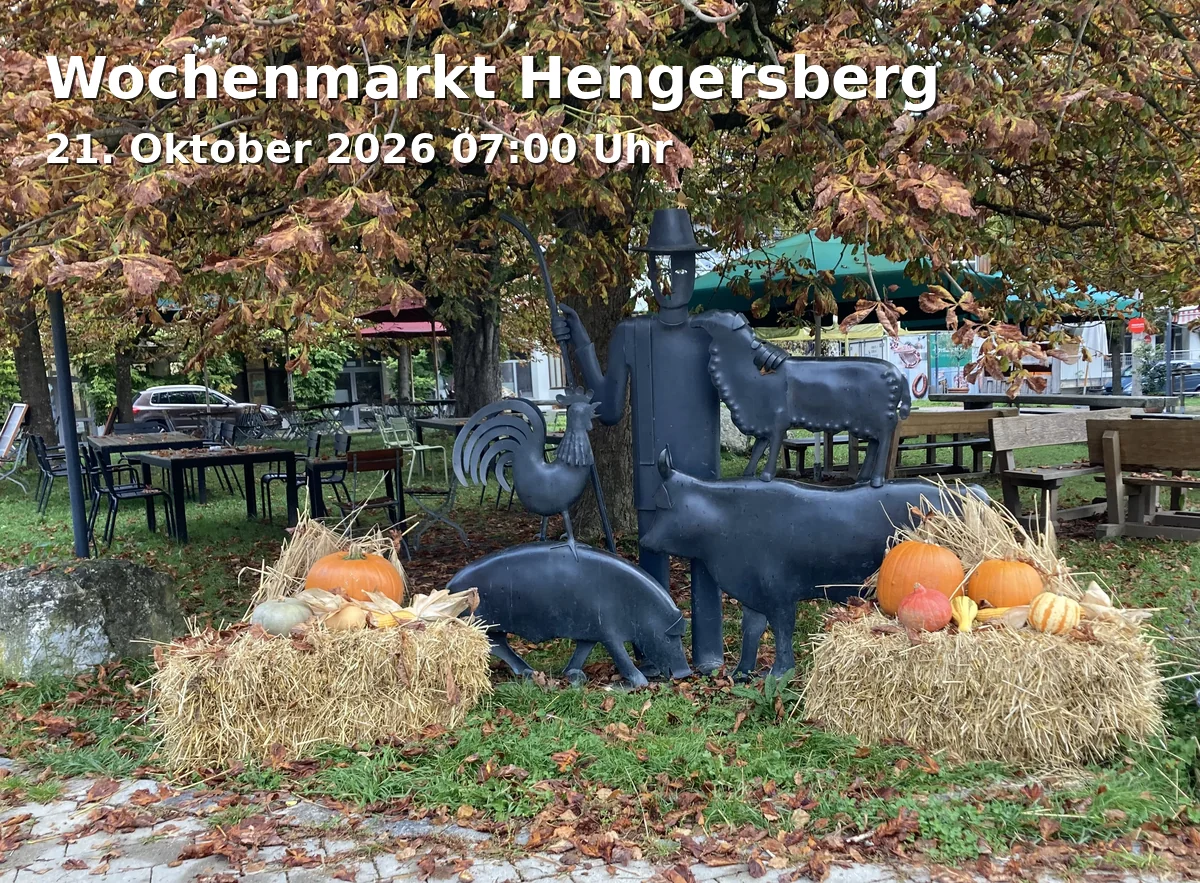
The most important recurring everyday event at the Marketplace Hengersberg is the weekly market. According to the event calendar of the local platform, it takes place every Wednesday from 7:00 to 13:00. Among other things, it features organic bakery, fruit stand, and butcher, which are exactly the types of offerings that make a marketplace visible not just as a backdrop, but as a place of supply and encounter. This is particularly interesting for visitors because the square has its strongest architectural and atmospheric impact on these mornings. Here, the marketplace becomes a real social space: people shop, stop, exchange ideas, and use the place like a small stage of local life. Therefore, anyone searching for a term like marketplace hengersberg today does not find just an empty square, but a regularly used place with a clear daily structure. ([hengersberg.dahoam-in-niederbayern.de](https://hengersberg.dahoam-in-niederbayern.de/veranstaltungen/))
The official webcam of the community also fits into today's usage. The site describes a livestream that allows one to gather various impressions from the Marketplace in Hengersberg. This is not only practical for assessing weather, mood, or visitor numbers, but also indicates that the community consciously presents the square as a visible center. In combination with the municipal event calendar, this creates a clear digital extension of the real town center: the marketplace is not only present on-site but also part of the local public online. This connection of physical space and digital observability is particularly valuable for a smaller market community because it provides orientation and sparks curiosity. Therefore, those who want to get to know the place in advance can get a very direct preview of what to expect on-site through the webcam and calendar. ([hengersberg.de](https://www.hengersberg.de/de/leben-in-hengersberg/allgemeine-informationen/webcam.html))
History of the Marketplace: From Market and Customs Rights to Today's Town Center
The historical depth of the marketplace cannot be understood without the origin of Hengersberg. The community cites the founding of the place in the year 997 and points out that Abbot Gotthard of Niederalteich later requested market and customs rights from the king, which were granted in 1009. In 1430, additional fair rights were added, and the development of the place was accompanied over many centuries by economic upturns, but also by crises, wars, and institutional changes. Particularly impressive is the community's record of how fairs also developed into livestock markets that had regional significance and attracted over 1,000 large cattle at times. This shows that the marketplace was not only a representative center but for a long time a real economic hub. In 1997, the market celebrated its 1000th founding anniversary with numerous events. ([hengersberg.de](https://www.hengersberg.de/de/markt-hengersberg/geschichte.html))
The monument sources also show that the current character of the square is no coincidence. The marketplace was long dependent on the monastery of Niederaltaich, and the historical development did not proceed linearly, but under multiple rule and legal conditions. The monument list states that around 1800, only 140 properties existed. This allows for an important classification: the square is not a large urban representation facility, but the condensed result of a smaller, centuries-old market history. Its compact form, its surrounding buildings, and its close relationship to trade, hospitality, and administration are therefore part of a very old structure. Today, walking through the square means not only traversing a town center but also moving through a historically grown layering of market privileges, monastic influence, Bavarian sovereignty, and communal development. ([geodaten.bayern.de](https://geodaten.bayern.de/denkmal_static_data/externe_denkmalliste/pdf/denkmalliste_merge_271125.pdf))
Protected Ensemble and Architecture Around the Square
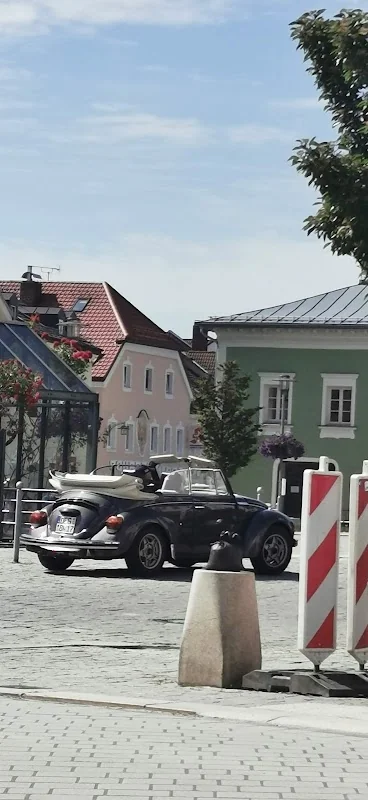
The Bavarian State Office for Monument Preservation describes the Marketplace Hengersberg as an ensemble that encompasses the small, roughly rectangular square with its surrounding buildings. This concise formulation is important because it precisely captures the architectural core: four sides of the square, at whose corners streets converge, frame the space and define it as a closed townscape. According to the monument list, there are the former care court, several large inns, and craftsmen's houses. Typical are plastered, often wide-set two- and three-story buildings from the 18th and early 19th centuries, complemented by some new constructions. Characteristic is also the variety of roof shapes, ranging from gable to eaves roofs to mansard and hipped roofs. It is also noteworthy that until the early 19th century, a freestanding small town hall stood in the center of the square. This means that the current impression of closure and density is not coincidental but the result of a long urban evolution. ([geodaten.bayern.de](https://geodaten.bayern.de/denkmal_static_data/externe_denkmalliste/pdf/denkmalliste_merge_271125.pdf))
The monument list even specifically names individual houses at the marketplace. These include, for example, Marktplatz 1 / Passauer Straße 2 as an inn, Marktplatz 2 as the former care court, Marktplatz 5 as a neoclassical residential and commercial building, Marktplatz 6 as a historicizing residential and commercial building, Marktplatz 8 as a three-story mansard-roof building, and Marktplatz 10 as an inn. This series shows that the square does not originate from a single time but can be read as an architectural mosaic of different epochs. This is precisely why the ensemble is so appealing: it does not appear monumental but rather everyday, and therein lies its quality. Additionally, the municipal facade promotion program explicitly aims to preserve and strengthen the independent character of the marketplace and its access roads. This makes it clear that the place is not only managed but consciously preserved. For visitors, this means that the facades, roofs, and proportions are not merely a backdrop but a protected part of the townscape. ([geodaten.bayern.de](https://geodaten.bayern.de/denkmal_static_data/externe_denkmalliste/pdf/denkmalliste_merge_271125.pdf))
Access, Parking, and Public Use in the Town Center
Those traveling to the marketplace hengersberg or looking to park at the marketplace hengersberg should understand the square as part of a regulated town center. The Market Hengersberg regulates public traffic space through its own statutes, and the special use statute explicitly applies to municipal roads as well as other public roads and squares under the responsibility of the market. This means practically: use, placement of objects, events, and other interventions in the roadway are not arbitrary but require approval. Additionally, there is a parking space statute and an online form for establishing a parking space barrier for parades in no-parking zones. These municipal regulations show that parking and traffic management in the town center are not improvised but orderly. For visitors, this is good because the pathways become clearer; at the same time, it means that one should pay attention to signage and current notices on-site instead of relying on general assumptions. ([hengersberg.de](https://www.hengersberg.de/de/Ortsrecht/Satzungen/satzung-uber-die-erlaubnisse-u.-gebuhren-fur-sonernutzungen-offentlichem-verkehrsraum.pdf?utm_source=openai))
Another indication of practical accessibility is the inner-town parking lot on Mangstraße. An official construction notice documents the reorganization of an existing parking lot at this location, right in the urban context of the market center. Additionally, the municipal facade promotion program names several access roads leading inward towards the marketplace, including Passauer Straße, Deggendorfer Straße, Mimminger Straße, Simon-Breu-Straße, Bahnhofstraße, and Mangstraße. From this list, it can be inferred that the marketplace is well integrated into the local road network and can be reached from several central axes. Therefore, those wishing to visit the square should consider it as a well-connected center rather than an isolated location. Practically, this means: arrival via the inner-town main axes, parking search according to current signage, and then a short walk through the historic core. This combination makes the place attractive for a relaxed visit. ([hengersberg.de](https://www.hengersberg.de/de/dateien/entwurfsplanung-.pdf?utm_source=openai))
Fairs, Special Uses, and Public Events
The Marketplace Hengersberg has traditionally been a market and event space, and this is still legally visible today. The fair statute regulates the use of the square for markets very specifically. It states, among other things, that only sales vehicles, trailers, and stalls are permitted as sales facilities in the marketplace. There are also clear rules for setup and teardown times: goods and facilities may be set up no earlier than one hour before the market time begins and must be removed no later than one hour after it ends. Such regulations are more than administrative details. They show that the square is open for controlled temporary uses but is simultaneously protected. This is particularly important in a historically sensitive ensemble because market life and townscape must be kept in balance here. The statute ensures that the square functions as a market space without losing its characteristic framework. ([hengersberg.de](https://www.hengersberg.de/de/Ortsrecht/Satzungen/jahrmarktsatzung.pdf?utm_source=openai))
History confirms this function over the centuries. As early as the 15th century, additional fairs were added, and the community emphasizes that the livestock markets had regional significance at times. Today, the event calendars of the community and the local platform show that the square continues to be used for customs and culture; for example, a citizens' festival at the marketplace is also listed. At the same time, the special use statute makes it clear that public roads and squares under the responsibility of the market are also open for other uses with appropriate permission. From the visitors' perspective, this is an advantage because the marketplace is not only lively on one day of the year but is regularly activated by the weekly market, events, and temporary occurrences. From the perspective of urban development, it is a sign that the marketplace does not become a mere monument zone but continues to live as a public space with clear rules. ([hengersberg.de](https://www.hengersberg.de/de/markt-hengersberg/geschichte.html))
For Visitors: How to Best Experience the Marketplace
Those who truly want to get to know the Marketplace Hengersberg should focus on Wednesday morning. That is when one encounters the weekly market, the most vibrant usage moment of the square, and simultaneously gets an immediate impression of how the historical backdrop and everyday function overlap. With a quick look at the webcam, one can already estimate how the square appears, and on-site, it is worthwhile to stroll slowly through the ensemble and observe the facades, roof shapes, and proportions. Precisely because the marketplace is small and roughly rectangular, it does not unfold its effect through size but through density, rhythm, and recognizability. This is particularly pleasant for visitors because the place is experienceable without long paths, and one perceives the most important structures within a few minutes. Those who enjoy photography will find here not spectacular monumental architecture but the finer beauty of a grown market center. ([hengersberg.dahoam-in-niederbayern.de](https://hengersberg.dahoam-in-niederbayern.de/veranstaltungen/))
Particularly interesting is the marketplace for all those who want to not only visit historical places but read them. The community and monument sources together tell a story of market privileges, monastic influence, economic function, centuries-long continuity, and conscious preservation. The facade promotion program shows that the character of the square is actively protected, and the monument list documents how strongly the townscape is shaped by administration, hospitality, and craftsmanship. Therefore, anyone planning a quiet stroll should not view the marketplace in isolation but as an entry point into the historical Hengersberg: a place that has developed from market, locality, and administration and still has its center there today. For a first visit, the combination of weekly market, webcam view, building substance, and local history is therefore ideal. It makes clear why the marketplace not only functions in everyday life but also remains important as a place of identity. ([hengersberg.de](https://www.hengersberg.de/de/Ortsrecht/Richtlinien/fassadenprogramm.pdf))
Sources:
- Market Hengersberg - History and Local Development ([hengersberg.de](https://www.hengersberg.de/de/markt-hengersberg/geschichte.html))
- Bavarian State Office for Monument Preservation - Monument List Hengersberg ([geodaten.bayern.de](https://geodaten.bayern.de/denkmal_static_data/externe_denkmalliste/pdf/denkmalliste_merge_271125.pdf))
- Dahoam in Hengersberg - Weekly Market at the Marketplace ([hengersberg.dahoam-in-niederbayern.de](https://hengersberg.dahoam-in-niederbayern.de/veranstaltungen/))
- Market Hengersberg - Webcam at the Marketplace ([hengersberg.de](https://www.hengersberg.de/de/leben-in-hengersberg/allgemeine-informationen/webcam.html))
- Market Hengersberg - Facade Promotion Program and Marketplace Ensemble ([hengersberg.de](https://www.hengersberg.de/de/Ortsrecht/Richtlinien/fassadenprogramm.pdf))
Mehr anzeigenWeniger anzeigen
Marketplace Hengersberg | Weekly Market & Webcam
The Marketplace Hengersberg is much more than an address in the town center. It is the concentrated focal point of a market whose history dates back deep into the Middle Ages, and whose current appearance is shaped by monument preservation, everyday use, and public life. Official sources describe the square as a small, roughly rectangular ensemble with surrounding buildings; at the same time, the community reminds that Hengersberg received market and customs rights as early as 1009, making it the oldest market in Old Bavaria. It is precisely this connection of historical depth and current usability that makes the square appealing. Those who visit the marketplace do not experience just any urban furniture, but a space where market, encounters, local history, and communal identity come together very directly. The weekly market on Wednesdays, the webcam with live impressions, and the event calendar show that the square is not museum-like and remains a vibrant center. ([geodaten.bayern.de](https://geodaten.bayern.de/denkmal_static_data/externe_denkmalliste/pdf/denkmalliste_merge_271125.pdf))
Weekly Market, Webcam, and Current Events at the Marketplace
The most important recurring everyday event at the Marketplace Hengersberg is the weekly market. According to the event calendar of the local platform, it takes place every Wednesday from 7:00 to 13:00. Among other things, it features organic bakery, fruit stand, and butcher, which are exactly the types of offerings that make a marketplace visible not just as a backdrop, but as a place of supply and encounter. This is particularly interesting for visitors because the square has its strongest architectural and atmospheric impact on these mornings. Here, the marketplace becomes a real social space: people shop, stop, exchange ideas, and use the place like a small stage of local life. Therefore, anyone searching for a term like marketplace hengersberg today does not find just an empty square, but a regularly used place with a clear daily structure. ([hengersberg.dahoam-in-niederbayern.de](https://hengersberg.dahoam-in-niederbayern.de/veranstaltungen/))
The official webcam of the community also fits into today's usage. The site describes a livestream that allows one to gather various impressions from the Marketplace in Hengersberg. This is not only practical for assessing weather, mood, or visitor numbers, but also indicates that the community consciously presents the square as a visible center. In combination with the municipal event calendar, this creates a clear digital extension of the real town center: the marketplace is not only present on-site but also part of the local public online. This connection of physical space and digital observability is particularly valuable for a smaller market community because it provides orientation and sparks curiosity. Therefore, those who want to get to know the place in advance can get a very direct preview of what to expect on-site through the webcam and calendar. ([hengersberg.de](https://www.hengersberg.de/de/leben-in-hengersberg/allgemeine-informationen/webcam.html))
History of the Marketplace: From Market and Customs Rights to Today's Town Center
The historical depth of the marketplace cannot be understood without the origin of Hengersberg. The community cites the founding of the place in the year 997 and points out that Abbot Gotthard of Niederalteich later requested market and customs rights from the king, which were granted in 1009. In 1430, additional fair rights were added, and the development of the place was accompanied over many centuries by economic upturns, but also by crises, wars, and institutional changes. Particularly impressive is the community's record of how fairs also developed into livestock markets that had regional significance and attracted over 1,000 large cattle at times. This shows that the marketplace was not only a representative center but for a long time a real economic hub. In 1997, the market celebrated its 1000th founding anniversary with numerous events. ([hengersberg.de](https://www.hengersberg.de/de/markt-hengersberg/geschichte.html))
The monument sources also show that the current character of the square is no coincidence. The marketplace was long dependent on the monastery of Niederaltaich, and the historical development did not proceed linearly, but under multiple rule and legal conditions. The monument list states that around 1800, only 140 properties existed. This allows for an important classification: the square is not a large urban representation facility, but the condensed result of a smaller, centuries-old market history. Its compact form, its surrounding buildings, and its close relationship to trade, hospitality, and administration are therefore part of a very old structure. Today, walking through the square means not only traversing a town center but also moving through a historically grown layering of market privileges, monastic influence, Bavarian sovereignty, and communal development. ([geodaten.bayern.de](https://geodaten.bayern.de/denkmal_static_data/externe_denkmalliste/pdf/denkmalliste_merge_271125.pdf))
Protected Ensemble and Architecture Around the Square
The Bavarian State Office for Monument Preservation describes the Marketplace Hengersberg as an ensemble that encompasses the small, roughly rectangular square with its surrounding buildings. This concise formulation is important because it precisely captures the architectural core: four sides of the square, at whose corners streets converge, frame the space and define it as a closed townscape. According to the monument list, there are the former care court, several large inns, and craftsmen's houses. Typical are plastered, often wide-set two- and three-story buildings from the 18th and early 19th centuries, complemented by some new constructions. Characteristic is also the variety of roof shapes, ranging from gable to eaves roofs to mansard and hipped roofs. It is also noteworthy that until the early 19th century, a freestanding small town hall stood in the center of the square. This means that the current impression of closure and density is not coincidental but the result of a long urban evolution. ([geodaten.bayern.de](https://geodaten.bayern.de/denkmal_static_data/externe_denkmalliste/pdf/denkmalliste_merge_271125.pdf))
The monument list even specifically names individual houses at the marketplace. These include, for example, Marktplatz 1 / Passauer Straße 2 as an inn, Marktplatz 2 as the former care court, Marktplatz 5 as a neoclassical residential and commercial building, Marktplatz 6 as a historicizing residential and commercial building, Marktplatz 8 as a three-story mansard-roof building, and Marktplatz 10 as an inn. This series shows that the square does not originate from a single time but can be read as an architectural mosaic of different epochs. This is precisely why the ensemble is so appealing: it does not appear monumental but rather everyday, and therein lies its quality. Additionally, the municipal facade promotion program explicitly aims to preserve and strengthen the independent character of the marketplace and its access roads. This makes it clear that the place is not only managed but consciously preserved. For visitors, this means that the facades, roofs, and proportions are not merely a backdrop but a protected part of the townscape. ([geodaten.bayern.de](https://geodaten.bayern.de/denkmal_static_data/externe_denkmalliste/pdf/denkmalliste_merge_271125.pdf))
Access, Parking, and Public Use in the Town Center
Those traveling to the marketplace hengersberg or looking to park at the marketplace hengersberg should understand the square as part of a regulated town center. The Market Hengersberg regulates public traffic space through its own statutes, and the special use statute explicitly applies to municipal roads as well as other public roads and squares under the responsibility of the market. This means practically: use, placement of objects, events, and other interventions in the roadway are not arbitrary but require approval. Additionally, there is a parking space statute and an online form for establishing a parking space barrier for parades in no-parking zones. These municipal regulations show that parking and traffic management in the town center are not improvised but orderly. For visitors, this is good because the pathways become clearer; at the same time, it means that one should pay attention to signage and current notices on-site instead of relying on general assumptions. ([hengersberg.de](https://www.hengersberg.de/de/Ortsrecht/Satzungen/satzung-uber-die-erlaubnisse-u.-gebuhren-fur-sonernutzungen-offentlichem-verkehrsraum.pdf?utm_source=openai))
Another indication of practical accessibility is the inner-town parking lot on Mangstraße. An official construction notice documents the reorganization of an existing parking lot at this location, right in the urban context of the market center. Additionally, the municipal facade promotion program names several access roads leading inward towards the marketplace, including Passauer Straße, Deggendorfer Straße, Mimminger Straße, Simon-Breu-Straße, Bahnhofstraße, and Mangstraße. From this list, it can be inferred that the marketplace is well integrated into the local road network and can be reached from several central axes. Therefore, those wishing to visit the square should consider it as a well-connected center rather than an isolated location. Practically, this means: arrival via the inner-town main axes, parking search according to current signage, and then a short walk through the historic core. This combination makes the place attractive for a relaxed visit. ([hengersberg.de](https://www.hengersberg.de/de/dateien/entwurfsplanung-.pdf?utm_source=openai))
Fairs, Special Uses, and Public Events
The Marketplace Hengersberg has traditionally been a market and event space, and this is still legally visible today. The fair statute regulates the use of the square for markets very specifically. It states, among other things, that only sales vehicles, trailers, and stalls are permitted as sales facilities in the marketplace. There are also clear rules for setup and teardown times: goods and facilities may be set up no earlier than one hour before the market time begins and must be removed no later than one hour after it ends. Such regulations are more than administrative details. They show that the square is open for controlled temporary uses but is simultaneously protected. This is particularly important in a historically sensitive ensemble because market life and townscape must be kept in balance here. The statute ensures that the square functions as a market space without losing its characteristic framework. ([hengersberg.de](https://www.hengersberg.de/de/Ortsrecht/Satzungen/jahrmarktsatzung.pdf?utm_source=openai))
History confirms this function over the centuries. As early as the 15th century, additional fairs were added, and the community emphasizes that the livestock markets had regional significance at times. Today, the event calendars of the community and the local platform show that the square continues to be used for customs and culture; for example, a citizens' festival at the marketplace is also listed. At the same time, the special use statute makes it clear that public roads and squares under the responsibility of the market are also open for other uses with appropriate permission. From the visitors' perspective, this is an advantage because the marketplace is not only lively on one day of the year but is regularly activated by the weekly market, events, and temporary occurrences. From the perspective of urban development, it is a sign that the marketplace does not become a mere monument zone but continues to live as a public space with clear rules. ([hengersberg.de](https://www.hengersberg.de/de/markt-hengersberg/geschichte.html))
For Visitors: How to Best Experience the Marketplace
Those who truly want to get to know the Marketplace Hengersberg should focus on Wednesday morning. That is when one encounters the weekly market, the most vibrant usage moment of the square, and simultaneously gets an immediate impression of how the historical backdrop and everyday function overlap. With a quick look at the webcam, one can already estimate how the square appears, and on-site, it is worthwhile to stroll slowly through the ensemble and observe the facades, roof shapes, and proportions. Precisely because the marketplace is small and roughly rectangular, it does not unfold its effect through size but through density, rhythm, and recognizability. This is particularly pleasant for visitors because the place is experienceable without long paths, and one perceives the most important structures within a few minutes. Those who enjoy photography will find here not spectacular monumental architecture but the finer beauty of a grown market center. ([hengersberg.dahoam-in-niederbayern.de](https://hengersberg.dahoam-in-niederbayern.de/veranstaltungen/))
Particularly interesting is the marketplace for all those who want to not only visit historical places but read them. The community and monument sources together tell a story of market privileges, monastic influence, economic function, centuries-long continuity, and conscious preservation. The facade promotion program shows that the character of the square is actively protected, and the monument list documents how strongly the townscape is shaped by administration, hospitality, and craftsmanship. Therefore, anyone planning a quiet stroll should not view the marketplace in isolation but as an entry point into the historical Hengersberg: a place that has developed from market, locality, and administration and still has its center there today. For a first visit, the combination of weekly market, webcam view, building substance, and local history is therefore ideal. It makes clear why the marketplace not only functions in everyday life but also remains important as a place of identity. ([hengersberg.de](https://www.hengersberg.de/de/Ortsrecht/Richtlinien/fassadenprogramm.pdf))
Sources:
- Market Hengersberg - History and Local Development ([hengersberg.de](https://www.hengersberg.de/de/markt-hengersberg/geschichte.html))
- Bavarian State Office for Monument Preservation - Monument List Hengersberg ([geodaten.bayern.de](https://geodaten.bayern.de/denkmal_static_data/externe_denkmalliste/pdf/denkmalliste_merge_271125.pdf))
- Dahoam in Hengersberg - Weekly Market at the Marketplace ([hengersberg.dahoam-in-niederbayern.de](https://hengersberg.dahoam-in-niederbayern.de/veranstaltungen/))
- Market Hengersberg - Webcam at the Marketplace ([hengersberg.de](https://www.hengersberg.de/de/leben-in-hengersberg/allgemeine-informationen/webcam.html))
- Market Hengersberg - Facade Promotion Program and Marketplace Ensemble ([hengersberg.de](https://www.hengersberg.de/de/Ortsrecht/Richtlinien/fassadenprogramm.pdf))
Frequently Asked Questions
Reviews
No reviews found