
Hauptstraße 59, Osterhofen-Altenmarkt
Hauptstraße 59, 94486 Osterhofen, Germany
Asambasilika Altenmarkt | Photos & Reviews
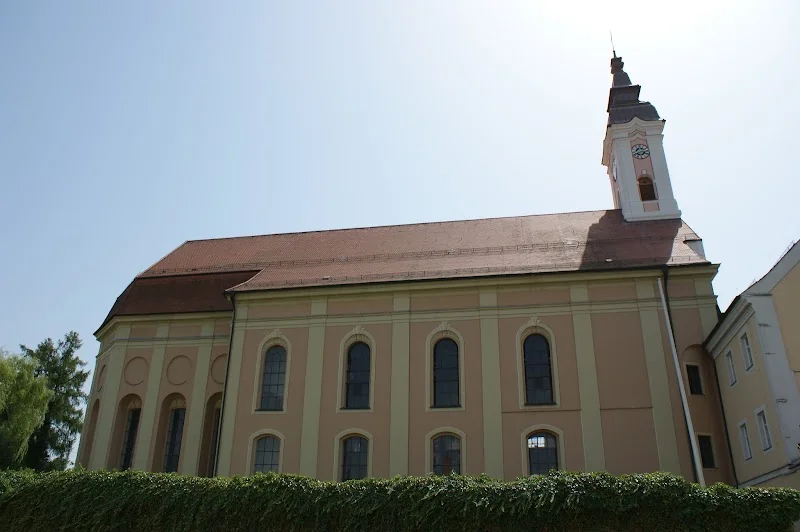
The Asambasilika Altenmarkt in Osterhofen is not an ordinary church building, but a baroque total work of art that stands at the highest point of the district of Altenmarkt and appears rather modest from the outside. This contrast is precisely what makes the visit appealing: What opens up behind the plain facade is a spacious, bright, and generous church space that delights with stucco, frescoes, gold, and an exceptionally clear spatial arrangement. The basilica is assigned to the parish of St. Margaretha Altenmarkt and is used not only as an art-historical monument but also as a vibrant place of worship. Those who visit the church thus experience history, spirituality, and architecture in close quarters. The official website describes the ensemble as a masterpiece by Johann Michael Fischer as well as Cosmas Damian Asam and Egid Quirin Asam; the city of Osterhofen emphasizes that it is a masterpiece of late baroque Bavarian church architecture. Services are held on Sundays at 10:00 AM, and tours can be arranged through the parish office. ([asambasilika.de](https://www.asambasilika.de/))
For inquiries such as photos, reviews, or directions, the Asambasilika is particularly interesting because it presents itself strongly both visually and historically. Visitors searching for images will find numerous insights into the church space, high altar, side altars, women's chapel, and other details on the official site; those looking for reviews will quickly encounter overwhelmingly enthusiastic impressions. The following sections categorize these search intentions thematically and connect them with the documented facts of the basilica. This creates a comprehensive overview that not only explains the name but also makes the significance of the place, its most important artworks, and practical visitor orientation understandable. ([asambasilika.de](https://www.asambasilika.de/))
Photos and Impressions from the Asambasilika Altenmarkt
Those searching for Asambasilika Altenmarkt photos are usually looking for not just a beautiful motif, but a sense of how powerful this space truly is. This is where the special strength of the basilica lies: From the outside, it appears rather modest at the entrance to Altenmarkt, but inside, a monumental yet harmonious spatial effect unfolds. The official description speaks of a large, bright, and generous space that opens up to the visitor, noting the unusually high interior height of 22 meters. This number is not merely a technical specification but an essential part of the impression one has upon entering. Light falls over the bright wall and vault surfaces, the baroque stuccoes and frescoes structure the view, and the golden shine of the furnishings enhances the effect. For photos, this means: Almost every perspective tells a different story because the space is both expansive and detailed. It becomes particularly clear how strongly the Asam brothers and Johann Michael Fischer conceived architecture and furnishings as a unit. ([asambasilika.de](https://www.asambasilika.de/kirchenraum.html))
The official website invites visitors to discover the church space, the high altar, the side altars, and the chapels individually; this is precisely how the image motifs arise that attract visitors and seekers so frequently. In the church space, the arrangement of the altars, frescoes, and reliefs is not randomly placed next to each other but is designed as a consciously composed path through the space. Therefore, a visit is worthwhile not only for classic exterior shots but especially for detail photos of sculptures, altars, and ceiling paintings. The images then show not just mere furnishings but a theologically and artistically thought-out overall concept. Thus, anyone photographing the Asambasilika captures not only a baroque interior but a staging of light, color, movement, and tranquility. This tension makes the church a destination that is also attractive to people who initially search for Asambasilika Altenmarkt photos and ultimately experience one of the most impressive church spaces in Lower Bavaria. ([asambasilika.de](https://www.asambasilika.de/?utm_source=openai))
The official website invites visitors to explore the church space, the high altar, the side altars, and the chapels individually; this is precisely how the image motifs arise that attract visitors and seekers so frequently. In the church space, the arrangement of the altars, frescoes, and reliefs is not randomly placed next to each other but is designed as a consciously composed path through the space. Therefore, a visit is worthwhile not only for classic exterior shots but especially for detail photos of sculptures, altars, and ceiling paintings. The images then show not just mere furnishings but a theologically and artistically thought-out overall concept. Thus, anyone photographing the Asambasilika captures not only a baroque interior but a staging of light, color, movement, and tranquility. This tension makes the church a destination that is also attractive to people who initially search for Asambasilika Altenmarkt photos and ultimately experience one of the most impressive church spaces in Lower Bavaria. ([asambasilika.de](https://www.asambasilika.de/?utm_source=openai))
History of the Asambasilika Altenmarkt in Osterhofen
The history of the Asambasilika Altenmarkt dates back long before the baroque new building. According to the official timeline, a collegiate foundation was established as early as 1004; in 1138, the Premonstratensians took over the site, and in 1288, the provostry was elevated to an abbey. Thus, the area had long been a spiritual center of growing importance before the current church building. Another significant turning point marks the year 1632 when the women's chapel was built during the Swedish crisis, and a lively pilgrimage activity developed. According to the official timeline, a lightning strike destroyed the convent buildings in 1701, and in 1726, the reconstruction of the damaged church began under Abbot Mari by Johann Michael Fischer and Cosmas Damian and Egid Quirin Asam. By 1731, the stucco work was completed, and in 1740, the new Asam church was consecrated. These stages show that the basilica did not emerge as an isolated work of art but rather arose from a long religious and architectural development. ([asambasilika.de](https://www.asambasilika.de/zeittafel.html))
Even the later history is significant because it explains why the basilica today serves as both a monument and a parish church. In 1783, the foundation was dissolved, and in 1858, the English Sisters from Altötting took over the complex and founded the Damenstift Institute, which existed as a precursor to the girls' secondary school until 2017. In 1983, the former abbey church and today's parish church was elevated to a papal basilica. The city of Osterhofen describes the building as the result of the fortunate collaboration of architect, painter, and sculptor, who significantly shaped Bavarian architectural history. For this reason, the Asambasilika is often understood not only as a church space but also as the historical memory of the place. It tells of medieval beginnings, baroque renewal, ecclesiastical use, and later educational influence. Thus, those who visit the basilica today see not only a magnificent interior but also read in the walls a development spanning several centuries that reaches into the present. ([asambasilika.de](https://www.asambasilika.de/zeittafel.html))
High Altar and Ceiling Frescoes as Baroque Center
The high altar is the centerpiece of the Asambasilika Altenmarkt and one of the most important motifs for all those searching for Asambasilika Altenmarkt photos or the famous high altar. The official description emphasizes that the altar, with its four columns, is an extremely impressive work of art and is likely modeled after the Bernini altar in St. Peter's Basilica in Rome. Particularly important is the division of artistic tasks: Egid Quirin Asam created the architectural and plastic effect of the altar, while Cosmas Damian Asam created his most significant work in Altenmarkt with the altar painting of the martyrdom of St. Margaret. At the center stands the bright figure of St. Margaret, flanked by the pagan environment and a Venus figure in the temple. Additionally, the devotional angels on both sides of the tabernacle are highlighted as particularly fine works. Thus, the high altar is not only a liturgical focus but also a stage for baroque art, where sculpture, painting, and architecture intertwine. ([asambasilika.de](https://www.asambasilika.de/hochaltar.html))
The baroque imagery continues in the ceiling frescoes and makes the walk through the church a narrative movement. Above the side altars are two large cycles: the Marian cycle with scenes such as Annunciation, Adoration of the Kings, Outpouring of the Holy Spirit, Appearance of the Risen One before Mary, Ascension of Christ, and Crowning of Mary, as well as the Passion cycle with Last Supper, Mount of Olives, Flagellation, Crowning with Thorns, Veronica, and Crucifixion. The official site explains that these image sequences are read in a zigzag from northeast to southwest through the nave. This is important for visitors because the ceiling images do not merely decorate randomly but unfold a spiritual dramaturgy. Those who take their time will recognize that the basilica not only directs the gaze upwards but also guides through the history of salvation. Thus, the frescoes become an important search and visit theme when people look for altars, ceiling paintings, or baroque church art in Altenmarkt. ([asambasilika.de](https://www.asambasilika.de/marienzyklus.html))
Side Altars, Rosary Altar, and Spatial Concept
The Asambasilika thrives not only on the high altar but also on the multitude of its side altars. The official spatial concept mentions a total of eight side altars that significantly shape the church space: St. Michael, St. John Nepomuk, St. Peter, St. John the Baptist, and St. John the Evangelist, St. Norbert, St. Augustine, and St. Dionysius, as well as the two prominent altars St. Mary with the Child and St. Anne with Mary. The Rosary altar on the north side, dedicated to the rosary and donated by a rosary brotherhood, is particularly highlighted. This variety explains why the church appears so rich and yet orderly inside. The space is not overloaded but structured in a dense baroque context, where each altar sets its own accent while remaining integrated into the larger whole. This is one of the reasons why visitors experience the interior as overwhelming but not chaotic. ([asambasilika.de](https://www.asambasilika.de/raumkonzept.html))
The spatial concept itself goes back to Johann Michael Fischer. The official description emphasizes that he structured the church space so that the basilica presents itself as a wide, open space in honor of God. The floor plan helps to understand this order: From the high altar through the side altars to the pulpit and sacristy, a clearly readable liturgical and artistic scheme emerges. Additionally, the altars and ceiling paintings are not simply perceived in a row but create a pathway in the church space. Those who slowly walk through the space from the entrances experience a kind of baroque narrative that continuously sets new focal points with the Rosary altar, the Marian and Passion images, and the other saint altars. For visitors looking for seating plans, space, interior, or layout, the basilica is therefore not only beautiful but also structurally very interesting. Its uniqueness lies in the connection between liturgical function and artistic staging. ([asambasilika.de](https://www.asambasilika.de/raumkonzept.html))
Directions to the Asambasilika Altenmarkt and Tours
The directions to the Asambasilika Altenmarkt are clearly described on the official website. From the federal highway 8, the basilica is easily accessible; coming from Passau, you exit the roundabout before Osterhofen at the third exit towards Gergweis and Altenmarkt and follow the signs to the right after about 500 meters. Coming from Plattling, you turn right at the second traffic light after the town square in Osterhofen and continue to the basilica in Altenmarkt. Those coming from the Passau-Nuremberg motorway exit at Hengersberg and follow the signs towards Osterhofen until reaching the roundabout at the federal highway 8. For the navigation device, the address of the parish office is recommended, as it is located opposite the basilica: Hauptstr. 54, 94486 Osterhofen. This information is particularly helpful for anyone specifically looking for directions to Asambasilika Altenmarkt and needing clear orientation. ([asambasilika.de](https://www.asambasilika.de/anreise.html))
There is also reliable information for the visit itself. The basilica is not only a destination for architecture enthusiasts but also a vibrant place of worship for the parish of St. Margaretha Altenmarkt. The homepage mentions the Sunday service at 10:00 AM, and the church explicitly invites participation in the services. Additionally, tours can be requested through the Catholic parish office Altenmarkt. In practice, this means: Those who want to not only glance at the basilica but understand it in peace should combine the visit with a tour. The official website and the city of Osterhofen emphasize that the basilica is closely connected to the history of the place and is perceived as both a sight and a spiritual space. For visitors, this is an advantage because one can choose between spontaneous visits, quiet prayers, photo stops, and guided art visits. This mixture makes the Asambasilika Altenmarkt in Osterhofen a particularly flexible and impressive stop. ([asambasilika.de](https://www.asambasilika.de/))
Reviews, Visiting Tips, and Excursions around the Basilica
The existing reviews paint a very uniform picture: Visitors describe the Asambasilika as fantastic, breathtaking, and a place that inspires awe. Such impressions align well with what the official pages say about the space, as the basilica thrives on immediate wonder. Upon entering, one quickly realizes that not only a church is being visited but a work that connects image, space, and liturgy. Precisely for this reason, the Asambasilika is a place that often receives particularly high approval in reviews. For travelers, this is a strong signal, as it shows that the famous baroque effect exists not only in descriptions but also resonates during real visits. Therefore, those searching for Asambasilika Altenmarkt reviews primarily find praise for the interior effect, the art-historical density, and the special feeling that the space conveys. This resonance makes the basilica a destination that remains worthwhile even for short visits. ([asambasilika.de](https://www.asambasilika.de/))
The surroundings of the basilica further enhance the visit. North of the church lies the women's chapel, whose origin dates back to a vow from 1632. Later, it developed into an early baroque chapel with a late Gothic figure of Mary from around 1480, which became a popular pilgrimage site; there is also a stone figure of Mary from 1641 on the outer wall. About 400 meters east lies the chapel of St. Martin at Angerbergl. There, the oldest cemetery in the urban area is documented, with the first burials occurring as early as 1305 according to the official site. Thus, those visiting the Asambasilika can easily connect their walk through Altenmarkt with these smaller, historically dense places. This creates a tour that not only makes the main basilica visible but also its religious neighborhood. For people who want to combine photos, architecture, and history, this is a particularly rewarding path. The Asambasilika Altenmarkt thus does not stop at a single sight but opens up an entire ensemble of baroque art, local memory, and quiet places of devotion. ([asambasilika.de](https://asambasilika.de/frauenkapelle))
Sources:
- Asambasilika Altenmarkt-Osterhofen - Official Website
- Asambasilika Altenmarkt-Osterhofen - Timeline
- Asambasilika Altenmarkt-Osterhofen - The Church Space
- Asambasilika Altenmarkt-Osterhofen - Directions
- City of Osterhofen - Asambasilika
- Asambasilika Altenmarkt-Osterhofen - High Altar
- Asambasilika Altenmarkt-Osterhofen - Side Altars
- Asambasilika Altenmarkt-Osterhofen - Women's Chapel
- Asambasilika Altenmarkt-Osterhofen - St. Martin
Show moreShow less
Asambasilika Altenmarkt | Photos & Reviews
The Asambasilika Altenmarkt in Osterhofen is not an ordinary church building, but a baroque total work of art that stands at the highest point of the district of Altenmarkt and appears rather modest from the outside. This contrast is precisely what makes the visit appealing: What opens up behind the plain facade is a spacious, bright, and generous church space that delights with stucco, frescoes, gold, and an exceptionally clear spatial arrangement. The basilica is assigned to the parish of St. Margaretha Altenmarkt and is used not only as an art-historical monument but also as a vibrant place of worship. Those who visit the church thus experience history, spirituality, and architecture in close quarters. The official website describes the ensemble as a masterpiece by Johann Michael Fischer as well as Cosmas Damian Asam and Egid Quirin Asam; the city of Osterhofen emphasizes that it is a masterpiece of late baroque Bavarian church architecture. Services are held on Sundays at 10:00 AM, and tours can be arranged through the parish office. ([asambasilika.de](https://www.asambasilika.de/))
For inquiries such as photos, reviews, or directions, the Asambasilika is particularly interesting because it presents itself strongly both visually and historically. Visitors searching for images will find numerous insights into the church space, high altar, side altars, women's chapel, and other details on the official site; those looking for reviews will quickly encounter overwhelmingly enthusiastic impressions. The following sections categorize these search intentions thematically and connect them with the documented facts of the basilica. This creates a comprehensive overview that not only explains the name but also makes the significance of the place, its most important artworks, and practical visitor orientation understandable. ([asambasilika.de](https://www.asambasilika.de/))
Photos and Impressions from the Asambasilika Altenmarkt
Those searching for Asambasilika Altenmarkt photos are usually looking for not just a beautiful motif, but a sense of how powerful this space truly is. This is where the special strength of the basilica lies: From the outside, it appears rather modest at the entrance to Altenmarkt, but inside, a monumental yet harmonious spatial effect unfolds. The official description speaks of a large, bright, and generous space that opens up to the visitor, noting the unusually high interior height of 22 meters. This number is not merely a technical specification but an essential part of the impression one has upon entering. Light falls over the bright wall and vault surfaces, the baroque stuccoes and frescoes structure the view, and the golden shine of the furnishings enhances the effect. For photos, this means: Almost every perspective tells a different story because the space is both expansive and detailed. It becomes particularly clear how strongly the Asam brothers and Johann Michael Fischer conceived architecture and furnishings as a unit. ([asambasilika.de](https://www.asambasilika.de/kirchenraum.html))
The official website invites visitors to discover the church space, the high altar, the side altars, and the chapels individually; this is precisely how the image motifs arise that attract visitors and seekers so frequently. In the church space, the arrangement of the altars, frescoes, and reliefs is not randomly placed next to each other but is designed as a consciously composed path through the space. Therefore, a visit is worthwhile not only for classic exterior shots but especially for detail photos of sculptures, altars, and ceiling paintings. The images then show not just mere furnishings but a theologically and artistically thought-out overall concept. Thus, anyone photographing the Asambasilika captures not only a baroque interior but a staging of light, color, movement, and tranquility. This tension makes the church a destination that is also attractive to people who initially search for Asambasilika Altenmarkt photos and ultimately experience one of the most impressive church spaces in Lower Bavaria. ([asambasilika.de](https://www.asambasilika.de/?utm_source=openai))
The official website invites visitors to explore the church space, the high altar, the side altars, and the chapels individually; this is precisely how the image motifs arise that attract visitors and seekers so frequently. In the church space, the arrangement of the altars, frescoes, and reliefs is not randomly placed next to each other but is designed as a consciously composed path through the space. Therefore, a visit is worthwhile not only for classic exterior shots but especially for detail photos of sculptures, altars, and ceiling paintings. The images then show not just mere furnishings but a theologically and artistically thought-out overall concept. Thus, anyone photographing the Asambasilika captures not only a baroque interior but a staging of light, color, movement, and tranquility. This tension makes the church a destination that is also attractive to people who initially search for Asambasilika Altenmarkt photos and ultimately experience one of the most impressive church spaces in Lower Bavaria. ([asambasilika.de](https://www.asambasilika.de/?utm_source=openai))
History of the Asambasilika Altenmarkt in Osterhofen
The history of the Asambasilika Altenmarkt dates back long before the baroque new building. According to the official timeline, a collegiate foundation was established as early as 1004; in 1138, the Premonstratensians took over the site, and in 1288, the provostry was elevated to an abbey. Thus, the area had long been a spiritual center of growing importance before the current church building. Another significant turning point marks the year 1632 when the women's chapel was built during the Swedish crisis, and a lively pilgrimage activity developed. According to the official timeline, a lightning strike destroyed the convent buildings in 1701, and in 1726, the reconstruction of the damaged church began under Abbot Mari by Johann Michael Fischer and Cosmas Damian and Egid Quirin Asam. By 1731, the stucco work was completed, and in 1740, the new Asam church was consecrated. These stages show that the basilica did not emerge as an isolated work of art but rather arose from a long religious and architectural development. ([asambasilika.de](https://www.asambasilika.de/zeittafel.html))
Even the later history is significant because it explains why the basilica today serves as both a monument and a parish church. In 1783, the foundation was dissolved, and in 1858, the English Sisters from Altötting took over the complex and founded the Damenstift Institute, which existed as a precursor to the girls' secondary school until 2017. In 1983, the former abbey church and today's parish church was elevated to a papal basilica. The city of Osterhofen describes the building as the result of the fortunate collaboration of architect, painter, and sculptor, who significantly shaped Bavarian architectural history. For this reason, the Asambasilika is often understood not only as a church space but also as the historical memory of the place. It tells of medieval beginnings, baroque renewal, ecclesiastical use, and later educational influence. Thus, those who visit the basilica today see not only a magnificent interior but also read in the walls a development spanning several centuries that reaches into the present. ([asambasilika.de](https://www.asambasilika.de/zeittafel.html))
High Altar and Ceiling Frescoes as Baroque Center
The high altar is the centerpiece of the Asambasilika Altenmarkt and one of the most important motifs for all those searching for Asambasilika Altenmarkt photos or the famous high altar. The official description emphasizes that the altar, with its four columns, is an extremely impressive work of art and is likely modeled after the Bernini altar in St. Peter's Basilica in Rome. Particularly important is the division of artistic tasks: Egid Quirin Asam created the architectural and plastic effect of the altar, while Cosmas Damian Asam created his most significant work in Altenmarkt with the altar painting of the martyrdom of St. Margaret. At the center stands the bright figure of St. Margaret, flanked by the pagan environment and a Venus figure in the temple. Additionally, the devotional angels on both sides of the tabernacle are highlighted as particularly fine works. Thus, the high altar is not only a liturgical focus but also a stage for baroque art, where sculpture, painting, and architecture intertwine. ([asambasilika.de](https://www.asambasilika.de/hochaltar.html))
The baroque imagery continues in the ceiling frescoes and makes the walk through the church a narrative movement. Above the side altars are two large cycles: the Marian cycle with scenes such as Annunciation, Adoration of the Kings, Outpouring of the Holy Spirit, Appearance of the Risen One before Mary, Ascension of Christ, and Crowning of Mary, as well as the Passion cycle with Last Supper, Mount of Olives, Flagellation, Crowning with Thorns, Veronica, and Crucifixion. The official site explains that these image sequences are read in a zigzag from northeast to southwest through the nave. This is important for visitors because the ceiling images do not merely decorate randomly but unfold a spiritual dramaturgy. Those who take their time will recognize that the basilica not only directs the gaze upwards but also guides through the history of salvation. Thus, the frescoes become an important search and visit theme when people look for altars, ceiling paintings, or baroque church art in Altenmarkt. ([asambasilika.de](https://www.asambasilika.de/marienzyklus.html))
Side Altars, Rosary Altar, and Spatial Concept
The Asambasilika thrives not only on the high altar but also on the multitude of its side altars. The official spatial concept mentions a total of eight side altars that significantly shape the church space: St. Michael, St. John Nepomuk, St. Peter, St. John the Baptist, and St. John the Evangelist, St. Norbert, St. Augustine, and St. Dionysius, as well as the two prominent altars St. Mary with the Child and St. Anne with Mary. The Rosary altar on the north side, dedicated to the rosary and donated by a rosary brotherhood, is particularly highlighted. This variety explains why the church appears so rich and yet orderly inside. The space is not overloaded but structured in a dense baroque context, where each altar sets its own accent while remaining integrated into the larger whole. This is one of the reasons why visitors experience the interior as overwhelming but not chaotic. ([asambasilika.de](https://www.asambasilika.de/raumkonzept.html))
The spatial concept itself goes back to Johann Michael Fischer. The official description emphasizes that he structured the church space so that the basilica presents itself as a wide, open space in honor of God. The floor plan helps to understand this order: From the high altar through the side altars to the pulpit and sacristy, a clearly readable liturgical and artistic scheme emerges. Additionally, the altars and ceiling paintings are not simply perceived in a row but create a pathway in the church space. Those who slowly walk through the space from the entrances experience a kind of baroque narrative that continuously sets new focal points with the Rosary altar, the Marian and Passion images, and the other saint altars. For visitors looking for seating plans, space, interior, or layout, the basilica is therefore not only beautiful but also structurally very interesting. Its uniqueness lies in the connection between liturgical function and artistic staging. ([asambasilika.de](https://www.asambasilika.de/raumkonzept.html))
Directions to the Asambasilika Altenmarkt and Tours
The directions to the Asambasilika Altenmarkt are clearly described on the official website. From the federal highway 8, the basilica is easily accessible; coming from Passau, you exit the roundabout before Osterhofen at the third exit towards Gergweis and Altenmarkt and follow the signs to the right after about 500 meters. Coming from Plattling, you turn right at the second traffic light after the town square in Osterhofen and continue to the basilica in Altenmarkt. Those coming from the Passau-Nuremberg motorway exit at Hengersberg and follow the signs towards Osterhofen until reaching the roundabout at the federal highway 8. For the navigation device, the address of the parish office is recommended, as it is located opposite the basilica: Hauptstr. 54, 94486 Osterhofen. This information is particularly helpful for anyone specifically looking for directions to Asambasilika Altenmarkt and needing clear orientation. ([asambasilika.de](https://www.asambasilika.de/anreise.html))
There is also reliable information for the visit itself. The basilica is not only a destination for architecture enthusiasts but also a vibrant place of worship for the parish of St. Margaretha Altenmarkt. The homepage mentions the Sunday service at 10:00 AM, and the church explicitly invites participation in the services. Additionally, tours can be requested through the Catholic parish office Altenmarkt. In practice, this means: Those who want to not only glance at the basilica but understand it in peace should combine the visit with a tour. The official website and the city of Osterhofen emphasize that the basilica is closely connected to the history of the place and is perceived as both a sight and a spiritual space. For visitors, this is an advantage because one can choose between spontaneous visits, quiet prayers, photo stops, and guided art visits. This mixture makes the Asambasilika Altenmarkt in Osterhofen a particularly flexible and impressive stop. ([asambasilika.de](https://www.asambasilika.de/))
Reviews, Visiting Tips, and Excursions around the Basilica
The existing reviews paint a very uniform picture: Visitors describe the Asambasilika as fantastic, breathtaking, and a place that inspires awe. Such impressions align well with what the official pages say about the space, as the basilica thrives on immediate wonder. Upon entering, one quickly realizes that not only a church is being visited but a work that connects image, space, and liturgy. Precisely for this reason, the Asambasilika is a place that often receives particularly high approval in reviews. For travelers, this is a strong signal, as it shows that the famous baroque effect exists not only in descriptions but also resonates during real visits. Therefore, those searching for Asambasilika Altenmarkt reviews primarily find praise for the interior effect, the art-historical density, and the special feeling that the space conveys. This resonance makes the basilica a destination that remains worthwhile even for short visits. ([asambasilika.de](https://www.asambasilika.de/))
The surroundings of the basilica further enhance the visit. North of the church lies the women's chapel, whose origin dates back to a vow from 1632. Later, it developed into an early baroque chapel with a late Gothic figure of Mary from around 1480, which became a popular pilgrimage site; there is also a stone figure of Mary from 1641 on the outer wall. About 400 meters east lies the chapel of St. Martin at Angerbergl. There, the oldest cemetery in the urban area is documented, with the first burials occurring as early as 1305 according to the official site. Thus, those visiting the Asambasilika can easily connect their walk through Altenmarkt with these smaller, historically dense places. This creates a tour that not only makes the main basilica visible but also its religious neighborhood. For people who want to combine photos, architecture, and history, this is a particularly rewarding path. The Asambasilika Altenmarkt thus does not stop at a single sight but opens up an entire ensemble of baroque art, local memory, and quiet places of devotion. ([asambasilika.de](https://asambasilika.de/frauenkapelle))
Sources:
- Asambasilika Altenmarkt-Osterhofen - Official Website
- Asambasilika Altenmarkt-Osterhofen - Timeline
- Asambasilika Altenmarkt-Osterhofen - The Church Space
- Asambasilika Altenmarkt-Osterhofen - Directions
- City of Osterhofen - Asambasilika
- Asambasilika Altenmarkt-Osterhofen - High Altar
- Asambasilika Altenmarkt-Osterhofen - Side Altars
- Asambasilika Altenmarkt-Osterhofen - Women's Chapel
- Asambasilika Altenmarkt-Osterhofen - St. Martin
Asambasilika Altenmarkt | Photos & Reviews
The Asambasilika Altenmarkt in Osterhofen is not an ordinary church building, but a baroque total work of art that stands at the highest point of the district of Altenmarkt and appears rather modest from the outside. This contrast is precisely what makes the visit appealing: What opens up behind the plain facade is a spacious, bright, and generous church space that delights with stucco, frescoes, gold, and an exceptionally clear spatial arrangement. The basilica is assigned to the parish of St. Margaretha Altenmarkt and is used not only as an art-historical monument but also as a vibrant place of worship. Those who visit the church thus experience history, spirituality, and architecture in close quarters. The official website describes the ensemble as a masterpiece by Johann Michael Fischer as well as Cosmas Damian Asam and Egid Quirin Asam; the city of Osterhofen emphasizes that it is a masterpiece of late baroque Bavarian church architecture. Services are held on Sundays at 10:00 AM, and tours can be arranged through the parish office. ([asambasilika.de](https://www.asambasilika.de/))
For inquiries such as photos, reviews, or directions, the Asambasilika is particularly interesting because it presents itself strongly both visually and historically. Visitors searching for images will find numerous insights into the church space, high altar, side altars, women's chapel, and other details on the official site; those looking for reviews will quickly encounter overwhelmingly enthusiastic impressions. The following sections categorize these search intentions thematically and connect them with the documented facts of the basilica. This creates a comprehensive overview that not only explains the name but also makes the significance of the place, its most important artworks, and practical visitor orientation understandable. ([asambasilika.de](https://www.asambasilika.de/))
Photos and Impressions from the Asambasilika Altenmarkt
Those searching for Asambasilika Altenmarkt photos are usually looking for not just a beautiful motif, but a sense of how powerful this space truly is. This is where the special strength of the basilica lies: From the outside, it appears rather modest at the entrance to Altenmarkt, but inside, a monumental yet harmonious spatial effect unfolds. The official description speaks of a large, bright, and generous space that opens up to the visitor, noting the unusually high interior height of 22 meters. This number is not merely a technical specification but an essential part of the impression one has upon entering. Light falls over the bright wall and vault surfaces, the baroque stuccoes and frescoes structure the view, and the golden shine of the furnishings enhances the effect. For photos, this means: Almost every perspective tells a different story because the space is both expansive and detailed. It becomes particularly clear how strongly the Asam brothers and Johann Michael Fischer conceived architecture and furnishings as a unit. ([asambasilika.de](https://www.asambasilika.de/kirchenraum.html))
The official website invites visitors to discover the church space, the high altar, the side altars, and the chapels individually; this is precisely how the image motifs arise that attract visitors and seekers so frequently. In the church space, the arrangement of the altars, frescoes, and reliefs is not randomly placed next to each other but is designed as a consciously composed path through the space. Therefore, a visit is worthwhile not only for classic exterior shots but especially for detail photos of sculptures, altars, and ceiling paintings. The images then show not just mere furnishings but a theologically and artistically thought-out overall concept. Thus, anyone photographing the Asambasilika captures not only a baroque interior but a staging of light, color, movement, and tranquility. This tension makes the church a destination that is also attractive to people who initially search for Asambasilika Altenmarkt photos and ultimately experience one of the most impressive church spaces in Lower Bavaria. ([asambasilika.de](https://www.asambasilika.de/?utm_source=openai))
The official website invites visitors to explore the church space, the high altar, the side altars, and the chapels individually; this is precisely how the image motifs arise that attract visitors and seekers so frequently. In the church space, the arrangement of the altars, frescoes, and reliefs is not randomly placed next to each other but is designed as a consciously composed path through the space. Therefore, a visit is worthwhile not only for classic exterior shots but especially for detail photos of sculptures, altars, and ceiling paintings. The images then show not just mere furnishings but a theologically and artistically thought-out overall concept. Thus, anyone photographing the Asambasilika captures not only a baroque interior but a staging of light, color, movement, and tranquility. This tension makes the church a destination that is also attractive to people who initially search for Asambasilika Altenmarkt photos and ultimately experience one of the most impressive church spaces in Lower Bavaria. ([asambasilika.de](https://www.asambasilika.de/?utm_source=openai))
History of the Asambasilika Altenmarkt in Osterhofen
The history of the Asambasilika Altenmarkt dates back long before the baroque new building. According to the official timeline, a collegiate foundation was established as early as 1004; in 1138, the Premonstratensians took over the site, and in 1288, the provostry was elevated to an abbey. Thus, the area had long been a spiritual center of growing importance before the current church building. Another significant turning point marks the year 1632 when the women's chapel was built during the Swedish crisis, and a lively pilgrimage activity developed. According to the official timeline, a lightning strike destroyed the convent buildings in 1701, and in 1726, the reconstruction of the damaged church began under Abbot Mari by Johann Michael Fischer and Cosmas Damian and Egid Quirin Asam. By 1731, the stucco work was completed, and in 1740, the new Asam church was consecrated. These stages show that the basilica did not emerge as an isolated work of art but rather arose from a long religious and architectural development. ([asambasilika.de](https://www.asambasilika.de/zeittafel.html))
Even the later history is significant because it explains why the basilica today serves as both a monument and a parish church. In 1783, the foundation was dissolved, and in 1858, the English Sisters from Altötting took over the complex and founded the Damenstift Institute, which existed as a precursor to the girls' secondary school until 2017. In 1983, the former abbey church and today's parish church was elevated to a papal basilica. The city of Osterhofen describes the building as the result of the fortunate collaboration of architect, painter, and sculptor, who significantly shaped Bavarian architectural history. For this reason, the Asambasilika is often understood not only as a church space but also as the historical memory of the place. It tells of medieval beginnings, baroque renewal, ecclesiastical use, and later educational influence. Thus, those who visit the basilica today see not only a magnificent interior but also read in the walls a development spanning several centuries that reaches into the present. ([asambasilika.de](https://www.asambasilika.de/zeittafel.html))
High Altar and Ceiling Frescoes as Baroque Center
The high altar is the centerpiece of the Asambasilika Altenmarkt and one of the most important motifs for all those searching for Asambasilika Altenmarkt photos or the famous high altar. The official description emphasizes that the altar, with its four columns, is an extremely impressive work of art and is likely modeled after the Bernini altar in St. Peter's Basilica in Rome. Particularly important is the division of artistic tasks: Egid Quirin Asam created the architectural and plastic effect of the altar, while Cosmas Damian Asam created his most significant work in Altenmarkt with the altar painting of the martyrdom of St. Margaret. At the center stands the bright figure of St. Margaret, flanked by the pagan environment and a Venus figure in the temple. Additionally, the devotional angels on both sides of the tabernacle are highlighted as particularly fine works. Thus, the high altar is not only a liturgical focus but also a stage for baroque art, where sculpture, painting, and architecture intertwine. ([asambasilika.de](https://www.asambasilika.de/hochaltar.html))
The baroque imagery continues in the ceiling frescoes and makes the walk through the church a narrative movement. Above the side altars are two large cycles: the Marian cycle with scenes such as Annunciation, Adoration of the Kings, Outpouring of the Holy Spirit, Appearance of the Risen One before Mary, Ascension of Christ, and Crowning of Mary, as well as the Passion cycle with Last Supper, Mount of Olives, Flagellation, Crowning with Thorns, Veronica, and Crucifixion. The official site explains that these image sequences are read in a zigzag from northeast to southwest through the nave. This is important for visitors because the ceiling images do not merely decorate randomly but unfold a spiritual dramaturgy. Those who take their time will recognize that the basilica not only directs the gaze upwards but also guides through the history of salvation. Thus, the frescoes become an important search and visit theme when people look for altars, ceiling paintings, or baroque church art in Altenmarkt. ([asambasilika.de](https://www.asambasilika.de/marienzyklus.html))
Side Altars, Rosary Altar, and Spatial Concept
The Asambasilika thrives not only on the high altar but also on the multitude of its side altars. The official spatial concept mentions a total of eight side altars that significantly shape the church space: St. Michael, St. John Nepomuk, St. Peter, St. John the Baptist, and St. John the Evangelist, St. Norbert, St. Augustine, and St. Dionysius, as well as the two prominent altars St. Mary with the Child and St. Anne with Mary. The Rosary altar on the north side, dedicated to the rosary and donated by a rosary brotherhood, is particularly highlighted. This variety explains why the church appears so rich and yet orderly inside. The space is not overloaded but structured in a dense baroque context, where each altar sets its own accent while remaining integrated into the larger whole. This is one of the reasons why visitors experience the interior as overwhelming but not chaotic. ([asambasilika.de](https://www.asambasilika.de/raumkonzept.html))
The spatial concept itself goes back to Johann Michael Fischer. The official description emphasizes that he structured the church space so that the basilica presents itself as a wide, open space in honor of God. The floor plan helps to understand this order: From the high altar through the side altars to the pulpit and sacristy, a clearly readable liturgical and artistic scheme emerges. Additionally, the altars and ceiling paintings are not simply perceived in a row but create a pathway in the church space. Those who slowly walk through the space from the entrances experience a kind of baroque narrative that continuously sets new focal points with the Rosary altar, the Marian and Passion images, and the other saint altars. For visitors looking for seating plans, space, interior, or layout, the basilica is therefore not only beautiful but also structurally very interesting. Its uniqueness lies in the connection between liturgical function and artistic staging. ([asambasilika.de](https://www.asambasilika.de/raumkonzept.html))
Directions to the Asambasilika Altenmarkt and Tours
The directions to the Asambasilika Altenmarkt are clearly described on the official website. From the federal highway 8, the basilica is easily accessible; coming from Passau, you exit the roundabout before Osterhofen at the third exit towards Gergweis and Altenmarkt and follow the signs to the right after about 500 meters. Coming from Plattling, you turn right at the second traffic light after the town square in Osterhofen and continue to the basilica in Altenmarkt. Those coming from the Passau-Nuremberg motorway exit at Hengersberg and follow the signs towards Osterhofen until reaching the roundabout at the federal highway 8. For the navigation device, the address of the parish office is recommended, as it is located opposite the basilica: Hauptstr. 54, 94486 Osterhofen. This information is particularly helpful for anyone specifically looking for directions to Asambasilika Altenmarkt and needing clear orientation. ([asambasilika.de](https://www.asambasilika.de/anreise.html))
There is also reliable information for the visit itself. The basilica is not only a destination for architecture enthusiasts but also a vibrant place of worship for the parish of St. Margaretha Altenmarkt. The homepage mentions the Sunday service at 10:00 AM, and the church explicitly invites participation in the services. Additionally, tours can be requested through the Catholic parish office Altenmarkt. In practice, this means: Those who want to not only glance at the basilica but understand it in peace should combine the visit with a tour. The official website and the city of Osterhofen emphasize that the basilica is closely connected to the history of the place and is perceived as both a sight and a spiritual space. For visitors, this is an advantage because one can choose between spontaneous visits, quiet prayers, photo stops, and guided art visits. This mixture makes the Asambasilika Altenmarkt in Osterhofen a particularly flexible and impressive stop. ([asambasilika.de](https://www.asambasilika.de/))
Reviews, Visiting Tips, and Excursions around the Basilica
The existing reviews paint a very uniform picture: Visitors describe the Asambasilika as fantastic, breathtaking, and a place that inspires awe. Such impressions align well with what the official pages say about the space, as the basilica thrives on immediate wonder. Upon entering, one quickly realizes that not only a church is being visited but a work that connects image, space, and liturgy. Precisely for this reason, the Asambasilika is a place that often receives particularly high approval in reviews. For travelers, this is a strong signal, as it shows that the famous baroque effect exists not only in descriptions but also resonates during real visits. Therefore, those searching for Asambasilika Altenmarkt reviews primarily find praise for the interior effect, the art-historical density, and the special feeling that the space conveys. This resonance makes the basilica a destination that remains worthwhile even for short visits. ([asambasilika.de](https://www.asambasilika.de/))
The surroundings of the basilica further enhance the visit. North of the church lies the women's chapel, whose origin dates back to a vow from 1632. Later, it developed into an early baroque chapel with a late Gothic figure of Mary from around 1480, which became a popular pilgrimage site; there is also a stone figure of Mary from 1641 on the outer wall. About 400 meters east lies the chapel of St. Martin at Angerbergl. There, the oldest cemetery in the urban area is documented, with the first burials occurring as early as 1305 according to the official site. Thus, those visiting the Asambasilika can easily connect their walk through Altenmarkt with these smaller, historically dense places. This creates a tour that not only makes the main basilica visible but also its religious neighborhood. For people who want to combine photos, architecture, and history, this is a particularly rewarding path. The Asambasilika Altenmarkt thus does not stop at a single sight but opens up an entire ensemble of baroque art, local memory, and quiet places of devotion. ([asambasilika.de](https://asambasilika.de/frauenkapelle))
Sources:
- Asambasilika Altenmarkt-Osterhofen - Official Website
- Asambasilika Altenmarkt-Osterhofen - Timeline
- Asambasilika Altenmarkt-Osterhofen - The Church Space
- Asambasilika Altenmarkt-Osterhofen - Directions
- City of Osterhofen - Asambasilika
- Asambasilika Altenmarkt-Osterhofen - High Altar
- Asambasilika Altenmarkt-Osterhofen - Side Altars
- Asambasilika Altenmarkt-Osterhofen - Women's Chapel
- Asambasilika Altenmarkt-Osterhofen - St. Martin
Upcoming Events
No events found
Frequently Asked Questions
Reviews
david antoun
1. March 2026
Former medieval Convent, as of 18th century it is transformed into St Margaret basilica with interior touch of Asam Brothers. Another jewel in Passau Area.
Christian Germany
4. February 2019
Fantastic baroque church with finest. Breathtaking inside! Unbelievable to find this highlight of baroque interior wealth in the middle of nowhere.
Alex
30. June 2025
Really really nice church. A must see place which leaves you in awe. Totally recommend a visit if you’re in the area.
Wolfgang Laun
8. December 2021
The church is known as "Asambasilika", carrying the name of the Asam brothers, Cosmas Damian und Egid Quirin. Rightly so, because this church exhibits an interior that dazzles the eye with gold stucco over white walls of a nave with elegant curves along the galleries, the ceiling and the choir. Paintings show scenes from the live of St. Norbert, the passion of Christ and the life of St. Mary. A baroque gem!
Lars Friedrich
9. April 2017
Supernice