
Deggendorf
Maxmühle 3, 94554 Moos, Deutschland
Info Center Isar Estuary | Opening Hours & Directions
Embedded in the floodplain forests at the mouth of the Isar River into the Danube, the Info Center Isar Estuary – Dr. Georg Karl House – in Moos offers an authentic nature experience for families, school classes, and nature lovers. The exhibition clearly explains the habitats of the river floodplains, modern aquariums make fish from the Isar and Danube visible up close, and outside, model floodplain habitats await with circular paths and discovery stations. The location is easily accessible by bike via the Isar and Danube bike paths as well as by car via the federal highway B8. On-site, the visit is low-threshold: Admission is free, the paths are family-friendly, there is a children's world with a playground, and practical educational offerings from guided tours to 3D films. Seasonal opening hours ensure ample time slots between spring and autumn, while mobility offers such as call buses and e-charging stations facilitate access. Those who want to learn about the unique dynamics of the rivers, the floodplain forests, meadows, and old waters will find well-founded information, many interactive opportunities, and plenty of inspiration for their own tours.
Opening Hours, Admission & Seasonal Notes
The Info Center Isar Estuary is a seasonally open facility. The exhibition in the Dr. Georg Karl House opens annually from April 1 to October 31, every Wednesday to Sunday, from 10:00 AM to 5:00 PM. During these months, it is also open on all public holidays, even if the holiday falls on a Monday or Tuesday; an exception is Good Friday. The free admission makes the visit particularly low-threshold – perfect for spontaneous outings, families with children, or repeated visits throughout the year. Outside the season, the building remains closed; please inform yourself in advance about current notices, as seasonal adjustments or special openings in the context of events may be possible. Guided tours are offered for groups of about ten people and for school classes; prior registration is required to tailor content, duration, and route to age, prior knowledge, and weather conditions. The bookable programs range from thematic floodplain excursions to special animal and plant tours to combined offerings in the exhibition and outdoor area. Those who want to experience the exhibition intensively should plan at least 60 to 90 minutes; with children or when participating in a guided tour, the stay can take significantly longer. Seasonal peculiarities are worth experiencing: In spring, the floodplain awakens with blossoms and bird songs, in summer the outdoor experience is particularly diverse, and in early autumn, ripe fruits, clear water levels, and vibrant colors can be experienced. Please also note the accessibility and safety information: The house is accessible with few barriers; details can be inquired at the information desk if needed. Dogs are not allowed immediately around the building; leashed dogs are permitted on the circular paths, and service and assistance dogs are exempt. For children's groups and school classes, there are additional organizational recommendations regarding meeting points, rest areas, and material distribution, which you will receive when scheduling the appointment. Practically: Since admission is free, you can also plan the visit as a stop on a longer bike or car tour and return later to explore further areas.
Directions, Parking, Call Bus, and E-Charging Stations
The Info Center is located at Maxmühle 3, 94554 Moos. From the direction of Plattling, drive about six kilometers on the B8 towards Osterhofen and turn off towards Moos; coming from Osterhofen, follow the B8 in the opposite direction. Cyclists can easily reach the destination via the Isar bike path or the Danube bike path and can integrate the visit into a day tour. An advantage of the location: The routes along the Isar and Danube are well signposted, have little motorized traffic, and lead through diverse floodplain landscapes, so access and nature experience seamlessly intertwine. On-site, parking is available directly at the Info Center. For sustainable arrivals, charging points are available: E-bikes can be charged under cover in the entrance area, and there is an e-car charging station from the operator Mer in the parking lot. The charging process can be done via app, ad-hoc payment, or roaming card; please refer to the operator app for the applicable conditions and availability. Those who prefer public transport can use the call bus: From the train stations Osterhofen or Plattling, there is a demand-oriented connection (line 8225) to the stop Sammern, which is closest to the Info Center. The ride request center accepts bookings daily from 6:30 AM to 9:00 PM – also on weekends and public holidays – and requires at least one hour's notice. Up to eight people can ride per trip; thus, the call bus is suitable for families, small groups, or school classes in small groups. For the last stretch, it is advisable to plan a few minutes of walking and to wear weather-appropriate clothing. Those traveling by bike can easily combine the visit with nearby dining options; traditional inns and beer gardens are located along the bike paths in the Danube-Isar region. Please pay attention to the signage on-site, especially in the areas of protected zones, bridges, and dams: Depending on water levels, breeding times, or maintenance work, paths may be temporarily closed. For a relaxed arrival, it is advisable to check the current notices of the facility shortly before the visit and to plan alternative routes if necessary.
Exhibition and Aquariums: Isar and Danube Under Glass
The exhibition is designed over approximately 250 m² and conveys – vividly and interactively – the formation and dynamics of the floodplain landscape at the Isar estuary. The centerpiece is the aquariums, which showcase representative habitats from the Isar and Danube. With the expansion in 2023, two new tanks were added indoors as well as a large aquarium as an outdoor extension (about 13.5 m³). Here, visitors can observe river fish in peace; information panels explain typical species, adaptations, and conservation needs. The Huchen, often referred to as Danube salmon, serves as an impressive flagship species for the migratory fish of the Danube catchment area; together with endemic Danube perch species such as Zingel, Streber, and Schrätzer, it highlights the uniqueness of the Isar-Danube waters. Additionally, a controllable water dynamics model illustrates how floods, groundwater, and runoff regimes shape the floodplain, create old waters, and develop softwood and hardwood floodplain forests. The exhibition also includes a permanent display from the water management office in Deggendorf and introduces topics such as water ecology, floodplain maintenance, and renaturation. An educational beehive on the grounds bridges the gap to pollination, biodiversity, and sustainable land use; this is complemented by the 3D film about the life of the honeybee shown in the lecture room, which can be booked free of charge for groups and school classes. The design is intentionally family-friendly: Many elements invite participation, touching, and trying out without neglecting the technical depth. Those who want to delve deeper can use the topic-specific guided tours or the materials for teachers. Together, this creates a multifaceted overall picture of the Isar estuary: Here, an alpine river flows into the freely flowing Danube – a constellation that is particularly unique and explains the diversity of habitats that come together in a small space. The aquariums make this diversity tangible, from the current tank to calmer old water habitats, and connect nature observation, research findings, and conservation practice.
Outdoor Facilities, Circular Paths, and Floodplain Experience
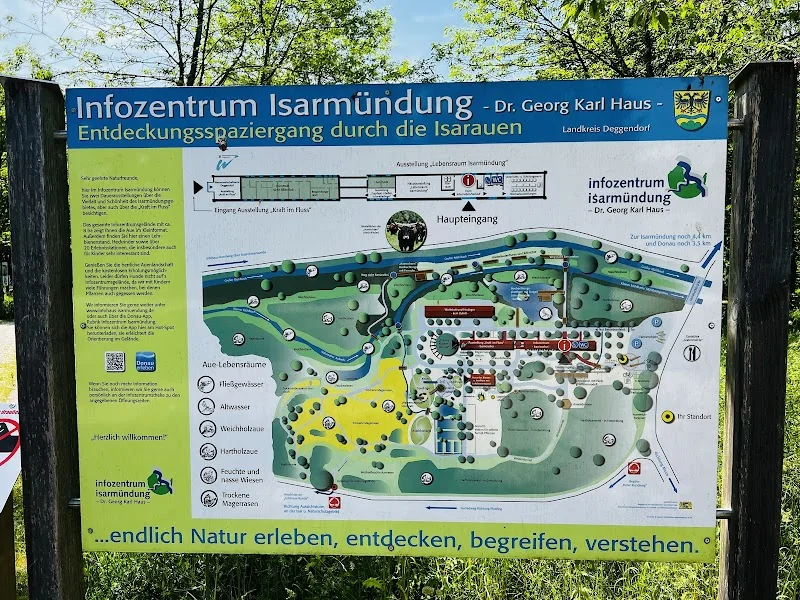
Directly in front of the exhibition, the content continues in the outdoor area. On extensive outdoor spaces, floodplain habitats in miniature are recreated: A winding flowing watercourse with natural banks, reed beds, meadow areas, and willow bushes form the landscape framework for observation and discovery. Visitors can independently explore the stations via circular paths; accompanying panels and interactive elements help sharpen the senses – from the sound of flowing water to the scent of herbs by the wayside. For families, several route lengths are sensible: Depending on the variant, a complete discovery round can be completed in two to over four hours; the distances are chosen so that even younger children can keep up. The paths are mostly natural, so sturdy footwear and weather-appropriate clothing are recommended. Spring and summer months offer particularly many opportunities for observation, but early autumn also has its charm with clear air and ripe fruits. Botanically interested visitors will encounter an extraordinary plant diversity: As a biogeographical junction, the Isar estuary area is home to numerous rare and endangered species – from plants native to the pre-Alpine region, such as the dark columbine, to warmth-loving species from southern European refuges. Already in the outdoor area, marked areas and examples point to these peculiarities. For wildlife, old waters, floodplain meadows, and floodplain forests are important retreat areas; those who are attentive and keep their distance can observe birds, dragonflies, or amphibians. Rest zones and protection regulations serve to protect these species; please observe path regulations and seasonal notices. It is practical that rest areas, play areas, and proximity to the house allow for short breaks without having to interrupt the circular path. Those who want to expand the nature experience can combine the outdoor tour with sections of the Isar or Danube bike path and cycle along the Danube to ferry points or dining options. Information on path lengths, combinations, and possible closures can be obtained at the information desk or on the notices at the site.
Children's World, Playground, and Children's Birthdays
The children's world is a highlight for families. It combines playful learning with movement and fosters curiosity about nature. A playground with a climbing tower, slide, and bouncing band invites children to let off steam; on the top level of the tower, display boards with small puzzles encourage observation and thinking. Along the family-friendly paths, interactive stations await that involve seeing, hearing, feeling, and smelling – making nature literally graspable. The discovery tours start at the house: Free exploration sheets available at the counter guide visitors through several themed stations. Depending on the combination, the rounds last about 2.5 to 4.5 hours; for school classes, small groups working in parallel at different stations are suitable. Those planning a special occasion can book children's birthdays on the grounds. The standard program is designed for children aged eight to twelve, lasts about two hours, and includes games, treasure hunts, and creative crafting activities. Optional campfires and stick bread dough can be booked. The organization is handled by the team or volunteers in the ecological year; prices and group sizes are clearly regulated, and alternative options are available in bad weather. The close connection between the exhibition, grounds, and educational offerings is advantageous: After a brief introduction, observations outside can be immediately practically tested, from identifying simple plant characteristics to exploring the model flowing watercourse. Parents will find seating within sight; at the same time, there is enough distance for children to explore in peace. Safety instructions – such as regarding water areas and path crossings – are explained on-site. Those who want to round off the day can combine the birthday with a small bike or hiking round or dine in the surrounding area. Due to high interest, early scheduling of appointments is recommended, especially in the months of May to September. Tip: Even without a special occasion, a family afternoon is worthwhile; thanks to free admission, you can flexibly adjust the visit to the weather and the children's energy levels.
Guided Tours, Events & Tips for Photo Spots
In addition to free visits, the Info Center offers a program of guided tours and events. Group tours (from about ten people) and school class appointments are individually coordinated; topics range from floodplain ecology to river fish to herb and nature workshop formats. Regular workshops are also held, for example, on wild herbs – sometimes seasonally in late autumn or winter – combining excursions and practical parts. For all bookable offers, prior registration is required, and places are limited. Photographically, the Isar estuary has special charms. Inside, the large panes of the aquariums, where flow conditions and species diversity can be observed, are impressive; early times of the day are suitable for calm shots without reflections. Outside, model shore zones, meadow strips, and willow bushes create interesting foregrounds. Botanical motifs arise throughout the year; in spring, it is mainly fresh shoots and early bloomers, in summer, species-rich meadows and dragonflies, and in late summer and early autumn, vibrant colors. For animal photography, it is important to maintain distance, stay on paths, and respect rest zones. Those who want to stage the landscape can use the transitions from old water to floodplain forest or compose along the bike paths that open sightlines to the river landscape. It is advisable to experiment with changing light moods – from backlighting at water surfaces to streaked light in the willow stands. For schools and associations, the lecture room in the house is additionally available; here, the 3D film about the honeybee can be shown, often combined with a visit to the educational beehive. Additionally, it is worth taking a look at the facility's event calendar, which lists current dates, booking deadlines, and target groups (e.g., adults, families, children). Those who want to dive deeper into the flora will find prepared information on the plant world of the Isar estuary; there, the extraordinary species richness at the biogeographical junction is explained, from dark columbine to site-typical reed and meadow species. Overall, the program combines nature education, recreation, and active nature conservation – always with the goal of making the peculiarities of the Isar-Danube floodplain tangible and understandable.
Sources:
- Info Center Isar Estuary – Opening Hours and Admission
- Info Center Isar Estuary – Location, Directions & Contact
- Info Center Isar Estuary – The Info Center
- Info Center Isar Estuary – Children's World
- Info Center Isar Estuary – E-Mobility
- Info Center Isar Estuary – Events
- Municipality of Moos – Info Center Isar Estuary
- District of Deggendorf – Opening of Large Aquarium (05/24/2023)
- Passauer Neue Presse – Three Aquariums with River Fish
- City of Plattling – Isar Estuary
- Info Center Isar Estuary – Plant World
- Info Center Isar Estuary – Discovery Tours
Show moreShow less
Info Center Isar Estuary | Opening Hours & Directions
Embedded in the floodplain forests at the mouth of the Isar River into the Danube, the Info Center Isar Estuary – Dr. Georg Karl House – in Moos offers an authentic nature experience for families, school classes, and nature lovers. The exhibition clearly explains the habitats of the river floodplains, modern aquariums make fish from the Isar and Danube visible up close, and outside, model floodplain habitats await with circular paths and discovery stations. The location is easily accessible by bike via the Isar and Danube bike paths as well as by car via the federal highway B8. On-site, the visit is low-threshold: Admission is free, the paths are family-friendly, there is a children's world with a playground, and practical educational offerings from guided tours to 3D films. Seasonal opening hours ensure ample time slots between spring and autumn, while mobility offers such as call buses and e-charging stations facilitate access. Those who want to learn about the unique dynamics of the rivers, the floodplain forests, meadows, and old waters will find well-founded information, many interactive opportunities, and plenty of inspiration for their own tours.
Opening Hours, Admission & Seasonal Notes
The Info Center Isar Estuary is a seasonally open facility. The exhibition in the Dr. Georg Karl House opens annually from April 1 to October 31, every Wednesday to Sunday, from 10:00 AM to 5:00 PM. During these months, it is also open on all public holidays, even if the holiday falls on a Monday or Tuesday; an exception is Good Friday. The free admission makes the visit particularly low-threshold – perfect for spontaneous outings, families with children, or repeated visits throughout the year. Outside the season, the building remains closed; please inform yourself in advance about current notices, as seasonal adjustments or special openings in the context of events may be possible. Guided tours are offered for groups of about ten people and for school classes; prior registration is required to tailor content, duration, and route to age, prior knowledge, and weather conditions. The bookable programs range from thematic floodplain excursions to special animal and plant tours to combined offerings in the exhibition and outdoor area. Those who want to experience the exhibition intensively should plan at least 60 to 90 minutes; with children or when participating in a guided tour, the stay can take significantly longer. Seasonal peculiarities are worth experiencing: In spring, the floodplain awakens with blossoms and bird songs, in summer the outdoor experience is particularly diverse, and in early autumn, ripe fruits, clear water levels, and vibrant colors can be experienced. Please also note the accessibility and safety information: The house is accessible with few barriers; details can be inquired at the information desk if needed. Dogs are not allowed immediately around the building; leashed dogs are permitted on the circular paths, and service and assistance dogs are exempt. For children's groups and school classes, there are additional organizational recommendations regarding meeting points, rest areas, and material distribution, which you will receive when scheduling the appointment. Practically: Since admission is free, you can also plan the visit as a stop on a longer bike or car tour and return later to explore further areas.
Directions, Parking, Call Bus, and E-Charging Stations
The Info Center is located at Maxmühle 3, 94554 Moos. From the direction of Plattling, drive about six kilometers on the B8 towards Osterhofen and turn off towards Moos; coming from Osterhofen, follow the B8 in the opposite direction. Cyclists can easily reach the destination via the Isar bike path or the Danube bike path and can integrate the visit into a day tour. An advantage of the location: The routes along the Isar and Danube are well signposted, have little motorized traffic, and lead through diverse floodplain landscapes, so access and nature experience seamlessly intertwine. On-site, parking is available directly at the Info Center. For sustainable arrivals, charging points are available: E-bikes can be charged under cover in the entrance area, and there is an e-car charging station from the operator Mer in the parking lot. The charging process can be done via app, ad-hoc payment, or roaming card; please refer to the operator app for the applicable conditions and availability. Those who prefer public transport can use the call bus: From the train stations Osterhofen or Plattling, there is a demand-oriented connection (line 8225) to the stop Sammern, which is closest to the Info Center. The ride request center accepts bookings daily from 6:30 AM to 9:00 PM – also on weekends and public holidays – and requires at least one hour's notice. Up to eight people can ride per trip; thus, the call bus is suitable for families, small groups, or school classes in small groups. For the last stretch, it is advisable to plan a few minutes of walking and to wear weather-appropriate clothing. Those traveling by bike can easily combine the visit with nearby dining options; traditional inns and beer gardens are located along the bike paths in the Danube-Isar region. Please pay attention to the signage on-site, especially in the areas of protected zones, bridges, and dams: Depending on water levels, breeding times, or maintenance work, paths may be temporarily closed. For a relaxed arrival, it is advisable to check the current notices of the facility shortly before the visit and to plan alternative routes if necessary.
Exhibition and Aquariums: Isar and Danube Under Glass
The exhibition is designed over approximately 250 m² and conveys – vividly and interactively – the formation and dynamics of the floodplain landscape at the Isar estuary. The centerpiece is the aquariums, which showcase representative habitats from the Isar and Danube. With the expansion in 2023, two new tanks were added indoors as well as a large aquarium as an outdoor extension (about 13.5 m³). Here, visitors can observe river fish in peace; information panels explain typical species, adaptations, and conservation needs. The Huchen, often referred to as Danube salmon, serves as an impressive flagship species for the migratory fish of the Danube catchment area; together with endemic Danube perch species such as Zingel, Streber, and Schrätzer, it highlights the uniqueness of the Isar-Danube waters. Additionally, a controllable water dynamics model illustrates how floods, groundwater, and runoff regimes shape the floodplain, create old waters, and develop softwood and hardwood floodplain forests. The exhibition also includes a permanent display from the water management office in Deggendorf and introduces topics such as water ecology, floodplain maintenance, and renaturation. An educational beehive on the grounds bridges the gap to pollination, biodiversity, and sustainable land use; this is complemented by the 3D film about the life of the honeybee shown in the lecture room, which can be booked free of charge for groups and school classes. The design is intentionally family-friendly: Many elements invite participation, touching, and trying out without neglecting the technical depth. Those who want to delve deeper can use the topic-specific guided tours or the materials for teachers. Together, this creates a multifaceted overall picture of the Isar estuary: Here, an alpine river flows into the freely flowing Danube – a constellation that is particularly unique and explains the diversity of habitats that come together in a small space. The aquariums make this diversity tangible, from the current tank to calmer old water habitats, and connect nature observation, research findings, and conservation practice.
Outdoor Facilities, Circular Paths, and Floodplain Experience
Directly in front of the exhibition, the content continues in the outdoor area. On extensive outdoor spaces, floodplain habitats in miniature are recreated: A winding flowing watercourse with natural banks, reed beds, meadow areas, and willow bushes form the landscape framework for observation and discovery. Visitors can independently explore the stations via circular paths; accompanying panels and interactive elements help sharpen the senses – from the sound of flowing water to the scent of herbs by the wayside. For families, several route lengths are sensible: Depending on the variant, a complete discovery round can be completed in two to over four hours; the distances are chosen so that even younger children can keep up. The paths are mostly natural, so sturdy footwear and weather-appropriate clothing are recommended. Spring and summer months offer particularly many opportunities for observation, but early autumn also has its charm with clear air and ripe fruits. Botanically interested visitors will encounter an extraordinary plant diversity: As a biogeographical junction, the Isar estuary area is home to numerous rare and endangered species – from plants native to the pre-Alpine region, such as the dark columbine, to warmth-loving species from southern European refuges. Already in the outdoor area, marked areas and examples point to these peculiarities. For wildlife, old waters, floodplain meadows, and floodplain forests are important retreat areas; those who are attentive and keep their distance can observe birds, dragonflies, or amphibians. Rest zones and protection regulations serve to protect these species; please observe path regulations and seasonal notices. It is practical that rest areas, play areas, and proximity to the house allow for short breaks without having to interrupt the circular path. Those who want to expand the nature experience can combine the outdoor tour with sections of the Isar or Danube bike path and cycle along the Danube to ferry points or dining options. Information on path lengths, combinations, and possible closures can be obtained at the information desk or on the notices at the site.
Children's World, Playground, and Children's Birthdays
The children's world is a highlight for families. It combines playful learning with movement and fosters curiosity about nature. A playground with a climbing tower, slide, and bouncing band invites children to let off steam; on the top level of the tower, display boards with small puzzles encourage observation and thinking. Along the family-friendly paths, interactive stations await that involve seeing, hearing, feeling, and smelling – making nature literally graspable. The discovery tours start at the house: Free exploration sheets available at the counter guide visitors through several themed stations. Depending on the combination, the rounds last about 2.5 to 4.5 hours; for school classes, small groups working in parallel at different stations are suitable. Those planning a special occasion can book children's birthdays on the grounds. The standard program is designed for children aged eight to twelve, lasts about two hours, and includes games, treasure hunts, and creative crafting activities. Optional campfires and stick bread dough can be booked. The organization is handled by the team or volunteers in the ecological year; prices and group sizes are clearly regulated, and alternative options are available in bad weather. The close connection between the exhibition, grounds, and educational offerings is advantageous: After a brief introduction, observations outside can be immediately practically tested, from identifying simple plant characteristics to exploring the model flowing watercourse. Parents will find seating within sight; at the same time, there is enough distance for children to explore in peace. Safety instructions – such as regarding water areas and path crossings – are explained on-site. Those who want to round off the day can combine the birthday with a small bike or hiking round or dine in the surrounding area. Due to high interest, early scheduling of appointments is recommended, especially in the months of May to September. Tip: Even without a special occasion, a family afternoon is worthwhile; thanks to free admission, you can flexibly adjust the visit to the weather and the children's energy levels.
Guided Tours, Events & Tips for Photo Spots
In addition to free visits, the Info Center offers a program of guided tours and events. Group tours (from about ten people) and school class appointments are individually coordinated; topics range from floodplain ecology to river fish to herb and nature workshop formats. Regular workshops are also held, for example, on wild herbs – sometimes seasonally in late autumn or winter – combining excursions and practical parts. For all bookable offers, prior registration is required, and places are limited. Photographically, the Isar estuary has special charms. Inside, the large panes of the aquariums, where flow conditions and species diversity can be observed, are impressive; early times of the day are suitable for calm shots without reflections. Outside, model shore zones, meadow strips, and willow bushes create interesting foregrounds. Botanical motifs arise throughout the year; in spring, it is mainly fresh shoots and early bloomers, in summer, species-rich meadows and dragonflies, and in late summer and early autumn, vibrant colors. For animal photography, it is important to maintain distance, stay on paths, and respect rest zones. Those who want to stage the landscape can use the transitions from old water to floodplain forest or compose along the bike paths that open sightlines to the river landscape. It is advisable to experiment with changing light moods – from backlighting at water surfaces to streaked light in the willow stands. For schools and associations, the lecture room in the house is additionally available; here, the 3D film about the honeybee can be shown, often combined with a visit to the educational beehive. Additionally, it is worth taking a look at the facility's event calendar, which lists current dates, booking deadlines, and target groups (e.g., adults, families, children). Those who want to dive deeper into the flora will find prepared information on the plant world of the Isar estuary; there, the extraordinary species richness at the biogeographical junction is explained, from dark columbine to site-typical reed and meadow species. Overall, the program combines nature education, recreation, and active nature conservation – always with the goal of making the peculiarities of the Isar-Danube floodplain tangible and understandable.
Sources:
- Info Center Isar Estuary – Opening Hours and Admission
- Info Center Isar Estuary – Location, Directions & Contact
- Info Center Isar Estuary – The Info Center
- Info Center Isar Estuary – Children's World
- Info Center Isar Estuary – E-Mobility
- Info Center Isar Estuary – Events
- Municipality of Moos – Info Center Isar Estuary
- District of Deggendorf – Opening of Large Aquarium (05/24/2023)
- Passauer Neue Presse – Three Aquariums with River Fish
- City of Plattling – Isar Estuary
- Info Center Isar Estuary – Plant World
- Info Center Isar Estuary – Discovery Tours
Info Center Isar Estuary | Opening Hours & Directions
Embedded in the floodplain forests at the mouth of the Isar River into the Danube, the Info Center Isar Estuary – Dr. Georg Karl House – in Moos offers an authentic nature experience for families, school classes, and nature lovers. The exhibition clearly explains the habitats of the river floodplains, modern aquariums make fish from the Isar and Danube visible up close, and outside, model floodplain habitats await with circular paths and discovery stations. The location is easily accessible by bike via the Isar and Danube bike paths as well as by car via the federal highway B8. On-site, the visit is low-threshold: Admission is free, the paths are family-friendly, there is a children's world with a playground, and practical educational offerings from guided tours to 3D films. Seasonal opening hours ensure ample time slots between spring and autumn, while mobility offers such as call buses and e-charging stations facilitate access. Those who want to learn about the unique dynamics of the rivers, the floodplain forests, meadows, and old waters will find well-founded information, many interactive opportunities, and plenty of inspiration for their own tours.
Opening Hours, Admission & Seasonal Notes
The Info Center Isar Estuary is a seasonally open facility. The exhibition in the Dr. Georg Karl House opens annually from April 1 to October 31, every Wednesday to Sunday, from 10:00 AM to 5:00 PM. During these months, it is also open on all public holidays, even if the holiday falls on a Monday or Tuesday; an exception is Good Friday. The free admission makes the visit particularly low-threshold – perfect for spontaneous outings, families with children, or repeated visits throughout the year. Outside the season, the building remains closed; please inform yourself in advance about current notices, as seasonal adjustments or special openings in the context of events may be possible. Guided tours are offered for groups of about ten people and for school classes; prior registration is required to tailor content, duration, and route to age, prior knowledge, and weather conditions. The bookable programs range from thematic floodplain excursions to special animal and plant tours to combined offerings in the exhibition and outdoor area. Those who want to experience the exhibition intensively should plan at least 60 to 90 minutes; with children or when participating in a guided tour, the stay can take significantly longer. Seasonal peculiarities are worth experiencing: In spring, the floodplain awakens with blossoms and bird songs, in summer the outdoor experience is particularly diverse, and in early autumn, ripe fruits, clear water levels, and vibrant colors can be experienced. Please also note the accessibility and safety information: The house is accessible with few barriers; details can be inquired at the information desk if needed. Dogs are not allowed immediately around the building; leashed dogs are permitted on the circular paths, and service and assistance dogs are exempt. For children's groups and school classes, there are additional organizational recommendations regarding meeting points, rest areas, and material distribution, which you will receive when scheduling the appointment. Practically: Since admission is free, you can also plan the visit as a stop on a longer bike or car tour and return later to explore further areas.
Directions, Parking, Call Bus, and E-Charging Stations
The Info Center is located at Maxmühle 3, 94554 Moos. From the direction of Plattling, drive about six kilometers on the B8 towards Osterhofen and turn off towards Moos; coming from Osterhofen, follow the B8 in the opposite direction. Cyclists can easily reach the destination via the Isar bike path or the Danube bike path and can integrate the visit into a day tour. An advantage of the location: The routes along the Isar and Danube are well signposted, have little motorized traffic, and lead through diverse floodplain landscapes, so access and nature experience seamlessly intertwine. On-site, parking is available directly at the Info Center. For sustainable arrivals, charging points are available: E-bikes can be charged under cover in the entrance area, and there is an e-car charging station from the operator Mer in the parking lot. The charging process can be done via app, ad-hoc payment, or roaming card; please refer to the operator app for the applicable conditions and availability. Those who prefer public transport can use the call bus: From the train stations Osterhofen or Plattling, there is a demand-oriented connection (line 8225) to the stop Sammern, which is closest to the Info Center. The ride request center accepts bookings daily from 6:30 AM to 9:00 PM – also on weekends and public holidays – and requires at least one hour's notice. Up to eight people can ride per trip; thus, the call bus is suitable for families, small groups, or school classes in small groups. For the last stretch, it is advisable to plan a few minutes of walking and to wear weather-appropriate clothing. Those traveling by bike can easily combine the visit with nearby dining options; traditional inns and beer gardens are located along the bike paths in the Danube-Isar region. Please pay attention to the signage on-site, especially in the areas of protected zones, bridges, and dams: Depending on water levels, breeding times, or maintenance work, paths may be temporarily closed. For a relaxed arrival, it is advisable to check the current notices of the facility shortly before the visit and to plan alternative routes if necessary.
Exhibition and Aquariums: Isar and Danube Under Glass
The exhibition is designed over approximately 250 m² and conveys – vividly and interactively – the formation and dynamics of the floodplain landscape at the Isar estuary. The centerpiece is the aquariums, which showcase representative habitats from the Isar and Danube. With the expansion in 2023, two new tanks were added indoors as well as a large aquarium as an outdoor extension (about 13.5 m³). Here, visitors can observe river fish in peace; information panels explain typical species, adaptations, and conservation needs. The Huchen, often referred to as Danube salmon, serves as an impressive flagship species for the migratory fish of the Danube catchment area; together with endemic Danube perch species such as Zingel, Streber, and Schrätzer, it highlights the uniqueness of the Isar-Danube waters. Additionally, a controllable water dynamics model illustrates how floods, groundwater, and runoff regimes shape the floodplain, create old waters, and develop softwood and hardwood floodplain forests. The exhibition also includes a permanent display from the water management office in Deggendorf and introduces topics such as water ecology, floodplain maintenance, and renaturation. An educational beehive on the grounds bridges the gap to pollination, biodiversity, and sustainable land use; this is complemented by the 3D film about the life of the honeybee shown in the lecture room, which can be booked free of charge for groups and school classes. The design is intentionally family-friendly: Many elements invite participation, touching, and trying out without neglecting the technical depth. Those who want to delve deeper can use the topic-specific guided tours or the materials for teachers. Together, this creates a multifaceted overall picture of the Isar estuary: Here, an alpine river flows into the freely flowing Danube – a constellation that is particularly unique and explains the diversity of habitats that come together in a small space. The aquariums make this diversity tangible, from the current tank to calmer old water habitats, and connect nature observation, research findings, and conservation practice.
Outdoor Facilities, Circular Paths, and Floodplain Experience
Directly in front of the exhibition, the content continues in the outdoor area. On extensive outdoor spaces, floodplain habitats in miniature are recreated: A winding flowing watercourse with natural banks, reed beds, meadow areas, and willow bushes form the landscape framework for observation and discovery. Visitors can independently explore the stations via circular paths; accompanying panels and interactive elements help sharpen the senses – from the sound of flowing water to the scent of herbs by the wayside. For families, several route lengths are sensible: Depending on the variant, a complete discovery round can be completed in two to over four hours; the distances are chosen so that even younger children can keep up. The paths are mostly natural, so sturdy footwear and weather-appropriate clothing are recommended. Spring and summer months offer particularly many opportunities for observation, but early autumn also has its charm with clear air and ripe fruits. Botanically interested visitors will encounter an extraordinary plant diversity: As a biogeographical junction, the Isar estuary area is home to numerous rare and endangered species – from plants native to the pre-Alpine region, such as the dark columbine, to warmth-loving species from southern European refuges. Already in the outdoor area, marked areas and examples point to these peculiarities. For wildlife, old waters, floodplain meadows, and floodplain forests are important retreat areas; those who are attentive and keep their distance can observe birds, dragonflies, or amphibians. Rest zones and protection regulations serve to protect these species; please observe path regulations and seasonal notices. It is practical that rest areas, play areas, and proximity to the house allow for short breaks without having to interrupt the circular path. Those who want to expand the nature experience can combine the outdoor tour with sections of the Isar or Danube bike path and cycle along the Danube to ferry points or dining options. Information on path lengths, combinations, and possible closures can be obtained at the information desk or on the notices at the site.
Children's World, Playground, and Children's Birthdays
The children's world is a highlight for families. It combines playful learning with movement and fosters curiosity about nature. A playground with a climbing tower, slide, and bouncing band invites children to let off steam; on the top level of the tower, display boards with small puzzles encourage observation and thinking. Along the family-friendly paths, interactive stations await that involve seeing, hearing, feeling, and smelling – making nature literally graspable. The discovery tours start at the house: Free exploration sheets available at the counter guide visitors through several themed stations. Depending on the combination, the rounds last about 2.5 to 4.5 hours; for school classes, small groups working in parallel at different stations are suitable. Those planning a special occasion can book children's birthdays on the grounds. The standard program is designed for children aged eight to twelve, lasts about two hours, and includes games, treasure hunts, and creative crafting activities. Optional campfires and stick bread dough can be booked. The organization is handled by the team or volunteers in the ecological year; prices and group sizes are clearly regulated, and alternative options are available in bad weather. The close connection between the exhibition, grounds, and educational offerings is advantageous: After a brief introduction, observations outside can be immediately practically tested, from identifying simple plant characteristics to exploring the model flowing watercourse. Parents will find seating within sight; at the same time, there is enough distance for children to explore in peace. Safety instructions – such as regarding water areas and path crossings – are explained on-site. Those who want to round off the day can combine the birthday with a small bike or hiking round or dine in the surrounding area. Due to high interest, early scheduling of appointments is recommended, especially in the months of May to September. Tip: Even without a special occasion, a family afternoon is worthwhile; thanks to free admission, you can flexibly adjust the visit to the weather and the children's energy levels.
Guided Tours, Events & Tips for Photo Spots
In addition to free visits, the Info Center offers a program of guided tours and events. Group tours (from about ten people) and school class appointments are individually coordinated; topics range from floodplain ecology to river fish to herb and nature workshop formats. Regular workshops are also held, for example, on wild herbs – sometimes seasonally in late autumn or winter – combining excursions and practical parts. For all bookable offers, prior registration is required, and places are limited. Photographically, the Isar estuary has special charms. Inside, the large panes of the aquariums, where flow conditions and species diversity can be observed, are impressive; early times of the day are suitable for calm shots without reflections. Outside, model shore zones, meadow strips, and willow bushes create interesting foregrounds. Botanical motifs arise throughout the year; in spring, it is mainly fresh shoots and early bloomers, in summer, species-rich meadows and dragonflies, and in late summer and early autumn, vibrant colors. For animal photography, it is important to maintain distance, stay on paths, and respect rest zones. Those who want to stage the landscape can use the transitions from old water to floodplain forest or compose along the bike paths that open sightlines to the river landscape. It is advisable to experiment with changing light moods – from backlighting at water surfaces to streaked light in the willow stands. For schools and associations, the lecture room in the house is additionally available; here, the 3D film about the honeybee can be shown, often combined with a visit to the educational beehive. Additionally, it is worth taking a look at the facility's event calendar, which lists current dates, booking deadlines, and target groups (e.g., adults, families, children). Those who want to dive deeper into the flora will find prepared information on the plant world of the Isar estuary; there, the extraordinary species richness at the biogeographical junction is explained, from dark columbine to site-typical reed and meadow species. Overall, the program combines nature education, recreation, and active nature conservation – always with the goal of making the peculiarities of the Isar-Danube floodplain tangible and understandable.
Sources:
- Info Center Isar Estuary – Opening Hours and Admission
- Info Center Isar Estuary – Location, Directions & Contact
- Info Center Isar Estuary – The Info Center
- Info Center Isar Estuary – Children's World
- Info Center Isar Estuary – E-Mobility
- Info Center Isar Estuary – Events
- Municipality of Moos – Info Center Isar Estuary
- District of Deggendorf – Opening of Large Aquarium (05/24/2023)
- Passauer Neue Presse – Three Aquariums with River Fish
- City of Plattling – Isar Estuary
- Info Center Isar Estuary – Plant World
- Info Center Isar Estuary – Discovery Tours
Upcoming Events
No events found
Frequently Asked Questions
Reviews
Michaela Sippl
13. August 2025
Simply fantastic 💖 No entrance fee! Blooming Siberian irises everywhere on the grounds (in May). Insects in the air. Dragonflies and butterflies in every color. Aquariums with fish from the Isar and the Danube. Countless attractions for kids. Indescribable 🦋🪲🐝🐜 Anyone who loves nature will be happy here 💖 we'll be back 🐞🐌
C.J.
22. October 2025
Entrance is free. Nice playground. Interesting for kids and adults.
Marc Manchester United
25. July 2024
We were there on a weekday and had a wonderful day. There's so much to discover, a great playground, and a small, charming information hall about the life of river inhabitants. If you drive an electric car, there are also four charging stations in the parking lot, which is really convenient. Across from the information center, there's a small, cozy restaurant where you can take a break (unfortunately, we didn't have enough time to stop there).
Angelika S
18. October 2019
This information center is well-organized and informative. The associated grounds are beautiful, pure nature with some display boards that clearly explain plants, flowers, trees, birds, rocks, and much more. Highly recommended for kids as well. There's also a playground and an observation tower here. Very recommended for the whole family. We didn't pay any entrance fee in mid-October. A free parking lot is available.
R W
17. August 2025
Very nice, extensive facility for children and adults, no entrance or parking fees. You can easily spend 2 hours there. Highly recommended.