
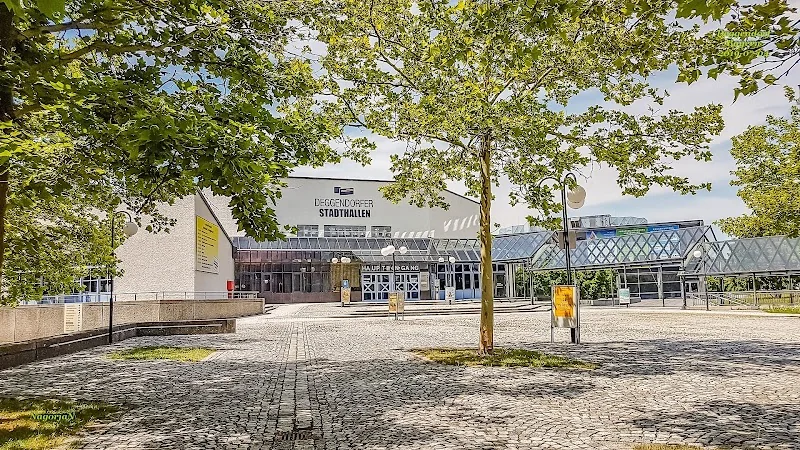
Edlmairstraße 2, Deggendorf
Edlmairstraße 2, 94469 Deggendorf, Germany
Stadthallen Deggendorf GmbH | Events & Tickets
The Stadthallen Deggendorf GmbH has been one of the most important event venues in Lower Bavaria for decades. Those looking for a place for concerts, shows, conferences, trade fairs, balls, or corporate events in Deggendorf will find a facility with two large halls, an additional cultural room, and a location that is as attractive for guests from the city as it is for visitors from the region. The address at Edlmairstraße 2 is located right in the center and close to parking options, the train station, and the city center. This makes the location particularly versatile for audiences, organizers, and exhibitors. The official website provides not only the event calendar but also information on directions, catering, accessibility, technology, and the various hall areas. This makes the venue not just a place for individual evenings but a complete event location with a clear structure and high flexibility. ([deggendorfer-stadthallen.de](https://www.deggendorfer-stadthallen.de/))
Events, Program, and Tickets at Stadthallen Deggendorf
The event calendar is the heart of Stadthallen Deggendorf because it shows the diversity of the venue most clearly. The Stadthallen consider themselves a neutral event location; content and presentations are always the responsibility of the respective organizers. This is an advantage for visitors, as the program is broad and constantly changes between entertainment, culture, infotainment, and regional events. For example, the official calendar for 2026 features Thorsten Havener, Biyon Kattilathu, Lisa Eckhart, Breakin' Mozart, a Schlager night, Herbert Pixner Project, Max Raabe & Palast Orchester, Impulso Tenors, Bavarian Comedy Championship, as well as Gerhard Polt and the Well Brothers. This mix makes Stadthallen Deggendorf interesting for many search queries: Those looking for programs, tickets, or dates often want to see not just one hall but a stage with regularly changing formats. In practice, this means that the venue is suitable for classical concertgoers as well as guests of cabaret, gala, family programs, or business events. Those wishing to purchase tickets should note that the organizer themselves determines the seating categories and wheelchair spaces; the Stadthallen do not offer their own ticket sales. This keeps the ordering process clear while the venue provides the stage and framework. ([deggendorfer-stadthallen.de](https://www.deggendorfer-stadthallen.de/index.php?nr=4&unnr=113))
For search queries with specific artist names or date combinations, the official schedule overview is particularly important because it shows the actual performance days and hall assignments. This is especially helpful for large public events, as not every event takes place in the same hall. In practice, formats change depending on the number of visitors and stage setup between Hall 1 and Hall 2. This provides visitors with better orientation, and organizers can optimally adapt the spaces to their concepts. So, for example, if someone plans a Schlager night, a solo program, a classical crossover, or a show with stage and audience focus, they will find a place that works for both densely seated evening events and larger standing concerts. This combination of calendar, room variety, and central location is one of the strongest SEO and user factors of the venue. ([deggendorfer-stadthallen.de](https://www.deggendorfer-stadthallen.de/index.php?nr=4&unnr=113))
Parking and Directions to Stadthallen Deggendorf GmbH
Access is often the decisive comfort factor at event venues, and here Stadthallen Deggendorf scores with very clear visitor guidance. According to the official description, the location is right in the center and directly next to a park. By car, the venue can be reached via the A3 Nuremberg-Passau and the A92 Munich-Deggendorf; after the Deggendorf Mitte exit, follow the signs to the Stadthallen. Those arriving by train can reach the Deggendorf train station in about 15 minutes on foot. Additionally, the website points to good public transport connections via the Hbf Plattling. This is important for guests from the wider region as it makes travel uncomplicated even without a car. Particularly convenient is the Stadthalle parking garage located opposite the event venue. A tunnel leads directly from the parking garage to the main entrance, allowing visitors to arrive dry even in the rain. However, for large events, one should plan for longer waiting and exit times, as the venue is naturally heavily frequented then. ([deggendorfer-stadthallen.de](https://www.deggendorfer-stadthallen.de/anfahrt.html))
The parking garage itself is also well adapted for event visits. It offers 417 parking spaces, is suitable for many cars with a maximum entrance height of 1.95 m, and has up to 60 minutes of free parking. The official site also mentions 3 extra wide disabled parking spaces, 1 parent-child parking space, 2 E-charging stations, and access via Hans-Krämer-Straße and Wiesenstraße. With its location opposite the Stadthallen and a walking time of only about five minutes to the city center, it is a sensible starting point for the visit. For guests who do not want to drive directly into the parking garage or want to remain flexible during very large events, there are also additional parking garages in the center of Deggendorf. Here, too, short distances are a clear advantage as they make the evening more relaxed and the arrival time more predictable. In search queries related to parking, parking garage, and access, these details play a significant role as they answer the most important question for many visitors: How do I get there and back without stress? ([stadtparken-deggendorf.de](https://stadtparken-deggendorf.de/unsere-parkgaragen))
Seating Plan, Seating Arrangement, and Capacity of the Halls
The Stadthallen Deggendorf is not a rigid single-purpose hall but a flexibly usable space concept with clear capacity advantages. Hall 1 consists of the small hall, the right and left side halls, and other combined room solutions. Depending on the seating arrangement, the large hall can accommodate up to 934 people in row seating and up to 2,000 people for standing concerts. The balcony adds 98 additional seats to the room offer. For banquet formats, the seating overview in the large hall lists 596 seats in the second tier; the small hall is designated with 356 seats in the corresponding configuration. This shows how strongly the space can adapt to different types of events. The stage covers 150 square meters and can be expanded if necessary by a movable orchestra pit. Additionally, the hall is air-conditioned and can be fully darkened, making it interesting not only for concerts but also for congresses, trade fairs, and stage productions. For visitors searching for a seating plan, this variability is particularly relevant as it explains why the same hall can be used very differently depending on the event. ([deggendorfer-stadthallen.de](https://www.deggendorfer-stadthallen.de/grosser-saal.html))
Hall 2 takes size a step further. The 1,890 square meter area can be visually separated every six meters in depth according to the official description. Depending on the stage size, up to 2,300 people can be accommodated in row seating and up to 4,000 people for standing concerts. In addition, there are 793 additional seats in the grandstand, which also allows for a good view of the stage even when the hall is fully occupied. The stage can be up to 230 square meters and can be freely positioned in the hall. This is an enormous advantage for organizers as ticket sales, pathways, and sightlines can be planned very flexibly. Visitors benefit from the fact that the seats in the stalls are accessible and the hall is equipped with sound absorbers as well as a permanently installed truss system. Additionally, daylight from the glass front and the option to darken the hall provide broad usability. So, those looking for a seating plan, seating arrangement, or capacity will discover a location that masters both intimate concert moments and large audience shows. Especially in search queries related to the hall plan and seats, the strength of the venue lies in the combination of understandable structure and high capacity. ([deggendorfer-stadthallen.de](https://www.deggendorfer-stadthallen.de/saal1und2-halle2.html))
Hall 2, Baroque Theater, and Flexible Space Concepts
A special feature of Stadthallen Deggendorf is the design diversity within Hall 2. The official theater curtain allows for the creation of a completely new space in baroque theater style within the hall. According to the website, this solution is unique in the region and is particularly suitable for weddings, corporate parties, theater performances, smaller congresses, and exclusive meetings. The resulting theater hall can accommodate up to 400 people. The motifs of the curtain can be adjusted quickly via a rail system, allowing the space to create a different effect depending on the occasion. Additionally, a visually designed stage portal enhances the atmosphere. For organizers, this is a strong stage for emotional storytelling, and for guests, it is an unusual eye-catcher that goes far beyond the classic hall experience. So, those looking for special features, highlights, or a unique selling point of the location will quickly come across this solution as it transforms a functional event space into a surprisingly staged room. ([deggendorfer-stadthallen.de](https://www.deggendorfer-stadthallen.de/theater.html))
Technically, Hall 2 is also designed for great flexibility. The concrete floor, six-meter-wide gates, and truck accessibility significantly facilitate setup and teardown. Lifts and forklifts are available for heavy stage elements, and a permanently installed truss system for stage technology or PA systems is located on the ceiling. The directly adjacent foyer provides guests with a comfortable area to stay before the event, during breaks, and after the event. Together with the free positioning of the stage, the modular reduction or enlargement of the hall, and the grandstand with 793 elevated seats, a space is created that is suitable not only for pop and Schlager events but also for concerts, dance balls, anniversaries, and stage formats with demanding logistics. The Stadthallen Deggendorf combines technology, acoustics, and atmosphere in a remarkably compact way. This is precisely why search queries often include combinations of Hall 2, theater, stage, seats, and event formats: The hall is not only large but also stageable. ([deggendorfer-stadthallen.de](https://www.deggendorfer-stadthallen.de/saal1und2-halle2.html))
Accessibility, Service, and Kapuzinerstadl as a Supplement
Accessibility is not just an addition at Stadthallen Deggendorf but part of the core concept. The website explicitly states that the indoor and outdoor areas of the event spaces as well as the parking lots are accessible without steps. Each hall has at least one disabled toilet for men and women. For hearing-impaired individuals, a hearing loop is available in Hall 1 that can be activated during cultural events; for foreign sound systems, prior notice is requested. All stairs in the visitor area are equipped with handrails for visually impaired individuals, and guide dogs are allowed in the venue. This shows that the location is not only focused on large visitor numbers but also on ensuring a smooth and inclusive stay. For many users, this information is crucial when searching for accessibility, wheelchair, toilet, or hearing loop. Additionally, the Stadthallen offer a virtual 360-degree tour that provides an impression of the rooms before the visit. This allows guests to orient themselves in advance and plan their arrival more precisely. ([deggendorfer-stadthallen.de](https://www.deggendorfer-stadthallen.de/handicap.html))
As a supplementary location, the Kapuzinerstadl is also part of the Stadthallen Deggendorf offering. This room is located at Maria-Ward-Platz 10 and was created in 1990 from the original monastery church of the Capuchin order. Today, it is used for art exhibitions, concerts, cabaret, conferences, symposia, and small congresses. Characteristic are the two very different rooms: the upper floor with a barrel vault and the ground floor with unplastered masonry. Depending on the event, one of the rooms or both together can be used. The capacities are 120 square meters and 120 people on the ground floor, as well as 160 square meters and 196 people on the upper floor. Technical equipment details such as screen, projector, wireless transmission system, and mobile sound system are also officially mentioned. This is important for search intent because the name Stadthallen Deggendorf not only refers to the large halls but also to this smaller, atmospheric addition for culture and business in a more intimate setting. This significantly expands the brand's offering and gives organizers more choices between large audiences, special staging, and a compact spatial feel. ([deggendorfer-stadthallen.de](https://www.deggendorfer-stadthallen.de/index.php?nr=9))
History and Development of the Deggendorfer Stadthallen
The history of Stadthallen Deggendorf explains much of its current strength. With the grand opening of the Deggendorf Stadthalle in December 1984, a larger opportunity to hold cultural and commercial events directly in Deggendorf was created for the first time in the catchment area between Passau, Landshut, Straubing, and Regensburg. The venue was originally designed as a multipurpose hall and already offered space for up to 1,000 seats as well as numerous room combinations for different requirements. The official website describes the Stadthalle during this phase as the cultural center of the East Bavarian region, attracting 100,000 visitors annually. This historical dimension is important because it shows that the current positioning of the venue did not arise by chance but is based on a long development. Those visiting the hall today experience not only modern event architecture but also a venue with grown regional significance and tradition. ([deggendorfer-stadthallen.de](https://www.deggendorfer-stadthallen.de/ueber-uns.html))
Following this foundation, the expansion took place. In 2008, a functional extension building of 2,500 square meters was realized directly adjacent to the old Stadthalle; the opening took place in January 2009. Since then, the Deggendorfer Stadthallen have offered an exemplary symbiosis of different rooms and usage possibilities. For SEO and user understanding, this development is particularly relevant as it explains why Hall 1 and Hall 2 are so different yet so well combinable. The original structure was preserved but supplemented by new spaces, modern technology, and more variable event concepts. In conjunction with the Kapuzinerstadl, a comprehensive offering emerges that ranges from large show stages to cultural spaces in a smaller context. This mix makes Stadthallen Deggendorf a location that is perceived in the region not just as a single hall but as an event family. Those searching for history, special features, and development will find a coherent line here: from the classic multipurpose hall through the extension building to a modern, flexibly usable cultural and congress center with its own profile. ([deggendorfer-stadthallen.de](https://www.deggendorfer-stadthallen.de/ueber-uns.html))
Sources:
- Deggendorfer Stadthallen - Official Website ([deggendorfer-stadthallen.de](https://www.deggendorfer-stadthallen.de/))
- Deggendorfer Stadthallen - Directions / Location ([deggendorfer-stadthallen.de](https://www.deggendorfer-stadthallen.de/anfahrt.html))
- Stadtparken Deggendorf - Stadthalle Parking Garage ([stadtparken-deggendorf.de](https://stadtparken-deggendorf.de/unsere-parkgaragen))
- Deggendorfer Stadthallen - Hall 1 Large Hall ([deggendorfer-stadthallen.de](https://www.deggendorfer-stadthallen.de/grosser-saal.html))
- Deggendorfer Stadthallen - Hall 2 Hall 1 + 2 ([deggendorfer-stadthallen.de](https://www.deggendorfer-stadthallen.de/saal1und2-halle2.html))
- Deggendorfer Stadthallen - Baroque Theater in Hall 2 ([deggendorfer-stadthallen.de](https://www.deggendorfer-stadthallen.de/theater.html))
- Deggendorfer Stadthallen - About Us ([deggendorfer-stadthallen.de](https://www.deggendorfer-stadthallen.de/ueber-uns.html))
- Deggendorfer Stadthallen - Accessibility ([deggendorfer-stadthallen.de](https://www.deggendorfer-stadthallen.de/handicap.html))
- Deggendorfer Stadthallen - Stadthallen 2026 ([deggendorfer-stadthallen.de](https://www.deggendorfer-stadthallen.de/index.php?nr=4&unnr=113))
- Deggendorfer Stadthallen - Kapuzinerstadl ([deggendorfer-stadthallen.de](https://www.deggendorfer-stadthallen.de/index.php?nr=9))
Show moreShow less
Stadthallen Deggendorf GmbH | Events & Tickets
The Stadthallen Deggendorf GmbH has been one of the most important event venues in Lower Bavaria for decades. Those looking for a place for concerts, shows, conferences, trade fairs, balls, or corporate events in Deggendorf will find a facility with two large halls, an additional cultural room, and a location that is as attractive for guests from the city as it is for visitors from the region. The address at Edlmairstraße 2 is located right in the center and close to parking options, the train station, and the city center. This makes the location particularly versatile for audiences, organizers, and exhibitors. The official website provides not only the event calendar but also information on directions, catering, accessibility, technology, and the various hall areas. This makes the venue not just a place for individual evenings but a complete event location with a clear structure and high flexibility. ([deggendorfer-stadthallen.de](https://www.deggendorfer-stadthallen.de/))
Events, Program, and Tickets at Stadthallen Deggendorf
The event calendar is the heart of Stadthallen Deggendorf because it shows the diversity of the venue most clearly. The Stadthallen consider themselves a neutral event location; content and presentations are always the responsibility of the respective organizers. This is an advantage for visitors, as the program is broad and constantly changes between entertainment, culture, infotainment, and regional events. For example, the official calendar for 2026 features Thorsten Havener, Biyon Kattilathu, Lisa Eckhart, Breakin' Mozart, a Schlager night, Herbert Pixner Project, Max Raabe & Palast Orchester, Impulso Tenors, Bavarian Comedy Championship, as well as Gerhard Polt and the Well Brothers. This mix makes Stadthallen Deggendorf interesting for many search queries: Those looking for programs, tickets, or dates often want to see not just one hall but a stage with regularly changing formats. In practice, this means that the venue is suitable for classical concertgoers as well as guests of cabaret, gala, family programs, or business events. Those wishing to purchase tickets should note that the organizer themselves determines the seating categories and wheelchair spaces; the Stadthallen do not offer their own ticket sales. This keeps the ordering process clear while the venue provides the stage and framework. ([deggendorfer-stadthallen.de](https://www.deggendorfer-stadthallen.de/index.php?nr=4&unnr=113))
For search queries with specific artist names or date combinations, the official schedule overview is particularly important because it shows the actual performance days and hall assignments. This is especially helpful for large public events, as not every event takes place in the same hall. In practice, formats change depending on the number of visitors and stage setup between Hall 1 and Hall 2. This provides visitors with better orientation, and organizers can optimally adapt the spaces to their concepts. So, for example, if someone plans a Schlager night, a solo program, a classical crossover, or a show with stage and audience focus, they will find a place that works for both densely seated evening events and larger standing concerts. This combination of calendar, room variety, and central location is one of the strongest SEO and user factors of the venue. ([deggendorfer-stadthallen.de](https://www.deggendorfer-stadthallen.de/index.php?nr=4&unnr=113))
Parking and Directions to Stadthallen Deggendorf GmbH
Access is often the decisive comfort factor at event venues, and here Stadthallen Deggendorf scores with very clear visitor guidance. According to the official description, the location is right in the center and directly next to a park. By car, the venue can be reached via the A3 Nuremberg-Passau and the A92 Munich-Deggendorf; after the Deggendorf Mitte exit, follow the signs to the Stadthallen. Those arriving by train can reach the Deggendorf train station in about 15 minutes on foot. Additionally, the website points to good public transport connections via the Hbf Plattling. This is important for guests from the wider region as it makes travel uncomplicated even without a car. Particularly convenient is the Stadthalle parking garage located opposite the event venue. A tunnel leads directly from the parking garage to the main entrance, allowing visitors to arrive dry even in the rain. However, for large events, one should plan for longer waiting and exit times, as the venue is naturally heavily frequented then. ([deggendorfer-stadthallen.de](https://www.deggendorfer-stadthallen.de/anfahrt.html))
The parking garage itself is also well adapted for event visits. It offers 417 parking spaces, is suitable for many cars with a maximum entrance height of 1.95 m, and has up to 60 minutes of free parking. The official site also mentions 3 extra wide disabled parking spaces, 1 parent-child parking space, 2 E-charging stations, and access via Hans-Krämer-Straße and Wiesenstraße. With its location opposite the Stadthallen and a walking time of only about five minutes to the city center, it is a sensible starting point for the visit. For guests who do not want to drive directly into the parking garage or want to remain flexible during very large events, there are also additional parking garages in the center of Deggendorf. Here, too, short distances are a clear advantage as they make the evening more relaxed and the arrival time more predictable. In search queries related to parking, parking garage, and access, these details play a significant role as they answer the most important question for many visitors: How do I get there and back without stress? ([stadtparken-deggendorf.de](https://stadtparken-deggendorf.de/unsere-parkgaragen))
Seating Plan, Seating Arrangement, and Capacity of the Halls
The Stadthallen Deggendorf is not a rigid single-purpose hall but a flexibly usable space concept with clear capacity advantages. Hall 1 consists of the small hall, the right and left side halls, and other combined room solutions. Depending on the seating arrangement, the large hall can accommodate up to 934 people in row seating and up to 2,000 people for standing concerts. The balcony adds 98 additional seats to the room offer. For banquet formats, the seating overview in the large hall lists 596 seats in the second tier; the small hall is designated with 356 seats in the corresponding configuration. This shows how strongly the space can adapt to different types of events. The stage covers 150 square meters and can be expanded if necessary by a movable orchestra pit. Additionally, the hall is air-conditioned and can be fully darkened, making it interesting not only for concerts but also for congresses, trade fairs, and stage productions. For visitors searching for a seating plan, this variability is particularly relevant as it explains why the same hall can be used very differently depending on the event. ([deggendorfer-stadthallen.de](https://www.deggendorfer-stadthallen.de/grosser-saal.html))
Hall 2 takes size a step further. The 1,890 square meter area can be visually separated every six meters in depth according to the official description. Depending on the stage size, up to 2,300 people can be accommodated in row seating and up to 4,000 people for standing concerts. In addition, there are 793 additional seats in the grandstand, which also allows for a good view of the stage even when the hall is fully occupied. The stage can be up to 230 square meters and can be freely positioned in the hall. This is an enormous advantage for organizers as ticket sales, pathways, and sightlines can be planned very flexibly. Visitors benefit from the fact that the seats in the stalls are accessible and the hall is equipped with sound absorbers as well as a permanently installed truss system. Additionally, daylight from the glass front and the option to darken the hall provide broad usability. So, those looking for a seating plan, seating arrangement, or capacity will discover a location that masters both intimate concert moments and large audience shows. Especially in search queries related to the hall plan and seats, the strength of the venue lies in the combination of understandable structure and high capacity. ([deggendorfer-stadthallen.de](https://www.deggendorfer-stadthallen.de/saal1und2-halle2.html))
Hall 2, Baroque Theater, and Flexible Space Concepts
A special feature of Stadthallen Deggendorf is the design diversity within Hall 2. The official theater curtain allows for the creation of a completely new space in baroque theater style within the hall. According to the website, this solution is unique in the region and is particularly suitable for weddings, corporate parties, theater performances, smaller congresses, and exclusive meetings. The resulting theater hall can accommodate up to 400 people. The motifs of the curtain can be adjusted quickly via a rail system, allowing the space to create a different effect depending on the occasion. Additionally, a visually designed stage portal enhances the atmosphere. For organizers, this is a strong stage for emotional storytelling, and for guests, it is an unusual eye-catcher that goes far beyond the classic hall experience. So, those looking for special features, highlights, or a unique selling point of the location will quickly come across this solution as it transforms a functional event space into a surprisingly staged room. ([deggendorfer-stadthallen.de](https://www.deggendorfer-stadthallen.de/theater.html))
Technically, Hall 2 is also designed for great flexibility. The concrete floor, six-meter-wide gates, and truck accessibility significantly facilitate setup and teardown. Lifts and forklifts are available for heavy stage elements, and a permanently installed truss system for stage technology or PA systems is located on the ceiling. The directly adjacent foyer provides guests with a comfortable area to stay before the event, during breaks, and after the event. Together with the free positioning of the stage, the modular reduction or enlargement of the hall, and the grandstand with 793 elevated seats, a space is created that is suitable not only for pop and Schlager events but also for concerts, dance balls, anniversaries, and stage formats with demanding logistics. The Stadthallen Deggendorf combines technology, acoustics, and atmosphere in a remarkably compact way. This is precisely why search queries often include combinations of Hall 2, theater, stage, seats, and event formats: The hall is not only large but also stageable. ([deggendorfer-stadthallen.de](https://www.deggendorfer-stadthallen.de/saal1und2-halle2.html))
Accessibility, Service, and Kapuzinerstadl as a Supplement
Accessibility is not just an addition at Stadthallen Deggendorf but part of the core concept. The website explicitly states that the indoor and outdoor areas of the event spaces as well as the parking lots are accessible without steps. Each hall has at least one disabled toilet for men and women. For hearing-impaired individuals, a hearing loop is available in Hall 1 that can be activated during cultural events; for foreign sound systems, prior notice is requested. All stairs in the visitor area are equipped with handrails for visually impaired individuals, and guide dogs are allowed in the venue. This shows that the location is not only focused on large visitor numbers but also on ensuring a smooth and inclusive stay. For many users, this information is crucial when searching for accessibility, wheelchair, toilet, or hearing loop. Additionally, the Stadthallen offer a virtual 360-degree tour that provides an impression of the rooms before the visit. This allows guests to orient themselves in advance and plan their arrival more precisely. ([deggendorfer-stadthallen.de](https://www.deggendorfer-stadthallen.de/handicap.html))
As a supplementary location, the Kapuzinerstadl is also part of the Stadthallen Deggendorf offering. This room is located at Maria-Ward-Platz 10 and was created in 1990 from the original monastery church of the Capuchin order. Today, it is used for art exhibitions, concerts, cabaret, conferences, symposia, and small congresses. Characteristic are the two very different rooms: the upper floor with a barrel vault and the ground floor with unplastered masonry. Depending on the event, one of the rooms or both together can be used. The capacities are 120 square meters and 120 people on the ground floor, as well as 160 square meters and 196 people on the upper floor. Technical equipment details such as screen, projector, wireless transmission system, and mobile sound system are also officially mentioned. This is important for search intent because the name Stadthallen Deggendorf not only refers to the large halls but also to this smaller, atmospheric addition for culture and business in a more intimate setting. This significantly expands the brand's offering and gives organizers more choices between large audiences, special staging, and a compact spatial feel. ([deggendorfer-stadthallen.de](https://www.deggendorfer-stadthallen.de/index.php?nr=9))
History and Development of the Deggendorfer Stadthallen
The history of Stadthallen Deggendorf explains much of its current strength. With the grand opening of the Deggendorf Stadthalle in December 1984, a larger opportunity to hold cultural and commercial events directly in Deggendorf was created for the first time in the catchment area between Passau, Landshut, Straubing, and Regensburg. The venue was originally designed as a multipurpose hall and already offered space for up to 1,000 seats as well as numerous room combinations for different requirements. The official website describes the Stadthalle during this phase as the cultural center of the East Bavarian region, attracting 100,000 visitors annually. This historical dimension is important because it shows that the current positioning of the venue did not arise by chance but is based on a long development. Those visiting the hall today experience not only modern event architecture but also a venue with grown regional significance and tradition. ([deggendorfer-stadthallen.de](https://www.deggendorfer-stadthallen.de/ueber-uns.html))
Following this foundation, the expansion took place. In 2008, a functional extension building of 2,500 square meters was realized directly adjacent to the old Stadthalle; the opening took place in January 2009. Since then, the Deggendorfer Stadthallen have offered an exemplary symbiosis of different rooms and usage possibilities. For SEO and user understanding, this development is particularly relevant as it explains why Hall 1 and Hall 2 are so different yet so well combinable. The original structure was preserved but supplemented by new spaces, modern technology, and more variable event concepts. In conjunction with the Kapuzinerstadl, a comprehensive offering emerges that ranges from large show stages to cultural spaces in a smaller context. This mix makes Stadthallen Deggendorf a location that is perceived in the region not just as a single hall but as an event family. Those searching for history, special features, and development will find a coherent line here: from the classic multipurpose hall through the extension building to a modern, flexibly usable cultural and congress center with its own profile. ([deggendorfer-stadthallen.de](https://www.deggendorfer-stadthallen.de/ueber-uns.html))
Sources:
- Deggendorfer Stadthallen - Official Website ([deggendorfer-stadthallen.de](https://www.deggendorfer-stadthallen.de/))
- Deggendorfer Stadthallen - Directions / Location ([deggendorfer-stadthallen.de](https://www.deggendorfer-stadthallen.de/anfahrt.html))
- Stadtparken Deggendorf - Stadthalle Parking Garage ([stadtparken-deggendorf.de](https://stadtparken-deggendorf.de/unsere-parkgaragen))
- Deggendorfer Stadthallen - Hall 1 Large Hall ([deggendorfer-stadthallen.de](https://www.deggendorfer-stadthallen.de/grosser-saal.html))
- Deggendorfer Stadthallen - Hall 2 Hall 1 + 2 ([deggendorfer-stadthallen.de](https://www.deggendorfer-stadthallen.de/saal1und2-halle2.html))
- Deggendorfer Stadthallen - Baroque Theater in Hall 2 ([deggendorfer-stadthallen.de](https://www.deggendorfer-stadthallen.de/theater.html))
- Deggendorfer Stadthallen - About Us ([deggendorfer-stadthallen.de](https://www.deggendorfer-stadthallen.de/ueber-uns.html))
- Deggendorfer Stadthallen - Accessibility ([deggendorfer-stadthallen.de](https://www.deggendorfer-stadthallen.de/handicap.html))
- Deggendorfer Stadthallen - Stadthallen 2026 ([deggendorfer-stadthallen.de](https://www.deggendorfer-stadthallen.de/index.php?nr=4&unnr=113))
- Deggendorfer Stadthallen - Kapuzinerstadl ([deggendorfer-stadthallen.de](https://www.deggendorfer-stadthallen.de/index.php?nr=9))
Stadthallen Deggendorf GmbH | Events & Tickets
The Stadthallen Deggendorf GmbH has been one of the most important event venues in Lower Bavaria for decades. Those looking for a place for concerts, shows, conferences, trade fairs, balls, or corporate events in Deggendorf will find a facility with two large halls, an additional cultural room, and a location that is as attractive for guests from the city as it is for visitors from the region. The address at Edlmairstraße 2 is located right in the center and close to parking options, the train station, and the city center. This makes the location particularly versatile for audiences, organizers, and exhibitors. The official website provides not only the event calendar but also information on directions, catering, accessibility, technology, and the various hall areas. This makes the venue not just a place for individual evenings but a complete event location with a clear structure and high flexibility. ([deggendorfer-stadthallen.de](https://www.deggendorfer-stadthallen.de/))
Events, Program, and Tickets at Stadthallen Deggendorf
The event calendar is the heart of Stadthallen Deggendorf because it shows the diversity of the venue most clearly. The Stadthallen consider themselves a neutral event location; content and presentations are always the responsibility of the respective organizers. This is an advantage for visitors, as the program is broad and constantly changes between entertainment, culture, infotainment, and regional events. For example, the official calendar for 2026 features Thorsten Havener, Biyon Kattilathu, Lisa Eckhart, Breakin' Mozart, a Schlager night, Herbert Pixner Project, Max Raabe & Palast Orchester, Impulso Tenors, Bavarian Comedy Championship, as well as Gerhard Polt and the Well Brothers. This mix makes Stadthallen Deggendorf interesting for many search queries: Those looking for programs, tickets, or dates often want to see not just one hall but a stage with regularly changing formats. In practice, this means that the venue is suitable for classical concertgoers as well as guests of cabaret, gala, family programs, or business events. Those wishing to purchase tickets should note that the organizer themselves determines the seating categories and wheelchair spaces; the Stadthallen do not offer their own ticket sales. This keeps the ordering process clear while the venue provides the stage and framework. ([deggendorfer-stadthallen.de](https://www.deggendorfer-stadthallen.de/index.php?nr=4&unnr=113))
For search queries with specific artist names or date combinations, the official schedule overview is particularly important because it shows the actual performance days and hall assignments. This is especially helpful for large public events, as not every event takes place in the same hall. In practice, formats change depending on the number of visitors and stage setup between Hall 1 and Hall 2. This provides visitors with better orientation, and organizers can optimally adapt the spaces to their concepts. So, for example, if someone plans a Schlager night, a solo program, a classical crossover, or a show with stage and audience focus, they will find a place that works for both densely seated evening events and larger standing concerts. This combination of calendar, room variety, and central location is one of the strongest SEO and user factors of the venue. ([deggendorfer-stadthallen.de](https://www.deggendorfer-stadthallen.de/index.php?nr=4&unnr=113))
Parking and Directions to Stadthallen Deggendorf GmbH
Access is often the decisive comfort factor at event venues, and here Stadthallen Deggendorf scores with very clear visitor guidance. According to the official description, the location is right in the center and directly next to a park. By car, the venue can be reached via the A3 Nuremberg-Passau and the A92 Munich-Deggendorf; after the Deggendorf Mitte exit, follow the signs to the Stadthallen. Those arriving by train can reach the Deggendorf train station in about 15 minutes on foot. Additionally, the website points to good public transport connections via the Hbf Plattling. This is important for guests from the wider region as it makes travel uncomplicated even without a car. Particularly convenient is the Stadthalle parking garage located opposite the event venue. A tunnel leads directly from the parking garage to the main entrance, allowing visitors to arrive dry even in the rain. However, for large events, one should plan for longer waiting and exit times, as the venue is naturally heavily frequented then. ([deggendorfer-stadthallen.de](https://www.deggendorfer-stadthallen.de/anfahrt.html))
The parking garage itself is also well adapted for event visits. It offers 417 parking spaces, is suitable for many cars with a maximum entrance height of 1.95 m, and has up to 60 minutes of free parking. The official site also mentions 3 extra wide disabled parking spaces, 1 parent-child parking space, 2 E-charging stations, and access via Hans-Krämer-Straße and Wiesenstraße. With its location opposite the Stadthallen and a walking time of only about five minutes to the city center, it is a sensible starting point for the visit. For guests who do not want to drive directly into the parking garage or want to remain flexible during very large events, there are also additional parking garages in the center of Deggendorf. Here, too, short distances are a clear advantage as they make the evening more relaxed and the arrival time more predictable. In search queries related to parking, parking garage, and access, these details play a significant role as they answer the most important question for many visitors: How do I get there and back without stress? ([stadtparken-deggendorf.de](https://stadtparken-deggendorf.de/unsere-parkgaragen))
Seating Plan, Seating Arrangement, and Capacity of the Halls
The Stadthallen Deggendorf is not a rigid single-purpose hall but a flexibly usable space concept with clear capacity advantages. Hall 1 consists of the small hall, the right and left side halls, and other combined room solutions. Depending on the seating arrangement, the large hall can accommodate up to 934 people in row seating and up to 2,000 people for standing concerts. The balcony adds 98 additional seats to the room offer. For banquet formats, the seating overview in the large hall lists 596 seats in the second tier; the small hall is designated with 356 seats in the corresponding configuration. This shows how strongly the space can adapt to different types of events. The stage covers 150 square meters and can be expanded if necessary by a movable orchestra pit. Additionally, the hall is air-conditioned and can be fully darkened, making it interesting not only for concerts but also for congresses, trade fairs, and stage productions. For visitors searching for a seating plan, this variability is particularly relevant as it explains why the same hall can be used very differently depending on the event. ([deggendorfer-stadthallen.de](https://www.deggendorfer-stadthallen.de/grosser-saal.html))
Hall 2 takes size a step further. The 1,890 square meter area can be visually separated every six meters in depth according to the official description. Depending on the stage size, up to 2,300 people can be accommodated in row seating and up to 4,000 people for standing concerts. In addition, there are 793 additional seats in the grandstand, which also allows for a good view of the stage even when the hall is fully occupied. The stage can be up to 230 square meters and can be freely positioned in the hall. This is an enormous advantage for organizers as ticket sales, pathways, and sightlines can be planned very flexibly. Visitors benefit from the fact that the seats in the stalls are accessible and the hall is equipped with sound absorbers as well as a permanently installed truss system. Additionally, daylight from the glass front and the option to darken the hall provide broad usability. So, those looking for a seating plan, seating arrangement, or capacity will discover a location that masters both intimate concert moments and large audience shows. Especially in search queries related to the hall plan and seats, the strength of the venue lies in the combination of understandable structure and high capacity. ([deggendorfer-stadthallen.de](https://www.deggendorfer-stadthallen.de/saal1und2-halle2.html))
Hall 2, Baroque Theater, and Flexible Space Concepts
A special feature of Stadthallen Deggendorf is the design diversity within Hall 2. The official theater curtain allows for the creation of a completely new space in baroque theater style within the hall. According to the website, this solution is unique in the region and is particularly suitable for weddings, corporate parties, theater performances, smaller congresses, and exclusive meetings. The resulting theater hall can accommodate up to 400 people. The motifs of the curtain can be adjusted quickly via a rail system, allowing the space to create a different effect depending on the occasion. Additionally, a visually designed stage portal enhances the atmosphere. For organizers, this is a strong stage for emotional storytelling, and for guests, it is an unusual eye-catcher that goes far beyond the classic hall experience. So, those looking for special features, highlights, or a unique selling point of the location will quickly come across this solution as it transforms a functional event space into a surprisingly staged room. ([deggendorfer-stadthallen.de](https://www.deggendorfer-stadthallen.de/theater.html))
Technically, Hall 2 is also designed for great flexibility. The concrete floor, six-meter-wide gates, and truck accessibility significantly facilitate setup and teardown. Lifts and forklifts are available for heavy stage elements, and a permanently installed truss system for stage technology or PA systems is located on the ceiling. The directly adjacent foyer provides guests with a comfortable area to stay before the event, during breaks, and after the event. Together with the free positioning of the stage, the modular reduction or enlargement of the hall, and the grandstand with 793 elevated seats, a space is created that is suitable not only for pop and Schlager events but also for concerts, dance balls, anniversaries, and stage formats with demanding logistics. The Stadthallen Deggendorf combines technology, acoustics, and atmosphere in a remarkably compact way. This is precisely why search queries often include combinations of Hall 2, theater, stage, seats, and event formats: The hall is not only large but also stageable. ([deggendorfer-stadthallen.de](https://www.deggendorfer-stadthallen.de/saal1und2-halle2.html))
Accessibility, Service, and Kapuzinerstadl as a Supplement
Accessibility is not just an addition at Stadthallen Deggendorf but part of the core concept. The website explicitly states that the indoor and outdoor areas of the event spaces as well as the parking lots are accessible without steps. Each hall has at least one disabled toilet for men and women. For hearing-impaired individuals, a hearing loop is available in Hall 1 that can be activated during cultural events; for foreign sound systems, prior notice is requested. All stairs in the visitor area are equipped with handrails for visually impaired individuals, and guide dogs are allowed in the venue. This shows that the location is not only focused on large visitor numbers but also on ensuring a smooth and inclusive stay. For many users, this information is crucial when searching for accessibility, wheelchair, toilet, or hearing loop. Additionally, the Stadthallen offer a virtual 360-degree tour that provides an impression of the rooms before the visit. This allows guests to orient themselves in advance and plan their arrival more precisely. ([deggendorfer-stadthallen.de](https://www.deggendorfer-stadthallen.de/handicap.html))
As a supplementary location, the Kapuzinerstadl is also part of the Stadthallen Deggendorf offering. This room is located at Maria-Ward-Platz 10 and was created in 1990 from the original monastery church of the Capuchin order. Today, it is used for art exhibitions, concerts, cabaret, conferences, symposia, and small congresses. Characteristic are the two very different rooms: the upper floor with a barrel vault and the ground floor with unplastered masonry. Depending on the event, one of the rooms or both together can be used. The capacities are 120 square meters and 120 people on the ground floor, as well as 160 square meters and 196 people on the upper floor. Technical equipment details such as screen, projector, wireless transmission system, and mobile sound system are also officially mentioned. This is important for search intent because the name Stadthallen Deggendorf not only refers to the large halls but also to this smaller, atmospheric addition for culture and business in a more intimate setting. This significantly expands the brand's offering and gives organizers more choices between large audiences, special staging, and a compact spatial feel. ([deggendorfer-stadthallen.de](https://www.deggendorfer-stadthallen.de/index.php?nr=9))
History and Development of the Deggendorfer Stadthallen
The history of Stadthallen Deggendorf explains much of its current strength. With the grand opening of the Deggendorf Stadthalle in December 1984, a larger opportunity to hold cultural and commercial events directly in Deggendorf was created for the first time in the catchment area between Passau, Landshut, Straubing, and Regensburg. The venue was originally designed as a multipurpose hall and already offered space for up to 1,000 seats as well as numerous room combinations for different requirements. The official website describes the Stadthalle during this phase as the cultural center of the East Bavarian region, attracting 100,000 visitors annually. This historical dimension is important because it shows that the current positioning of the venue did not arise by chance but is based on a long development. Those visiting the hall today experience not only modern event architecture but also a venue with grown regional significance and tradition. ([deggendorfer-stadthallen.de](https://www.deggendorfer-stadthallen.de/ueber-uns.html))
Following this foundation, the expansion took place. In 2008, a functional extension building of 2,500 square meters was realized directly adjacent to the old Stadthalle; the opening took place in January 2009. Since then, the Deggendorfer Stadthallen have offered an exemplary symbiosis of different rooms and usage possibilities. For SEO and user understanding, this development is particularly relevant as it explains why Hall 1 and Hall 2 are so different yet so well combinable. The original structure was preserved but supplemented by new spaces, modern technology, and more variable event concepts. In conjunction with the Kapuzinerstadl, a comprehensive offering emerges that ranges from large show stages to cultural spaces in a smaller context. This mix makes Stadthallen Deggendorf a location that is perceived in the region not just as a single hall but as an event family. Those searching for history, special features, and development will find a coherent line here: from the classic multipurpose hall through the extension building to a modern, flexibly usable cultural and congress center with its own profile. ([deggendorfer-stadthallen.de](https://www.deggendorfer-stadthallen.de/ueber-uns.html))
Sources:
- Deggendorfer Stadthallen - Official Website ([deggendorfer-stadthallen.de](https://www.deggendorfer-stadthallen.de/))
- Deggendorfer Stadthallen - Directions / Location ([deggendorfer-stadthallen.de](https://www.deggendorfer-stadthallen.de/anfahrt.html))
- Stadtparken Deggendorf - Stadthalle Parking Garage ([stadtparken-deggendorf.de](https://stadtparken-deggendorf.de/unsere-parkgaragen))
- Deggendorfer Stadthallen - Hall 1 Large Hall ([deggendorfer-stadthallen.de](https://www.deggendorfer-stadthallen.de/grosser-saal.html))
- Deggendorfer Stadthallen - Hall 2 Hall 1 + 2 ([deggendorfer-stadthallen.de](https://www.deggendorfer-stadthallen.de/saal1und2-halle2.html))
- Deggendorfer Stadthallen - Baroque Theater in Hall 2 ([deggendorfer-stadthallen.de](https://www.deggendorfer-stadthallen.de/theater.html))
- Deggendorfer Stadthallen - About Us ([deggendorfer-stadthallen.de](https://www.deggendorfer-stadthallen.de/ueber-uns.html))
- Deggendorfer Stadthallen - Accessibility ([deggendorfer-stadthallen.de](https://www.deggendorfer-stadthallen.de/handicap.html))
- Deggendorfer Stadthallen - Stadthallen 2026 ([deggendorfer-stadthallen.de](https://www.deggendorfer-stadthallen.de/index.php?nr=4&unnr=113))
- Deggendorfer Stadthallen - Kapuzinerstadl ([deggendorfer-stadthallen.de](https://www.deggendorfer-stadthallen.de/index.php?nr=9))
Upcoming Events
No events found
Frequently Asked Questions
Reviews
Niraj Vithani
17. April 2018
Real big place to have fun, and for big crowds...
Alberto Catania
16. November 2016
This is our 2nd consecutive year that we are part of the Wedding Show 2016. We are honoured to be part of the Hochzeitsmesse 2016 in the Stadthalle in Deggendorf, Niederbayern. We had an amazing time, sharing and meeting new Wedding Couples to be for next year. We are very happy to give our Photographic Services to lovely couples from all over Bayern and Europe.
Simon Kandler
9. December 2016
The place for the most events in Deggendorf. Starting with the graduation celebration of the diverse schools and the university, till the well-known FOS/BOS Ball - which is some kind of carnival fest.
Hiran Sajeevan
31. March 2023
Faster service. Good employees.
Ntox
27. November 2023
😀