
Discover the Top 5 Museums & Galleries in Deggendorf
Top 5 Museums & Galleries in Deggendorf: Cultural Ideas for Your Next Visit
If you are planning a cultural day in Deggendorf in the coming weeks or months, it is worth taking a look at museums, galleries, and art in public spaces. This guide is intended as a planning and inspiration aid: It shows you five stops that can be easily combined for a future tour—from city views to international perspectives.
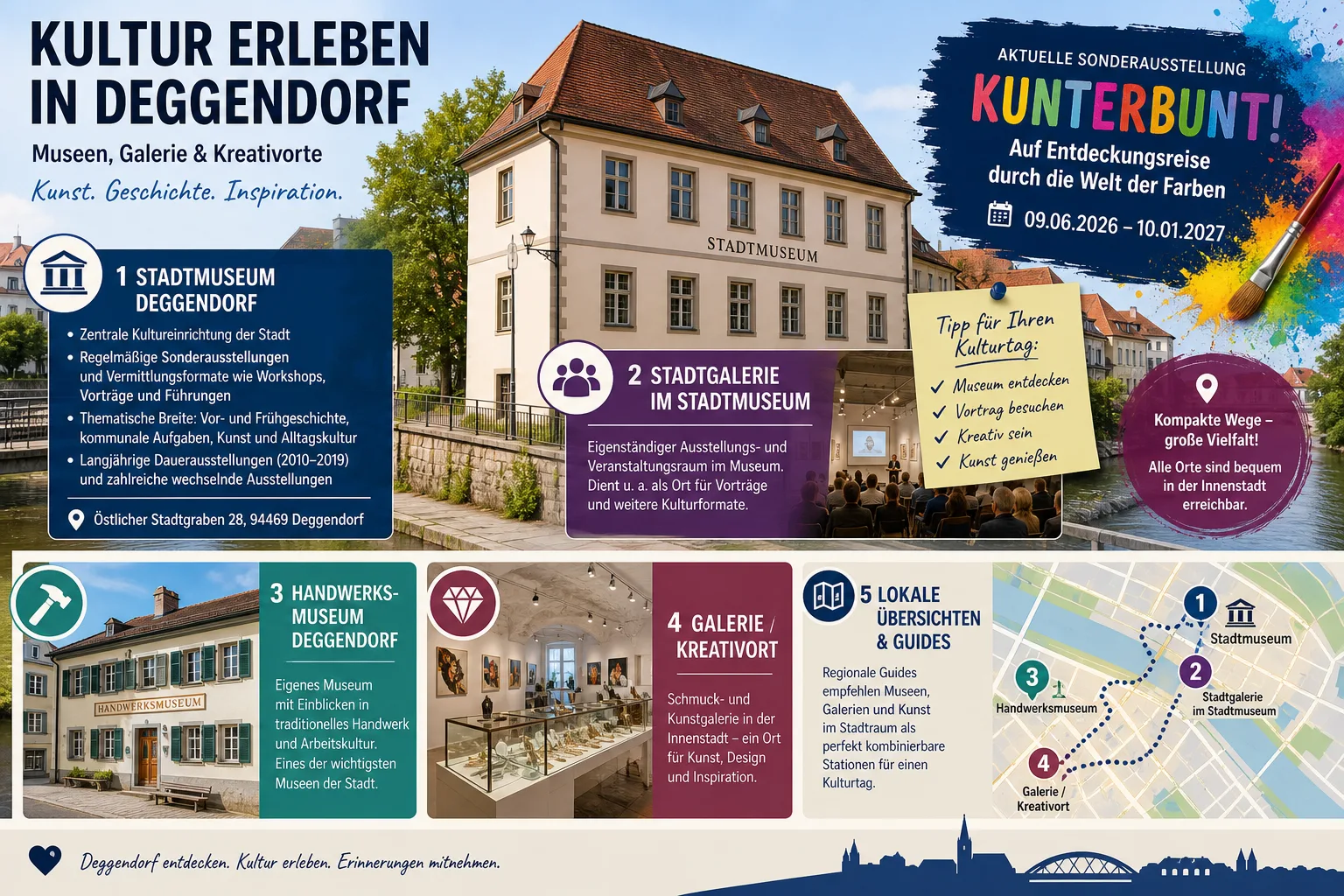
1) Deggendorf City Museum: Understand the city before you move on
A city museum is often the best starting point for a future cultural day: It gives you context, orientation, and a first look at the history, change, and identity of the place. If you want to visit Deggendorf in the coming months, this introduction can help you connect further stops meaningfully.
Why a city museum works well as a start
- Orientation: You understand the development of the city before you look at special topics or contemporary art.
- Comparison: After visiting a city museum, you will more easily notice architecture, street names, or historical traces in the urban space.
- Planability: A city museum is usually independent of the weather and thus a reliable base for a future tour.
2) Deggendorf Handicraft Museum: Craft as an experience
If you are looking for a museum visit in the future that feels "hands-on," a handicraft museum is a strong second stop. Such places are particularly suitable for mixed groups (adults, teenagers, children), because tools, materials, and workflows are immediately understandable.
How to get more out of a future visit
- Go with questions: Which professions still shape the region today? Which techniques could become more important again in the future (repair, sustainability, regional production)?
- Pay attention to mediation: When planning, look for demonstrations, hands-on offers, or themed tours—they make craft understandable without needing expertise.
- Bridge to the present: If the museum offers special topics on design, materials science, or sustainable production, this fits particularly well into a modern cultural day.
3) Museum of Cultures at the Station: Diversity as a topic for the future
For an upcoming Deggendorf trip with a contemporary focus, a museum that addresses cultural diversity, migration, or identity is a meaningful addition. Especially a location near the station is suitable as a stop that you can flexibly integrate into your daily schedule—for example, as a program point after a change of location or before the journey home.
What you should consider when planning
- Multimedia & content: Such exhibitions are often interview- or media-based—plan enough time to really use audio/video.
- Dialogue formats: Look out for dates for talks, workshops, or group offers if you want to use the visit as a learning or exchange format.
- Sensitivity: Content on flight, discrimination, or belonging can be emotional—especially with children, it is helpful to discuss the visit before and after.
4) Galleries & Art in Public Spaces: Discover spontaneously
If you want to experience culture spontaneously in the near future, galleries and art initiatives are often the most flexible option: shorter durations, often new positions, sometimes openings or artist talks. In addition, you can include art in public spaces in your tour—without a ticket and without a fixed start time.
Ideas for your upcoming gallery and public space check
- Pre-scan: Shortly before your visit, check city event calendars or information from the tourist information to select exhibitions that fit your timing.
- Build a route: Plan a walking route with 2–3 stops (gallery + art in public space + café break). This creates a "small festival" in the city center.
- Ask questions: In galleries, asking questions is expressly allowed—about technique, idea, price range (if for sale), or background of the position.
5) Special Houses & Collections: Small places, big impact
For your next (or the one after) cultural visit, it is also worth looking at smaller, specialized institutions: thematic collections, smaller exhibition spaces, or project-based places. They are often less "programmatic," but very approachable—and can provide exactly the perspective you are missing after the larger houses.
How to integrate special places into your future planning
- Timing: Plan them as a "bonus stop"—for example, at the end of the day if you still have energy.
- Contact: Many smaller places work with fixed time slots, guided tours, or events. A quick preliminary check (announcement/program) prevents disappointment.
- Added value: Special places are particularly suitable if you want to deepen a topic (technology, everyday culture, regional specialties, or artistic niches).
Suggestion: Your cultural tour (planable for one day)
The following schedule is designed so that you can adapt it for a future Saturday, a vacation day, or a free weekend—without fixed times, but with a clear dramaturgy.
- Morning: Start with a visit to the city museum to gain topics and orientation.
- Late morning: Continue to the handicraft museum and set a second focus: work, material, skill.
- Lunch: Plan a break in the city center—the "interruption" helps to sort impressions.
- Afternoon: Visit the Museum of Cultures at the station as a contemporary and future perspective.
- Late afternoon/evening: Round off the day with a gallery or an art walk in public space.
This creates a day that does not just feel like "checking off sights," but like a consciously planned narrative: understanding the city, experiencing craft, reflecting on diversity, discovering contemporary art.
Practical tips for your next visit
Tickets, times, accessibility
- Opening times & prices: Check them shortly before your visit on the official channels of the respective institution—especially on holidays or for special events.
- Accessibility: If you depend on elevators, ramps, seating, or guidance systems, inform yourself in advance. Many places now provide transparent information on this.
- Groups & school classes: For future visits with a group, pre-booked guided tours are usually the best option (planability, appropriate level, less waiting time).
This is how the visit becomes "more than just nice"
- One focus per stop: Set yourself a guiding theme for each place (e.g. "cityscapes," "material & tools," "arrival & belonging," "form & color").
- Notes for later: If you take a walk after the visit, note 2–3 things you want to find again outside (places, traces, motifs).
- Respectful behavior: Photos, sketches, or notes are often possible, but not always—pay attention to the on-site notices during your future visit.
Note (not legal advice): Rules on photo permission, house rules, or ticket conditions can change. The current notices of the respective institution before your visit are always binding.