Political Discussions & Talks in Deggendorf
Political Discussions & Talks in Deggendorf (Preview of Upcoming Dates)
Which political discussion formats will be relevant in Deggendorf in the future – and how can you as an audience member participate well-prepared? This overview compiles reliably announced dates and shows what matters in political lectures, panels, and audience questions.
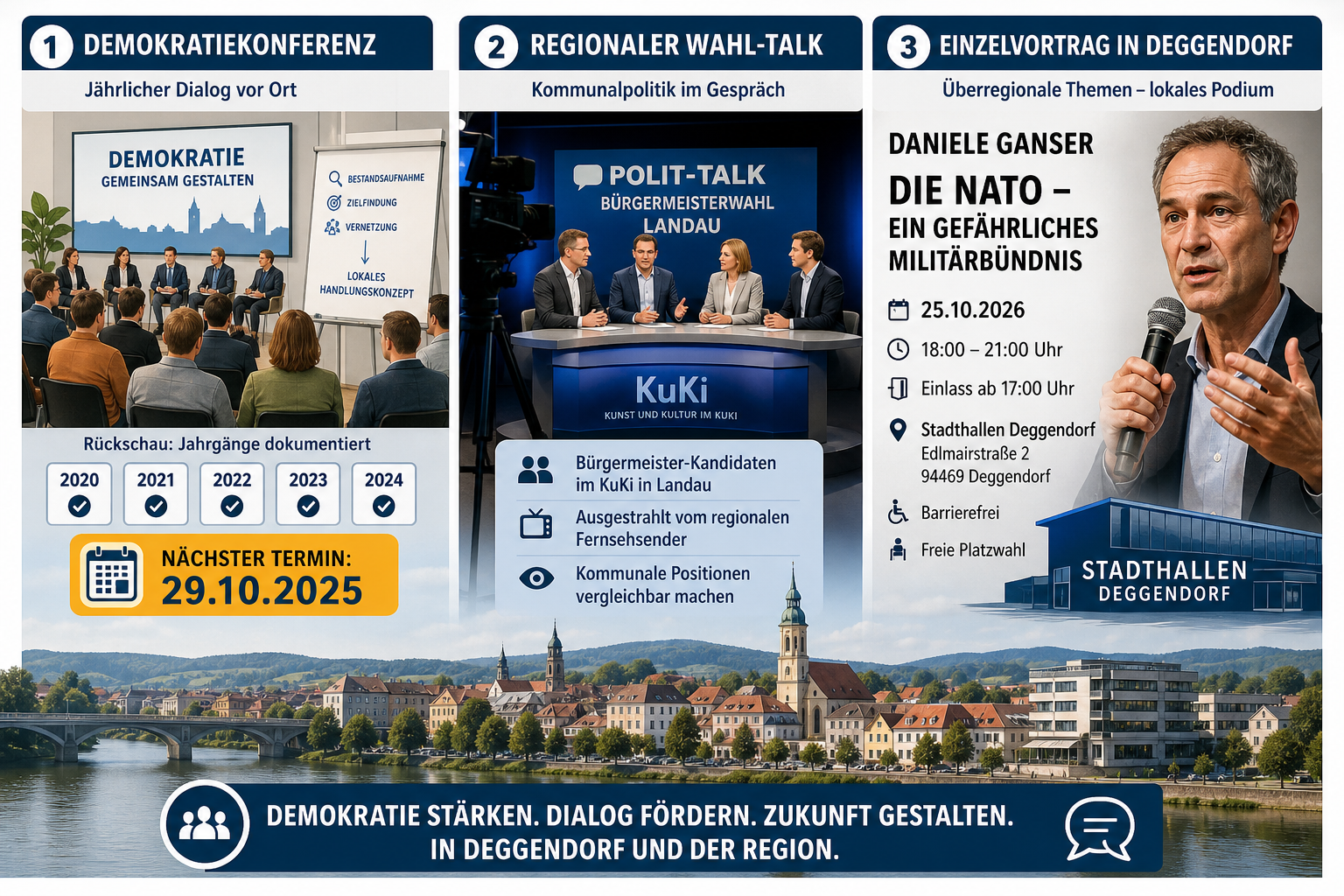
Upcoming Event in Deggendorf: Evening Lecture on October 25, 2026
Lecture at the Stadthallen Deggendorf
A political evening lecture has been announced for Deggendorf at the Stadthallen. According to the available event announcement, the following key details are given:
- Date: October 25, 2026
- Time: 6:00 PM to 9:00 PM (admission from 5:00 PM)
- Location: Stadthallen Deggendorf, Edlmairstraße 2, 94469 Deggendorf
- On-site information: barrier-free; free seating
What the Content Might Be About – and How to Classify It
The announced lecture addresses an international political topic and is thus an example of how world politics is discussed in a local event setting. For lectures that deliberately announce pointed theses, the responsibility increases on all sides: speakers should substantiate arguments in a comprehensible way; audience and moderators should ask critical questions and demand context.
If you wish to participate, these two guiding questions are especially helpful:
- What verifiable evidence is provided? (e.g., official documents, primary sources, comprehensible statistics)
- Which relevant counterarguments are presented fairly? A convincing analysis is often recognizable by the fact that it correctly presents strong opposing positions before criticizing them.
How to Prepare for Political Lectures & Discussions
1) Create a Short Fact Set in Advance
Before the event, note down 3–5 points you want to clarify (terms, data, causal claims). This prevents you from being guided only by dramaturgy or individual examples during the lecture.
2) Use Source Competence (Without a “Source Battle”)
Good discussions are not improved by dropping as many links as possible. It is more helpful to ask for primary sources (legal texts, official reports, scientific overviews) and to clearly distinguish between:
- Facts (verifiable, dated, reproducible),
- Interpretations (reasoned interpretation of facts), and
- Opinions/Value Judgments (normative conclusions).
3) Formulate Questions So That Answers Are Possible
Ask as concrete questions as possible, for example:
- “Which two sources are decisive for your central thesis – and why?”
- “What observation would change your assessment?”
- “Which counterposition do you consider the strongest, and where do you disagree with it?”
Practical Tips for Attending Events in Deggendorf
- Arrive Early: With free seating, it is worth arriving with enough buffer time before admission.
- Accessibility: Even if the venue is designated as barrier-free, details (e.g., routes, seating areas) may vary. If necessary, clarify directly with the organizer in advance what is specifically offered.
- Documentation: If allowed, take notes. This way you can objectively review key theses afterwards.
- Discussion Rules: Pay attention to the moderator’s instructions (question cards, microphones, speaking time). This facilitates fair participation.
Debate Culture: Asking Constructive Questions, Disagreeing Fairly
Controversial topics are not automatically “bad” for a city – what matters is the quality of the exchange. A helpful attitude for the audience is: critical, but not cynical; open, but not arbitrary.
Three practical rules that have proven themselves in public discussions:
- Claim → Evidence: For strong theses, always ask for evidence, not for volume.
- Steelman instead of Strawman: First summarize the opposing position correctly, then criticize.
- Separate Person and Argument: Examine arguments without devaluing people.
Sources
- Federal Agency for Civic Education (bpb.de) — Background on political education, debate culture, and classification of political information (accessed 2026-05-27)
- The Federal Government (bundesregierung.de) — Official information and documents as a starting point for primary source research (accessed 2026-05-27)