Pop Culture in Deggendorf: Experience Music, Fashion, Media
Pop Culture in Deggendorf: Music, Fashion, Media – What the Next Events in the City Center Are Expected to Bring
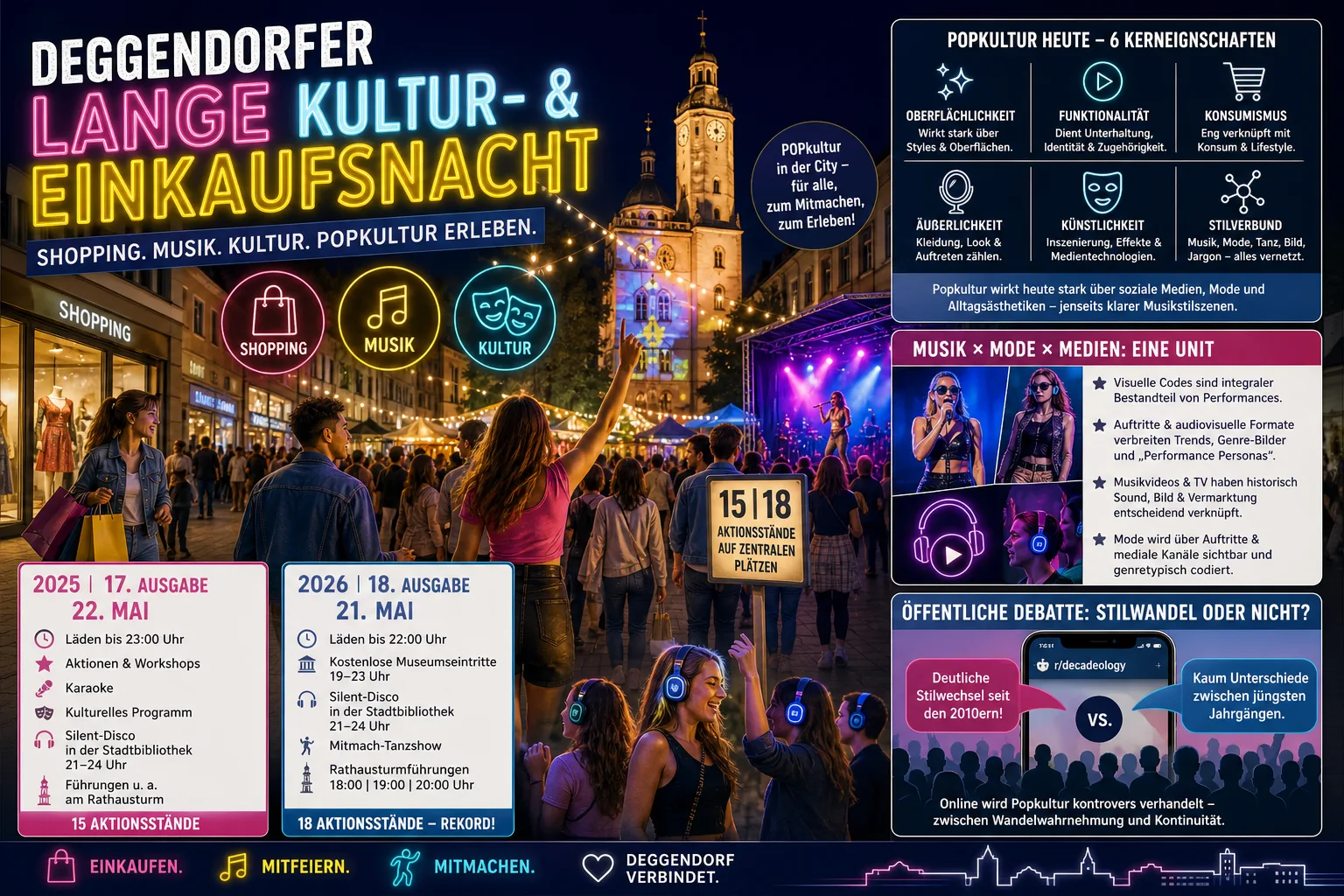
When a city center becomes a stage for an evening, pop culture emerges not only on screens but between shop windows, squares, and cultural venues. In Deggendorf, upcoming formats are expected to build precisely on this: music, fashion, and media are to be interwoven as a shared experience – low-threshold, visible, and with many opportunities for participation.
Pop Culture Today: Why “Surface” Is More Than Just Decoration
In cultural studies debates, pop culture is often described as an interplay of visible signs and everyday functions: style, consumption, media logic, and quick recognizability work together. “Surface” is not automatically derogatory, but mainly refers to what is immediately perceptible: outfits, gestures, light, sound, stage designs, posters, social media clips.
This perspective is helpful for Deggendorf because it explains why pop culture works particularly well in a city center: it doesn’t need long introductions. A song, a look, a short clip – and suddenly there is atmosphere, a sense of belonging, or curiosity. It is precisely this short “entry threshold” that makes pop culture a tool for activating public spaces.
- Entertainment and Activation: Pop culture relies on attention, rhythm, and participation – for example, through singing along, dancing, interaction.
- Style Combination: Music, fashion, visual language, and media forms work together (e.g., song + outfit + camera aesthetics).
- Everyday Aesthetics: Pop often becomes relevant where people already are: while strolling, meeting, eating, waiting, passing by.
Music, Fashion, Media: How the City Center Can Become a “Stage”
Pop culture thrives on sound and image working simultaneously. Since the era of music television and music videos, sound and look have belonged together: the way artists present themselves, how a scene is lit, which styles dominate, and how the audience films, all shape the overall picture.
Applied to Deggendorf, this means: future city center formats can plan music not only as an acoustic offering but as a visual event – with attention to locations, routes, lighting, photo spots, and interaction. Fashion stores, shop windows, and pop-up spaces can become backdrops without reducing culture to pure advertising: what matters is a clearly recognizable added value for visitors (e.g., small sets, short performances, workshops, encounters).
Media reinforce this effect. When visitors share impressions, a “second space” is created: Deggendorf becomes visible online as a place where contemporary culture happens. This can shape the city’s image in the long term – provided it is curated responsibly (e.g., respectful interaction, youth protection, accessibility, clear rules for photo and film areas).
Long Culture and Shopping Night: A Possible Guiding Format for the Coming Years
The Long Culture and Shopping Night is often mentioned as a guiding format for a pop-culturally charged city center. Future editions can be particularly effective when they bring together three things:
- Extended opening hours and city center comfort (orientation, safety, quality of stay, gastronomy)
- A diverse, short program (several small highlights instead of a few long stage blocks)
- Unusual locations that break expectations (e.g., cultural venues temporarily used differently)
Especially playing with locations can make pop culture in Deggendorf distinctive: when cultural institutions, retail, and public spaces jointly enable programming, the city center becomes not just a “backdrop” but a networked experience space. The dramaturgy can deliberately target different audiences – families earlier in the evening, youth- and club-oriented offerings later, quiet zones as a counterpoint.
- short, spontaneous program points that can be discovered “on the side”
- participatory offers (karaoke, dance formats, mini-workshops)
- “Shareable moments”: light, photo spots, small stagings
- changing locations as an experience (from square to square, from shop to cultural venue)
What Effects Pop Culture Can Have for Deggendorf in the Future
Well-planned pop culture formats can support several goals at once – without having to “solve” everything. For Deggendorf, these areas of impact are especially plausible:
- Revitalization of the city center: More reasons to stay longer in the evening, to take new routes, and to perceive places differently.
- Networking of local actors: When retail, gastronomy, clubs, culture, and the creative scene program together, new collaborations arise.
- Cultural participation: Low-threshold formats can reach people who rarely use classic cultural offerings.
- City image: Visible contemporary culture can strengthen the image of a modern, open mid-sized city – both online and offline.
A clear balance is important: pop culture should not just be a consumer-oriented backdrop, but also visibly offer space for non-commercial contributions. Transparent criteria (e.g., how program slots are allocated, which standards apply for volume, safety, inclusion, and youth protection) build trust.
Online Debates and Style Questions: Why “Mix-Events” Suit the Present
Current online discussions often ask whether each generation still has a clearly recognizable style – or whether aesthetics are blending more. For future Deggendorf formats, this debate is not just theoretical but practical: instead of rigid scenes, many signals suggest that hybrid forms work particularly well.
“Mix-events” can meet various expectations at once: people come for the music, stay for a performance, discover fashion or media offerings on the side, and take home a personal story – as a memory or as a shared clip. The more an evening offers different “entry reasons,” the more likely it is that different age groups and milieus will feel addressed.
Outlook: How Deggendorf Can Further Develop Pop Culture – Without Becoming Arbitrary
Pop culture is dynamic. To ensure that upcoming city center formats do not seem interchangeable, Deggendorf can rely on three strategies:
1) Strengthen local signature
When local bands, dance groups, schools, clubs, cultural initiatives, and creatives are visibly involved, authenticity is created. Pop culture then does not seem “bought in,” but like an expression of the city.
2) Curation instead of pure program quantity
A comprehensible dramaturgy (quiet zones, accessible routes, clear time slots, recognizable highlights) increases quality and safety. This builds trust – even among people who otherwise avoid large crowds.
3) Consciously consider the digital level
If social media communication is not just advertising but provides context (e.g., who is performing, why a location was chosen, what rules apply), a responsible, modern presence is created. In this way, digital visibility becomes a supplement to the city experience – not a replacement for it.