Time Travel Deggendorf: old photos, stories & people
Time Travel Deggendorf: Old Photos, Stories & People – Program Concept for Upcoming Activities
Target audience: Residents of Deggendorf, clubs, schools, families, cultural initiatives, and anyone interested in participating in a local photo and storytelling project in the future.
Idea & Goals of “Time Travel Deggendorf”
“Time Travel Deggendorf” is intended as a future participatory series in which people from Deggendorf and the surrounding area share their historical photos (private albums, club archives, company chronicles) along with short memories. The focus is on what becomes visible in the images: everyday life, work, celebrations, street spaces, and neighborhoods.
- Community: Generations should engage in conversation through pictures.
- Documentation: Photos are recorded with traceable information (location, period, source, rights).
- Education: Schools and clubs can develop future projects, workshops, or exhibitions from this.
- Transparency: Usage, rights, and inquiries are clearly regulated before images are published.
Program Overview (future dates as suggestion)
The following dates are designed as a realistic proposal for future implementation. Organizers can adjust them depending on the availability of venues and partners.
Fall 2026: Start Phase
- Saturday, 2026-09-12: Photo Collection Day (on-site scanning, short interviews, rights clarification)
- Wednesday, 2026-09-30: Storytelling Salon (moderated discussion round with photo contributions)
- Saturday, 2026-10-17: “Then & Now” Photo Walk I (downtown round)
- Saturday, 2026-11-07: Workshop “Labeling Photos: Place, Time, People” (metadata & source work)
Winter 2026/2027: Processing
- December 2026: Editorial phase (image selection, texts, captions, approvals)
- January 2027: Building the digital map (pilot operation with curated selection)
Spring 2027: Public
- Saturday, 2027-03-21: “Then & Now” Photo Walk II (Danube riverbank/bridge sightlines)
- April 2027: Pop-up Exhibition (2 weeks duration, including feedback station)
- May 2027: Closing evening (presentation of the digital map & handover of documentation)
Note on reliability: To allow participants to plan, organizers should confirm dates at least 8 weeks in advance and publish a central registration page (including contact, location, accessibility information, and data protection notices).
Format 1: Storytelling Salon “Old Photos, Young Ears”
The storytelling salon is planned as a moderated evening event where participants bring 1–3 photos (original or scan) and tell a short story about them. The goal is a respectful space where memory and questions come together.
Procedure (recommended, 90 minutes)
- Arrival & Introduction: brief explanation of the rules (respect, data protection, approvals).
- Photo round: 3–5 minutes per person (What is visible? Where? Approximately when? Who?).
- Questions: moderated questions, especially from young people or school groups.
- Documentation: Consents are recorded in writing, core data is collected.
- Outlook: Invitation to photo walk, workshop, and digital map.
Rules for contributions
- No publication without prior rights and consent check.
- No sensitive personal details in the public round (address, health data, conflict cases).
- Captions should remain observable: What is certain? What is memory/interpretation?
Format 2: “Then & Now” Photo Walks
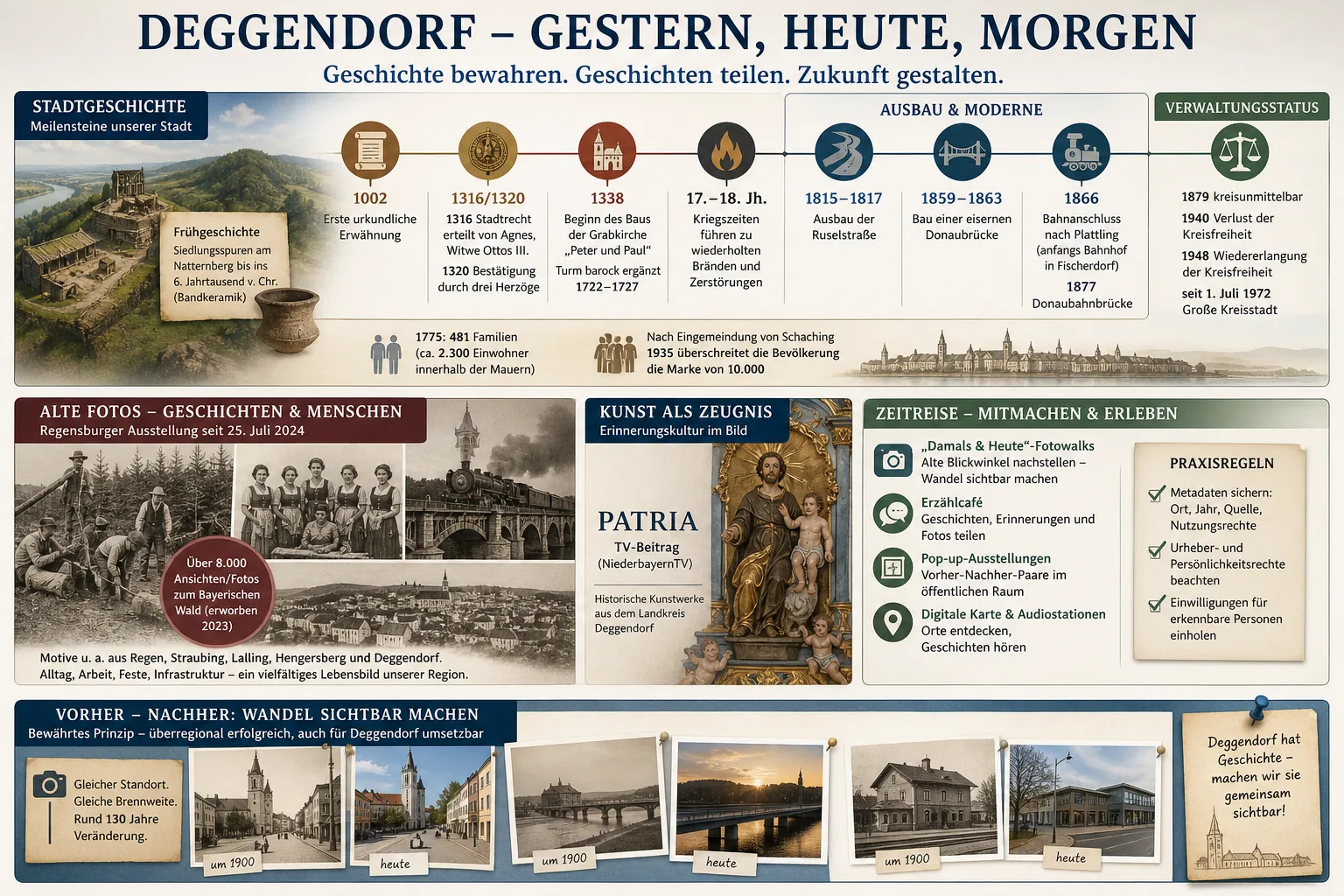
Photo walks are planned as guided, low-barrier city tours where old image sections serve as a starting point. Participants photograph today’s perspectives so that a later comparison is possible (standpoint, viewing direction, image section).
Recommended set-up
- Duration: 60–90 minutes
- Size: 10–20 people (if more participants: second group)
- Equipment: Smartphone or camera, optionally printouts of the historical photos
- Result: 5–10 comparison pairs per walk (curated)
Guide for comparable photos
- Mark standpoint (short text: “taken from here”).
- Use horizon and vertical lines (building edges/lampposts) as reference.
- Document date and time (for light/shadow comparison).
- If people are in the picture: only publish if legally permissible and approved.
Format 3: Pop-up Exhibition for a Limited Time
The pop-up exhibition is intended as a short, accessible presentation that tells city history through motifs without requiring long texts. Ideally, it is located in a place where many people pass by anyway (e.g., foyer, library, retail space, cultural venue).
Curatorial structure (recommended)
- Wall 1: “Work & Everyday Life” (workshops, fields, trade, club life)
- Wall 2: “Streets & Squares” (sightlines, mobility, cityscape)
- Wall 3: “Festivals & Community” (celebrations, parades, school classes, group photos)
- Feedback station: “Who recognizes something?” with contact option for additions
Format 4: Digital Map as an Open Archive
The digital map is planned as a long-term results space: photos are georeferenced (anchored to a location) and provided with a reliable caption. This keeps the project usable even after events.
What a map point should contain
- Image: scan/photo in suitable resolution (plus compressed web version)
- Location: map point + short plain text (“street/square/nearby landmark”)
- Period: as precise as can be substantiated (year, decade, or “around ...”)
- Source: private person/club/archive + contact method for inquiries (if desired)
- Rights: scope of use (e.g., “project website only” / “non-commercial”)
- Context: 3–6 sentences about the image statement (observable, not speculative)
Quality principle: Better fewer entries, but well documented. This increases trust and reusability (e.g., for teaching, city tours, club chronicles).
Submitting Photos & Quality Standards
For upcoming collection dates, a uniform standard is recommended so that contributions do not become “puzzling” later. These standards are deliberately pragmatic.
Recommended minimum information
- Location: as precise as possible (street, square, building, viewing direction)
- Period: year or rough classification (e.g., “1970s”)
- Source: who provides the photo and how to contact them
- Photographer: if known (or “unknown”)
- Usage approval: in writing, with clear scope
Scanning and file principles (practical)
- Scans preferred to preserve originals.
- File names according to scheme: Location_Period_Source_ShortMotif.
- Store unedited master file separately from the web version.
- Document every edit (cropping, contrast) in a traceable way.
Image Rights, Consents & Data Protection (practical)
To ensure a future “Time Travel Deggendorf” runs fairly and legally, organizers should publish clear rules in advance. In Germany, copyright, right to one's own image, and data protection are particularly relevant. These notes do not replace legal advice but help with clean practice.
- Copyright (photos): Clarify before use whether and how the photo may be used. Owning a photo does not automatically mean you may publish it.
- Right to one's own image: If people are recognizable, consent may be required (especially for younger people, not clearly contemporary historical images).
- Data protection (GDPR): Process submitters’ contact data only with purpose, legal basis, and transparent information; restrict access and set retention periods.
- Transparency: Before publication, record in writing: Where will the image appear (exhibition, website, social media)? For how long? May the caption mention names?
- Sensitivity: For potentially sensitive subjects (conflicts, accidents, private emergencies): when in doubt, do not publish or strongly anonymize.
Recommendation for organizers: A short, easy-to-read consent and usage agreement (one page) lowers barriers and protects all parties involved.
Roles, Schedule & Checklists
Roles (small team)
- Moderation: leads the storytelling salon, ensures respectful conversation
- Scan team: digitizes, names files, secures master/web version
- Documentation: records metadata, checks source logic, collects approvals
- Editorial: writes image captions, checks comprehensibility, marks uncertainties as such
- Exhibition/Map: curates, implements, manages feedback channels
Checklist: Before Photo Collection Day
- Submission rules (rights, data protection, procedure) visible online and on site.
- Consent forms and information sheet on data processing prepared.
- Scanner/camera, lighting, gloves (if needed), and data backup set up.
- System for file names, metadata, and backups established.
Checklist: Before publication (exhibition or digital map)
- Rights status per image clearly documented.
- Personal reference checked (consent, anonymization, or omission).
- Image captions checked for facts/observables; no unnecessary speculation.
- Contact method for corrections and additions published.
Sources
- Copyright Act (UrhG) — Legal basis for the use and publication of photographs (accessed 2026-08-05)
- Art Copyright Act (KunstUrhG) — Right to one's own image, portraits and consent (accessed 2026-08-05)
- General Data Protection Regulation (GDPR) — Principles for processing personal data (accessed 2026-08-05)
- Standing Conference of the Ministers of Education and Cultural Affairs (KMK) — Guidance on educational and school projects (for cooperation/project weeks as a framework source) (accessed 2026-08-05)