
Peter Glotz
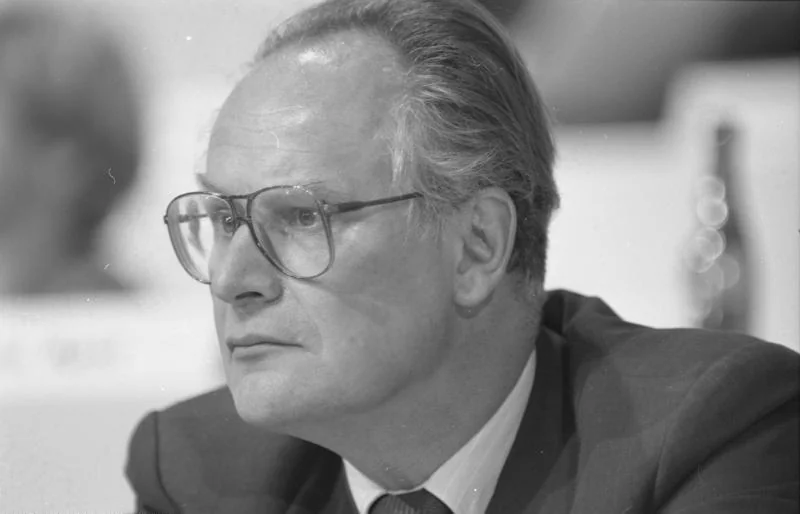
Image from Wikipedia
Image from Wikipedia
Peter Glotz – the political intellectual between science, culture of debate, and public impact
A German thinker who understood politics as argument and society as mission
Peter Glotz was part of that rare generation of politicians who not only managed power but infused it with intellectual ambition. Born on March 6, 1939, in Eger and died on August 25, 2005, in Zurich, he stood at the intersection of social democracy, media public sphere, and academia for decades. His biography connects the rise from newspaper scientist to a defining SPD strategist with a second career as a publicist, academic, and vocal commentator on the Federal Republic. (de.wikipedia.org)
Glotz was not a politician of mere apparatus, but a public intellectual with analytical acuity and a clear stance. His career led him to the Bavarian State Parliament, the German Bundestag, and the Federal Council; he also served as Parliamentary Secretary of State, Berlin Senator, Federal Managing Director of the SPD, and later as a higher education reformer and university professor. This versatility made him one of the most distinctive figures in post-war politics. (de.wikipedia.org)
Early influences: Origins, education, and the path to public life
Peter Glotz grew up in a time when German biographies were marked by war, displacement, and new beginnings. He studied newspaper science, philosophy, German studies, and sociology in Munich and Vienna, graduating in 1964 with a Magister Artium in newspaper science; in 1968, he earned his doctorate at the University of Munich. This academic background explains a significant part of his later impact: Glotz never thought about politics without language, publicness, and scientific reflection. (de.wikipedia.org)
His path initially led him into academia. Until 1970, he worked as a research assistant at the Institute for Newspaper Science at the University of Munich, while remaining closely connected to debates about media, communication, and society. Here, the profile that shaped his later career emerges: an analytical mind that observed and commented on political processes with social science precision. (de.wikipedia.org)
Rise in the SPD: Campaigns, conflicts, and strategic modernization
In 1970, Glotz shifted into politics and quickly became a defining voice of social democracy. He served as a member of parliament, secretary of state, and finally as federal managing director of the SPD, a role in which he oriented the party more towards communication, campaign capability, and scientifically grounded analysis. Especially during the election campaigns of 1983 and 1987, he sought to professionalize political work through social scientific insights. (de.wikipedia.org)
His political style was never conventional. Glotz sought debate, relied on arguments, and contradicted the complacent party rhetoric. His later alignment with neoliberal positions, support for student fees, and approval of reforms in labor and economic policy demonstrate how much he distanced himself from classical left-right templates. This inner flexibility made him for many an unpredictable, yet extremely influential thinker within the SPD. (de.wikipedia.org)
Political stations and public offices: From parliament to Berlin
Glotz was a member of the Bavarian State Parliament, the German Bundestag, and the Federal Council. In West Berlin, he held the position of Senator for Science and Research, shaping the higher education and science policy of a city that stood like no other for political symbolism. Later, he served as the Chancellor's representative at the European Constitutional Convention and worked on a European constitution that ultimately did not come into effect. (de.wikipedia.org)
His role as Senator for Science and Research and later as founding rector of the University of Erfurt and professor at the University of St. Gallen was particularly influential. Here, Glotz functioned not only as a politician but as an institution builder. His work at the intersection of university, public life, and reform policy granted him authority far beyond party contexts. (de.wikipedia.org)
The publicist as a cultural figure: Books, essays, and a love for debate
After retiring from active politics, Glotz remained a productive voice in public discourse. He published books, essays, and articles in newspapers and magazines, becoming an author who not only described political contemporary issues but also commented on and sharpened them. The WZB notes that he was working on his autobiography shortly before his death and wrote with great discipline both literarily and journalistically. (de.wikipedia.org)
His engagement with the history of displacement is also part of this journalistic legacy. The Center Against Expulsions emphasizes that with his book "Die Vertreibung," he brought historical connections closer to a broad readership and interpreted expulsions as human rights violations. He combined historical analysis, moral positioning, and political intervention into a typical Glotz profile. (z-g-v.de)
Style and impact: Communication manager with a scientific perspective
Glotz was a politician who understood communication as the core of political effectiveness. The WZB describes him as someone who strictly differentiated between science and politics, yet assigned an important role to social science in articulating political objectives. This stance explains why he was repeatedly perceived as a boundary crosser between disciplines, milieus, and institutions. (bibliothek.wzb.eu)
His style was argumentative, sharp, and often uncomfortable. The IfDem text describes him as a maverick, a jack-of-all-trades, and a boundary crosser between economy, science, and politics; it also refers to Glotz’s perception as a party visionary and intellectual troublemaker. This precisely formed his unique authority: He did not want to pacify politics but to enlighten, provoke, and keep it in motion. (ifdem.de)
Social influence: European perspective, memory politics, and reform thinking
Glotz’s impact extended far beyond the SPD. As a co-creator of European debates, a supporter of the Center Against Expulsions, and a commentator on NATO’s eastward expansion, he engaged in issues of history, identity, and European order. His criticism of mere expansion without deepening the European Union shows how strongly he tied the political future of Europe to institutional substance. (de.wikipedia.org)
He also made significant contributions to the culture of remembrance. The Center Against Expulsions honored his commitment as crucial for anchoring the foundation in the center of society, while other obituaries emphasized his role as an enlightening intellectual. Glotz combined historical sensitivity with a willingness to engage in current debates, making him a figure who understood political memory not as a museum piece but as something debatable. (z-g-v.de)
Discography, charts, and artistic work: a categorization without a musical career
Peter Glotz was not a musician and left no discography in the strict sense, no hit singles, no albums, and no chart career. His "publications" lie in the field of political journalism, science, and essays; these include books, commentaries, and texts closely related to science. Those searching for musical production will not find an artistic career in Glotz but rather an intellectual work of political and cultural relevance. (de.wikipedia.org)
This lack of a musical biography makes the reception of his name clear: Glotz represents the culture of debate, reform thinking, and analytical authority, rather than pop or music history. The strength of his oeuvre lies in the connection of political practice and reflective writing, which portrayed him in obituaries as a theorist of the left, a public intellectual, and a critic of his time. (bibliothek.wzb.eu)
Conclusion: Why Peter Glotz remains intriguing to this day
Peter Glotz remains a fascinating figure because he did not understand politics as mere management of majorities but as an intellectual process. He united science, journalism, and party work into a rare form of public intelligence that set standards in German post-war history. His texts, contributions to debate, and institutions had an impact far beyond his official positions and continue to make him an indispensable voice of political modernity. (de.wikipedia.org)
Those who wish to understand Peter Glotz discover a thinker who did not shy away from contradiction and did not relinquish responsibility. It is precisely in this that his enduring allure lies: in the connection of analysis, stance, and public presence. Anyone interested in German political history, intellectual culture of debate, and the art of precise argumentation should read Peter Glotz as a key figure and experience his writings and appearances as a vibrant part of the Federal Republic. (z-g-v.de)
Official channels of Peter Glotz:
- Instagram: No official profile found
- Facebook: No official profile found
- YouTube: No official profile found
- Spotify: No official profile found
- TikTok: No official profile found