
Deggendorf
Michael-Fischer-Platz 1, 94469 Deggendorf, Deutschland
Holy Sepulchre Church St. Peter and Paul | Deggendorf & Photos
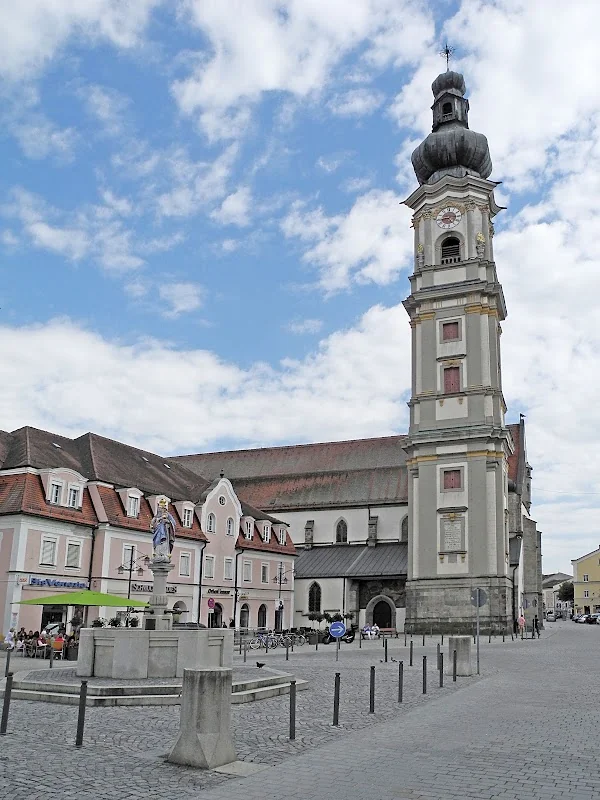
The Holy Sepulchre Church St. Peter and Paul is one of the defining landmarks of Deggendorf and is often the first strong impression for many visitors when they enter the historic old town. The building combines a Gothic basic structure with a Baroque tower, making the church immediately stand out from the cityscape while being deeply rooted in the city's history. Located at Michael-Fischer-Platz 1, it is not isolated but part of a historical ensemble that visibly shapes the old town core. Those searching for Holy Sepulchre Church, Sepulchre Church, Holy Sepulchre or Holy Sepulchre Chapel usually end up at this significant site, which combines religious function, monument value, and urban experience. The church is a Catholic pilgrimage church and remains integrated into church life to this day; at the same time, it is a strong motif for photos, city walks, and cultural-historical discoveries. The contrast between the medieval church body and the late Baroque tower makes it particularly characteristic. ([geodaten.bayern.de](https://www.geodaten.bayern.de/denkmal_static_data/externe_denkmalliste/pdf/denkmalliste_merge_271119.pdf))
History of the Holy Sepulchre Church St. Peter and Paul in Deggendorf
The origin of the Holy Sepulchre Church is closely linked to the urban needs of the Middle Ages. Within the city walls, there was initially only a smaller church building, the Martin Chapel next to the tower of the Old Town Hall. Since the parish church of the Assumption of Mary was located outside the walls and was difficult to reach at night or during wartime, the desire arose for a larger house of worship within the city. According to official sources, construction began in 1337, while parish and tourism sources classify its origin in the 14th century and date the church between 1338 and 1360 or around 1360 to 1390. Regardless of the respective dating, it is clear: The Sepulchre Church is one of the earliest and most important sacred buildings in Deggendorf. ([geodaten.bayern.de](https://www.geodaten.bayern.de/denkmal_static_data/externe_denkmalliste/pdf/denkmalliste_merge_271119.pdf))
Particularly formative for history was the so-called Holy Sepulchre, a replica of the tomb of Christ in Jerusalem, which used to be located in the church and gave the church its name. This already makes it clear from the outset that it is not simply another town church, but a place of special religious and historical significance. For centuries, the pilgrimage associated with the church was an important economic factor for Deggendorf. At the same time, this pilgrimage is now historically critically assessed, which is why modern representations describe the site not only as a spiritual monument but also as part of a complex urban and memory history. In the urban landscape and in the culture of remembrance, the Sepulchre Church remains a central reference point, as it impressively makes visible the transition from medieval piety, urban development, and later Baroque representation. ([mariae-himmelfahrt.de](https://mariae-himmelfahrt.de/portfolio/grabkirche/))
Architecture, Basilica, and Baroque Tower
Architecturally, the Holy Sepulchre Church is primarily a Gothic, three-nave vaulted basilica. This means that it has a high central nave and two lower side naves, which is particularly evident from the west facade. This view from the opposite side of the street makes the structure of the church very clear and explains why the building is so exciting for architecture enthusiasts. The monumental form appears both strict and clear, yet not cumbersome. It is a typical example of how medieval sacred architecture combines a strong external presence with a functional internal arrangement. The official monument list describes the building as a Catholic pilgrimage church to the Holy Sepulchre of Christ with a Gothic three-nave vaulted basilica. Thus, the church is not only a religious site but also an outstanding monument of architectural history in Lower Bavaria. ([geodaten.bayern.de](https://www.geodaten.bayern.de/denkmal_static_data/externe_denkmalliste/pdf/denkmalliste_merge_271119.pdf))
Perhaps the most famous feature is the late Baroque tower. It was built from 1722 to 1728 and has since shaped the silhouette of Deggendorf. The sources name Jakob Pawanger and Johann Gunetzrhainer as planners, while Johann Michael Fischer, one of the prominent Baroque builders, took over the execution. The city and tourism describe the tower as one of the most beautiful Baroque buildings in southern Germany or Bavaria, and this strong reputation is understandable when one sees the church on site: The tower elegantly rises above the Gothic nave and deliberately sets a later accent in the history of the building. For many visitors, this contrast is the main reason why they photograph the Sepulchre Church and perceive it as a landmark of the city. Additionally, the church is explicitly listed as a protected monument in the monument register, further emphasizing its cultural-historical significance. ([geodaten.bayern.de](https://www.geodaten.bayern.de/denkmal_static_data/externe_denkmalliste/pdf/denkmalliste_merge_271119.pdf))
The interior is also remarkable because it does not reduce the long history to a single epoch. In the Sepulchre Church, further artistic accents were set in the late 20th century and around the turn of the millennium, including stained glass windows by Erich Schickling from 1980, which take up motifs from the Old and New Testaments. These windows were integrated into the neo-Gothic window tracery of the choir and were initially removed during a renovation but were later reattached. Other windows in the right rear side chapel refer to Saint Jude Thaddeus and complement the sacred iconography. This creates an exciting dialogue between medieval architecture, Baroque tower design, and modern church art. Therefore, when entering the church, one does not only experience a historical building but a developed whole in which different times visibly come together. ([kunst-niederbayern.de](https://www.kunst-niederbayern.de/erich-schickling-grabkirche-deggendorf.html))
Pilgrimage, Services, and Church Life
The Holy Sepulchre Church is still not only a monument and photo motif but also a vibrant church location. The parish of the Assumption of Mary lists the church as part of its services and mentions regular Eucharistic celebrations as well as other liturgical forms such as adoration, rosary, and confession opportunities. Although the exact times change depending on the summer and winter half-year, it is clear: The Sepulchre Church is not treated as a museum but is actively used. This is important for visitors because it gives the place a special tranquility and dignity. Those who visit the church do not experience a mere exhibition space but a space that stands in the everyday life of the community, where faith, continuity, and urban identity come together. This connection is precisely what makes the appeal of the Sepulchre Church and explains why it plays such a visible role in Deggendorf. ([mariae-himmelfahrt.de](https://mariae-himmelfahrt.de/gottesdienste/))
Additionally, there are special forms of religious and cultural life closely connected to the Sepulchre Church. The city and the tourist information refer to guided tours and city walks, where the Sepulchre Church appears as a fixed point. In the digital city tour, there is even a dedicated audio stop for the Sepulchre Church, allowing the site to be explored not only on-site but also digitally. Particularly interesting is the connection with the Stations of the Cross group: It leads past the Water Chapel and the Holy Sepulchre Chapel up to Geiersberg, thereby linking several sites of the Deggendorf sacred landscape. This makes it clear that the Sepulchre Church does not stand alone but is part of a larger religious urban structure. Those searching for Holy Sepulchre Chapel, Stations of the Cross, or pilgrimage sites in Deggendorf will quickly encounter this environment. This makes the church attractive for pilgrims, culturally interested individuals, and city visitors alike. ([deggendorf.travel](https://deggendorf.travel/digitaler-stadtrundgang))
The historical memory of the Deggendorf Grace also remains present at this site. The city history and the museum place the tower and the church as part of a larger historical narrative that dates back to the 18th century and has left traces in images, votive offerings, and city views. The silver relief with the Deggendorf skyline, for example, shows the Sepulchre Church as the center of the city view and indicates how closely sacred architecture, city fortifications, and the self-image of the citizenry are interconnected. Today, the focus is less on the age-old legendary motif than on the cultural-historical approach to this heritage. That is precisely why the Sepulchre Church is a place where history is not only told but also reflected upon. ([handwerksmuseum.deggendorf.de](https://handwerksmuseum.deggendorf.de/neugierig-auf-skyline))
Location at Michael-Fischer-Platz and in the Deggendorf Cityscape
The address of the Holy Sepulchre Church is Michael-Fischer-Platz 1 in 94469 Deggendorf, and this location already makes its significance clear. It is located in the middle of the historic city center, at the southern end of Luitpoldplatz, where paths, sightlines, and urban experiences intersect. The tourism site describes that visitors, after passing through the Spital Gate into the old town, immediately encounter the striking tower of the Sepulchre Church. This very encounter of city gate, plaza, and church tower is one reason why the church is so strongly identified with Deggendorf. It is not a hidden side building but an urban orientation point that visibly organizes the historical center. The monument list also prominently features the church among the architectural monuments of the city. ([geodaten.bayern.de](https://www.geodaten.bayern.de/denkmal_static_data/externe_denkmalliste/pdf/denkmalliste_merge_271119.pdf))
In the cityscape, the tower plays a prominent role. The Handwerksmuseum describes that in a historical view of Deggendorf, the distinctive towers of the parish church, Sepulchre Church, and town hall rise like a skyline. It is also emphasized that the tower of the Sepulchre Church is visible in the center of the city and was crowned by a monstrance as a symbol of the Grace pilgrimage. This shows how much the church is read as a visual symbol. For photographers, this is particularly exciting: The Sepulchre Church is not just a single building but part of a characteristic urban panorama. Those who orient themselves by the church will also quickly find other destinations such as the city wall, the Old Town Hall, or the City Museum. This makes the site an excellent starting point for a walk through the old town. The combination of historic square, sacred building, and urban backdrop makes the location one of the most photogenic spots in Deggendorf. ([handwerksmuseum.deggendorf.de](https://handwerksmuseum.deggendorf.de/neugierig-auf-skyline))
Photos, Digital City Tour, and Visiting Tips
Those looking for photos of the Holy Sepulchre Church should pay particular attention to the view of the west facade and the tower. The parish description explains very clearly that from the opposite side of the street, one can see well how the nave is structured with a high central nave and two lower side naves. This perspective is also particularly suitable for photography because it makes the Gothic structure clearly readable. The Baroque tower sets a strong accent above and provides the contrast that makes many shots appear so impressive. In the official tourism presentation and the digital city tour, the Sepulchre Church is therefore a recurring motif. So, those who come with the search term Holy Sepulchre Church St. Peter and Paul photos are usually looking for this mix of monumentality, old town atmosphere, and architectural beauty. ([mariae-himmelfahrt.de](https://mariae-himmelfahrt.de/portfolio/grabkirche/))
For a visit, it is worthwhile to experience the Sepulchre Church not in isolation but as part of a small city walk. The digital city tour includes it as its own station, and the official tourist information also lists it as a sight. The site can be well combined with the Old Town Hall, the city wall, the City Museum, and other historical points in the old town. When searching for Holy Sepulchre Church or Sepulchre Church Deggendorf, it is often not just about a single building but about a whole historical route through the city center. The nearby Holy Sepulchre Chapel and the Stations of the Cross group also belong to the extended context. This makes the visit particularly varied, as art, piety, and urban space overlap directly. Thus, a simple search for photos or the place name quickly leads to a complete insight into Deggendorf's cultural-historical center. ([deggendorf.travel](https://deggendorf.travel/digitaler-stadtrundgang))
In summary, the Holy Sepulchre Church St. Peter and Paul is a place where Deggendorf shows its history very concentrated. The medieval core, the Baroque tower, the liturgical use, the position in the cityscape, and the integration into the digital and real city tour make the church an indispensable destination for visitors who want to understand the character of the city. Those who linger here discover not only a monument but a living point between faith, architecture, and culture of remembrance. ([geodaten.bayern.de](https://www.geodaten.bayern.de/denkmal_static_data/externe_denkmalliste/pdf/denkmalliste_merge_271119.pdf))
Sources:
- Parish of the Assumption of Mary Deggendorf – Sepulchre Church
- City of Deggendorf – History of the City of Deggendorf
- deggendorf.travel – Holy Sepulchre Church St. Peter and Paul
- Bavarian State Office for Monument Preservation – Monument List
- City of Deggendorf – Sepulchre Tower Tour
- deggendorf.travel – Digital City Tour
- Art in Lower Bavaria – Erich Schickling: Sepulchre Church Deggendorf
- Handwerksmuseum Deggendorf – Skyline of the City
Mehr anzeigenWeniger anzeigen
Holy Sepulchre Church St. Peter and Paul | Deggendorf & Photos
The Holy Sepulchre Church St. Peter and Paul is one of the defining landmarks of Deggendorf and is often the first strong impression for many visitors when they enter the historic old town. The building combines a Gothic basic structure with a Baroque tower, making the church immediately stand out from the cityscape while being deeply rooted in the city's history. Located at Michael-Fischer-Platz 1, it is not isolated but part of a historical ensemble that visibly shapes the old town core. Those searching for Holy Sepulchre Church, Sepulchre Church, Holy Sepulchre or Holy Sepulchre Chapel usually end up at this significant site, which combines religious function, monument value, and urban experience. The church is a Catholic pilgrimage church and remains integrated into church life to this day; at the same time, it is a strong motif for photos, city walks, and cultural-historical discoveries. The contrast between the medieval church body and the late Baroque tower makes it particularly characteristic. ([geodaten.bayern.de](https://www.geodaten.bayern.de/denkmal_static_data/externe_denkmalliste/pdf/denkmalliste_merge_271119.pdf))
History of the Holy Sepulchre Church St. Peter and Paul in Deggendorf
The origin of the Holy Sepulchre Church is closely linked to the urban needs of the Middle Ages. Within the city walls, there was initially only a smaller church building, the Martin Chapel next to the tower of the Old Town Hall. Since the parish church of the Assumption of Mary was located outside the walls and was difficult to reach at night or during wartime, the desire arose for a larger house of worship within the city. According to official sources, construction began in 1337, while parish and tourism sources classify its origin in the 14th century and date the church between 1338 and 1360 or around 1360 to 1390. Regardless of the respective dating, it is clear: The Sepulchre Church is one of the earliest and most important sacred buildings in Deggendorf. ([geodaten.bayern.de](https://www.geodaten.bayern.de/denkmal_static_data/externe_denkmalliste/pdf/denkmalliste_merge_271119.pdf))
Particularly formative for history was the so-called Holy Sepulchre, a replica of the tomb of Christ in Jerusalem, which used to be located in the church and gave the church its name. This already makes it clear from the outset that it is not simply another town church, but a place of special religious and historical significance. For centuries, the pilgrimage associated with the church was an important economic factor for Deggendorf. At the same time, this pilgrimage is now historically critically assessed, which is why modern representations describe the site not only as a spiritual monument but also as part of a complex urban and memory history. In the urban landscape and in the culture of remembrance, the Sepulchre Church remains a central reference point, as it impressively makes visible the transition from medieval piety, urban development, and later Baroque representation. ([mariae-himmelfahrt.de](https://mariae-himmelfahrt.de/portfolio/grabkirche/))
Architecture, Basilica, and Baroque Tower
Architecturally, the Holy Sepulchre Church is primarily a Gothic, three-nave vaulted basilica. This means that it has a high central nave and two lower side naves, which is particularly evident from the west facade. This view from the opposite side of the street makes the structure of the church very clear and explains why the building is so exciting for architecture enthusiasts. The monumental form appears both strict and clear, yet not cumbersome. It is a typical example of how medieval sacred architecture combines a strong external presence with a functional internal arrangement. The official monument list describes the building as a Catholic pilgrimage church to the Holy Sepulchre of Christ with a Gothic three-nave vaulted basilica. Thus, the church is not only a religious site but also an outstanding monument of architectural history in Lower Bavaria. ([geodaten.bayern.de](https://www.geodaten.bayern.de/denkmal_static_data/externe_denkmalliste/pdf/denkmalliste_merge_271119.pdf))
Perhaps the most famous feature is the late Baroque tower. It was built from 1722 to 1728 and has since shaped the silhouette of Deggendorf. The sources name Jakob Pawanger and Johann Gunetzrhainer as planners, while Johann Michael Fischer, one of the prominent Baroque builders, took over the execution. The city and tourism describe the tower as one of the most beautiful Baroque buildings in southern Germany or Bavaria, and this strong reputation is understandable when one sees the church on site: The tower elegantly rises above the Gothic nave and deliberately sets a later accent in the history of the building. For many visitors, this contrast is the main reason why they photograph the Sepulchre Church and perceive it as a landmark of the city. Additionally, the church is explicitly listed as a protected monument in the monument register, further emphasizing its cultural-historical significance. ([geodaten.bayern.de](https://www.geodaten.bayern.de/denkmal_static_data/externe_denkmalliste/pdf/denkmalliste_merge_271119.pdf))
The interior is also remarkable because it does not reduce the long history to a single epoch. In the Sepulchre Church, further artistic accents were set in the late 20th century and around the turn of the millennium, including stained glass windows by Erich Schickling from 1980, which take up motifs from the Old and New Testaments. These windows were integrated into the neo-Gothic window tracery of the choir and were initially removed during a renovation but were later reattached. Other windows in the right rear side chapel refer to Saint Jude Thaddeus and complement the sacred iconography. This creates an exciting dialogue between medieval architecture, Baroque tower design, and modern church art. Therefore, when entering the church, one does not only experience a historical building but a developed whole in which different times visibly come together. ([kunst-niederbayern.de](https://www.kunst-niederbayern.de/erich-schickling-grabkirche-deggendorf.html))
Pilgrimage, Services, and Church Life
The Holy Sepulchre Church is still not only a monument and photo motif but also a vibrant church location. The parish of the Assumption of Mary lists the church as part of its services and mentions regular Eucharistic celebrations as well as other liturgical forms such as adoration, rosary, and confession opportunities. Although the exact times change depending on the summer and winter half-year, it is clear: The Sepulchre Church is not treated as a museum but is actively used. This is important for visitors because it gives the place a special tranquility and dignity. Those who visit the church do not experience a mere exhibition space but a space that stands in the everyday life of the community, where faith, continuity, and urban identity come together. This connection is precisely what makes the appeal of the Sepulchre Church and explains why it plays such a visible role in Deggendorf. ([mariae-himmelfahrt.de](https://mariae-himmelfahrt.de/gottesdienste/))
Additionally, there are special forms of religious and cultural life closely connected to the Sepulchre Church. The city and the tourist information refer to guided tours and city walks, where the Sepulchre Church appears as a fixed point. In the digital city tour, there is even a dedicated audio stop for the Sepulchre Church, allowing the site to be explored not only on-site but also digitally. Particularly interesting is the connection with the Stations of the Cross group: It leads past the Water Chapel and the Holy Sepulchre Chapel up to Geiersberg, thereby linking several sites of the Deggendorf sacred landscape. This makes it clear that the Sepulchre Church does not stand alone but is part of a larger religious urban structure. Those searching for Holy Sepulchre Chapel, Stations of the Cross, or pilgrimage sites in Deggendorf will quickly encounter this environment. This makes the church attractive for pilgrims, culturally interested individuals, and city visitors alike. ([deggendorf.travel](https://deggendorf.travel/digitaler-stadtrundgang))
The historical memory of the Deggendorf Grace also remains present at this site. The city history and the museum place the tower and the church as part of a larger historical narrative that dates back to the 18th century and has left traces in images, votive offerings, and city views. The silver relief with the Deggendorf skyline, for example, shows the Sepulchre Church as the center of the city view and indicates how closely sacred architecture, city fortifications, and the self-image of the citizenry are interconnected. Today, the focus is less on the age-old legendary motif than on the cultural-historical approach to this heritage. That is precisely why the Sepulchre Church is a place where history is not only told but also reflected upon. ([handwerksmuseum.deggendorf.de](https://handwerksmuseum.deggendorf.de/neugierig-auf-skyline))
Location at Michael-Fischer-Platz and in the Deggendorf Cityscape
The address of the Holy Sepulchre Church is Michael-Fischer-Platz 1 in 94469 Deggendorf, and this location already makes its significance clear. It is located in the middle of the historic city center, at the southern end of Luitpoldplatz, where paths, sightlines, and urban experiences intersect. The tourism site describes that visitors, after passing through the Spital Gate into the old town, immediately encounter the striking tower of the Sepulchre Church. This very encounter of city gate, plaza, and church tower is one reason why the church is so strongly identified with Deggendorf. It is not a hidden side building but an urban orientation point that visibly organizes the historical center. The monument list also prominently features the church among the architectural monuments of the city. ([geodaten.bayern.de](https://www.geodaten.bayern.de/denkmal_static_data/externe_denkmalliste/pdf/denkmalliste_merge_271119.pdf))
In the cityscape, the tower plays a prominent role. The Handwerksmuseum describes that in a historical view of Deggendorf, the distinctive towers of the parish church, Sepulchre Church, and town hall rise like a skyline. It is also emphasized that the tower of the Sepulchre Church is visible in the center of the city and was crowned by a monstrance as a symbol of the Grace pilgrimage. This shows how much the church is read as a visual symbol. For photographers, this is particularly exciting: The Sepulchre Church is not just a single building but part of a characteristic urban panorama. Those who orient themselves by the church will also quickly find other destinations such as the city wall, the Old Town Hall, or the City Museum. This makes the site an excellent starting point for a walk through the old town. The combination of historic square, sacred building, and urban backdrop makes the location one of the most photogenic spots in Deggendorf. ([handwerksmuseum.deggendorf.de](https://handwerksmuseum.deggendorf.de/neugierig-auf-skyline))
Photos, Digital City Tour, and Visiting Tips
Those looking for photos of the Holy Sepulchre Church should pay particular attention to the view of the west facade and the tower. The parish description explains very clearly that from the opposite side of the street, one can see well how the nave is structured with a high central nave and two lower side naves. This perspective is also particularly suitable for photography because it makes the Gothic structure clearly readable. The Baroque tower sets a strong accent above and provides the contrast that makes many shots appear so impressive. In the official tourism presentation and the digital city tour, the Sepulchre Church is therefore a recurring motif. So, those who come with the search term Holy Sepulchre Church St. Peter and Paul photos are usually looking for this mix of monumentality, old town atmosphere, and architectural beauty. ([mariae-himmelfahrt.de](https://mariae-himmelfahrt.de/portfolio/grabkirche/))
For a visit, it is worthwhile to experience the Sepulchre Church not in isolation but as part of a small city walk. The digital city tour includes it as its own station, and the official tourist information also lists it as a sight. The site can be well combined with the Old Town Hall, the city wall, the City Museum, and other historical points in the old town. When searching for Holy Sepulchre Church or Sepulchre Church Deggendorf, it is often not just about a single building but about a whole historical route through the city center. The nearby Holy Sepulchre Chapel and the Stations of the Cross group also belong to the extended context. This makes the visit particularly varied, as art, piety, and urban space overlap directly. Thus, a simple search for photos or the place name quickly leads to a complete insight into Deggendorf's cultural-historical center. ([deggendorf.travel](https://deggendorf.travel/digitaler-stadtrundgang))
In summary, the Holy Sepulchre Church St. Peter and Paul is a place where Deggendorf shows its history very concentrated. The medieval core, the Baroque tower, the liturgical use, the position in the cityscape, and the integration into the digital and real city tour make the church an indispensable destination for visitors who want to understand the character of the city. Those who linger here discover not only a monument but a living point between faith, architecture, and culture of remembrance. ([geodaten.bayern.de](https://www.geodaten.bayern.de/denkmal_static_data/externe_denkmalliste/pdf/denkmalliste_merge_271119.pdf))
Sources:
- Parish of the Assumption of Mary Deggendorf – Sepulchre Church
- City of Deggendorf – History of the City of Deggendorf
- deggendorf.travel – Holy Sepulchre Church St. Peter and Paul
- Bavarian State Office for Monument Preservation – Monument List
- City of Deggendorf – Sepulchre Tower Tour
- deggendorf.travel – Digital City Tour
- Art in Lower Bavaria – Erich Schickling: Sepulchre Church Deggendorf
- Handwerksmuseum Deggendorf – Skyline of the City
Holy Sepulchre Church St. Peter and Paul | Deggendorf & Photos
The Holy Sepulchre Church St. Peter and Paul is one of the defining landmarks of Deggendorf and is often the first strong impression for many visitors when they enter the historic old town. The building combines a Gothic basic structure with a Baroque tower, making the church immediately stand out from the cityscape while being deeply rooted in the city's history. Located at Michael-Fischer-Platz 1, it is not isolated but part of a historical ensemble that visibly shapes the old town core. Those searching for Holy Sepulchre Church, Sepulchre Church, Holy Sepulchre or Holy Sepulchre Chapel usually end up at this significant site, which combines religious function, monument value, and urban experience. The church is a Catholic pilgrimage church and remains integrated into church life to this day; at the same time, it is a strong motif for photos, city walks, and cultural-historical discoveries. The contrast between the medieval church body and the late Baroque tower makes it particularly characteristic. ([geodaten.bayern.de](https://www.geodaten.bayern.de/denkmal_static_data/externe_denkmalliste/pdf/denkmalliste_merge_271119.pdf))
History of the Holy Sepulchre Church St. Peter and Paul in Deggendorf
The origin of the Holy Sepulchre Church is closely linked to the urban needs of the Middle Ages. Within the city walls, there was initially only a smaller church building, the Martin Chapel next to the tower of the Old Town Hall. Since the parish church of the Assumption of Mary was located outside the walls and was difficult to reach at night or during wartime, the desire arose for a larger house of worship within the city. According to official sources, construction began in 1337, while parish and tourism sources classify its origin in the 14th century and date the church between 1338 and 1360 or around 1360 to 1390. Regardless of the respective dating, it is clear: The Sepulchre Church is one of the earliest and most important sacred buildings in Deggendorf. ([geodaten.bayern.de](https://www.geodaten.bayern.de/denkmal_static_data/externe_denkmalliste/pdf/denkmalliste_merge_271119.pdf))
Particularly formative for history was the so-called Holy Sepulchre, a replica of the tomb of Christ in Jerusalem, which used to be located in the church and gave the church its name. This already makes it clear from the outset that it is not simply another town church, but a place of special religious and historical significance. For centuries, the pilgrimage associated with the church was an important economic factor for Deggendorf. At the same time, this pilgrimage is now historically critically assessed, which is why modern representations describe the site not only as a spiritual monument but also as part of a complex urban and memory history. In the urban landscape and in the culture of remembrance, the Sepulchre Church remains a central reference point, as it impressively makes visible the transition from medieval piety, urban development, and later Baroque representation. ([mariae-himmelfahrt.de](https://mariae-himmelfahrt.de/portfolio/grabkirche/))
Architecture, Basilica, and Baroque Tower
Architecturally, the Holy Sepulchre Church is primarily a Gothic, three-nave vaulted basilica. This means that it has a high central nave and two lower side naves, which is particularly evident from the west facade. This view from the opposite side of the street makes the structure of the church very clear and explains why the building is so exciting for architecture enthusiasts. The monumental form appears both strict and clear, yet not cumbersome. It is a typical example of how medieval sacred architecture combines a strong external presence with a functional internal arrangement. The official monument list describes the building as a Catholic pilgrimage church to the Holy Sepulchre of Christ with a Gothic three-nave vaulted basilica. Thus, the church is not only a religious site but also an outstanding monument of architectural history in Lower Bavaria. ([geodaten.bayern.de](https://www.geodaten.bayern.de/denkmal_static_data/externe_denkmalliste/pdf/denkmalliste_merge_271119.pdf))
Perhaps the most famous feature is the late Baroque tower. It was built from 1722 to 1728 and has since shaped the silhouette of Deggendorf. The sources name Jakob Pawanger and Johann Gunetzrhainer as planners, while Johann Michael Fischer, one of the prominent Baroque builders, took over the execution. The city and tourism describe the tower as one of the most beautiful Baroque buildings in southern Germany or Bavaria, and this strong reputation is understandable when one sees the church on site: The tower elegantly rises above the Gothic nave and deliberately sets a later accent in the history of the building. For many visitors, this contrast is the main reason why they photograph the Sepulchre Church and perceive it as a landmark of the city. Additionally, the church is explicitly listed as a protected monument in the monument register, further emphasizing its cultural-historical significance. ([geodaten.bayern.de](https://www.geodaten.bayern.de/denkmal_static_data/externe_denkmalliste/pdf/denkmalliste_merge_271119.pdf))
The interior is also remarkable because it does not reduce the long history to a single epoch. In the Sepulchre Church, further artistic accents were set in the late 20th century and around the turn of the millennium, including stained glass windows by Erich Schickling from 1980, which take up motifs from the Old and New Testaments. These windows were integrated into the neo-Gothic window tracery of the choir and were initially removed during a renovation but were later reattached. Other windows in the right rear side chapel refer to Saint Jude Thaddeus and complement the sacred iconography. This creates an exciting dialogue between medieval architecture, Baroque tower design, and modern church art. Therefore, when entering the church, one does not only experience a historical building but a developed whole in which different times visibly come together. ([kunst-niederbayern.de](https://www.kunst-niederbayern.de/erich-schickling-grabkirche-deggendorf.html))
Pilgrimage, Services, and Church Life
The Holy Sepulchre Church is still not only a monument and photo motif but also a vibrant church location. The parish of the Assumption of Mary lists the church as part of its services and mentions regular Eucharistic celebrations as well as other liturgical forms such as adoration, rosary, and confession opportunities. Although the exact times change depending on the summer and winter half-year, it is clear: The Sepulchre Church is not treated as a museum but is actively used. This is important for visitors because it gives the place a special tranquility and dignity. Those who visit the church do not experience a mere exhibition space but a space that stands in the everyday life of the community, where faith, continuity, and urban identity come together. This connection is precisely what makes the appeal of the Sepulchre Church and explains why it plays such a visible role in Deggendorf. ([mariae-himmelfahrt.de](https://mariae-himmelfahrt.de/gottesdienste/))
Additionally, there are special forms of religious and cultural life closely connected to the Sepulchre Church. The city and the tourist information refer to guided tours and city walks, where the Sepulchre Church appears as a fixed point. In the digital city tour, there is even a dedicated audio stop for the Sepulchre Church, allowing the site to be explored not only on-site but also digitally. Particularly interesting is the connection with the Stations of the Cross group: It leads past the Water Chapel and the Holy Sepulchre Chapel up to Geiersberg, thereby linking several sites of the Deggendorf sacred landscape. This makes it clear that the Sepulchre Church does not stand alone but is part of a larger religious urban structure. Those searching for Holy Sepulchre Chapel, Stations of the Cross, or pilgrimage sites in Deggendorf will quickly encounter this environment. This makes the church attractive for pilgrims, culturally interested individuals, and city visitors alike. ([deggendorf.travel](https://deggendorf.travel/digitaler-stadtrundgang))
The historical memory of the Deggendorf Grace also remains present at this site. The city history and the museum place the tower and the church as part of a larger historical narrative that dates back to the 18th century and has left traces in images, votive offerings, and city views. The silver relief with the Deggendorf skyline, for example, shows the Sepulchre Church as the center of the city view and indicates how closely sacred architecture, city fortifications, and the self-image of the citizenry are interconnected. Today, the focus is less on the age-old legendary motif than on the cultural-historical approach to this heritage. That is precisely why the Sepulchre Church is a place where history is not only told but also reflected upon. ([handwerksmuseum.deggendorf.de](https://handwerksmuseum.deggendorf.de/neugierig-auf-skyline))
Location at Michael-Fischer-Platz and in the Deggendorf Cityscape
The address of the Holy Sepulchre Church is Michael-Fischer-Platz 1 in 94469 Deggendorf, and this location already makes its significance clear. It is located in the middle of the historic city center, at the southern end of Luitpoldplatz, where paths, sightlines, and urban experiences intersect. The tourism site describes that visitors, after passing through the Spital Gate into the old town, immediately encounter the striking tower of the Sepulchre Church. This very encounter of city gate, plaza, and church tower is one reason why the church is so strongly identified with Deggendorf. It is not a hidden side building but an urban orientation point that visibly organizes the historical center. The monument list also prominently features the church among the architectural monuments of the city. ([geodaten.bayern.de](https://www.geodaten.bayern.de/denkmal_static_data/externe_denkmalliste/pdf/denkmalliste_merge_271119.pdf))
In the cityscape, the tower plays a prominent role. The Handwerksmuseum describes that in a historical view of Deggendorf, the distinctive towers of the parish church, Sepulchre Church, and town hall rise like a skyline. It is also emphasized that the tower of the Sepulchre Church is visible in the center of the city and was crowned by a monstrance as a symbol of the Grace pilgrimage. This shows how much the church is read as a visual symbol. For photographers, this is particularly exciting: The Sepulchre Church is not just a single building but part of a characteristic urban panorama. Those who orient themselves by the church will also quickly find other destinations such as the city wall, the Old Town Hall, or the City Museum. This makes the site an excellent starting point for a walk through the old town. The combination of historic square, sacred building, and urban backdrop makes the location one of the most photogenic spots in Deggendorf. ([handwerksmuseum.deggendorf.de](https://handwerksmuseum.deggendorf.de/neugierig-auf-skyline))
Photos, Digital City Tour, and Visiting Tips
Those looking for photos of the Holy Sepulchre Church should pay particular attention to the view of the west facade and the tower. The parish description explains very clearly that from the opposite side of the street, one can see well how the nave is structured with a high central nave and two lower side naves. This perspective is also particularly suitable for photography because it makes the Gothic structure clearly readable. The Baroque tower sets a strong accent above and provides the contrast that makes many shots appear so impressive. In the official tourism presentation and the digital city tour, the Sepulchre Church is therefore a recurring motif. So, those who come with the search term Holy Sepulchre Church St. Peter and Paul photos are usually looking for this mix of monumentality, old town atmosphere, and architectural beauty. ([mariae-himmelfahrt.de](https://mariae-himmelfahrt.de/portfolio/grabkirche/))
For a visit, it is worthwhile to experience the Sepulchre Church not in isolation but as part of a small city walk. The digital city tour includes it as its own station, and the official tourist information also lists it as a sight. The site can be well combined with the Old Town Hall, the city wall, the City Museum, and other historical points in the old town. When searching for Holy Sepulchre Church or Sepulchre Church Deggendorf, it is often not just about a single building but about a whole historical route through the city center. The nearby Holy Sepulchre Chapel and the Stations of the Cross group also belong to the extended context. This makes the visit particularly varied, as art, piety, and urban space overlap directly. Thus, a simple search for photos or the place name quickly leads to a complete insight into Deggendorf's cultural-historical center. ([deggendorf.travel](https://deggendorf.travel/digitaler-stadtrundgang))
In summary, the Holy Sepulchre Church St. Peter and Paul is a place where Deggendorf shows its history very concentrated. The medieval core, the Baroque tower, the liturgical use, the position in the cityscape, and the integration into the digital and real city tour make the church an indispensable destination for visitors who want to understand the character of the city. Those who linger here discover not only a monument but a living point between faith, architecture, and culture of remembrance. ([geodaten.bayern.de](https://www.geodaten.bayern.de/denkmal_static_data/externe_denkmalliste/pdf/denkmalliste_merge_271119.pdf))
Sources:
- Parish of the Assumption of Mary Deggendorf – Sepulchre Church
- City of Deggendorf – History of the City of Deggendorf
- deggendorf.travel – Holy Sepulchre Church St. Peter and Paul
- Bavarian State Office for Monument Preservation – Monument List
- City of Deggendorf – Sepulchre Tower Tour
- deggendorf.travel – Digital City Tour
- Art in Lower Bavaria – Erich Schickling: Sepulchre Church Deggendorf
- Handwerksmuseum Deggendorf – Skyline of the City
Frequently Asked Questions
Reviews
No reviews found