
David Hockney
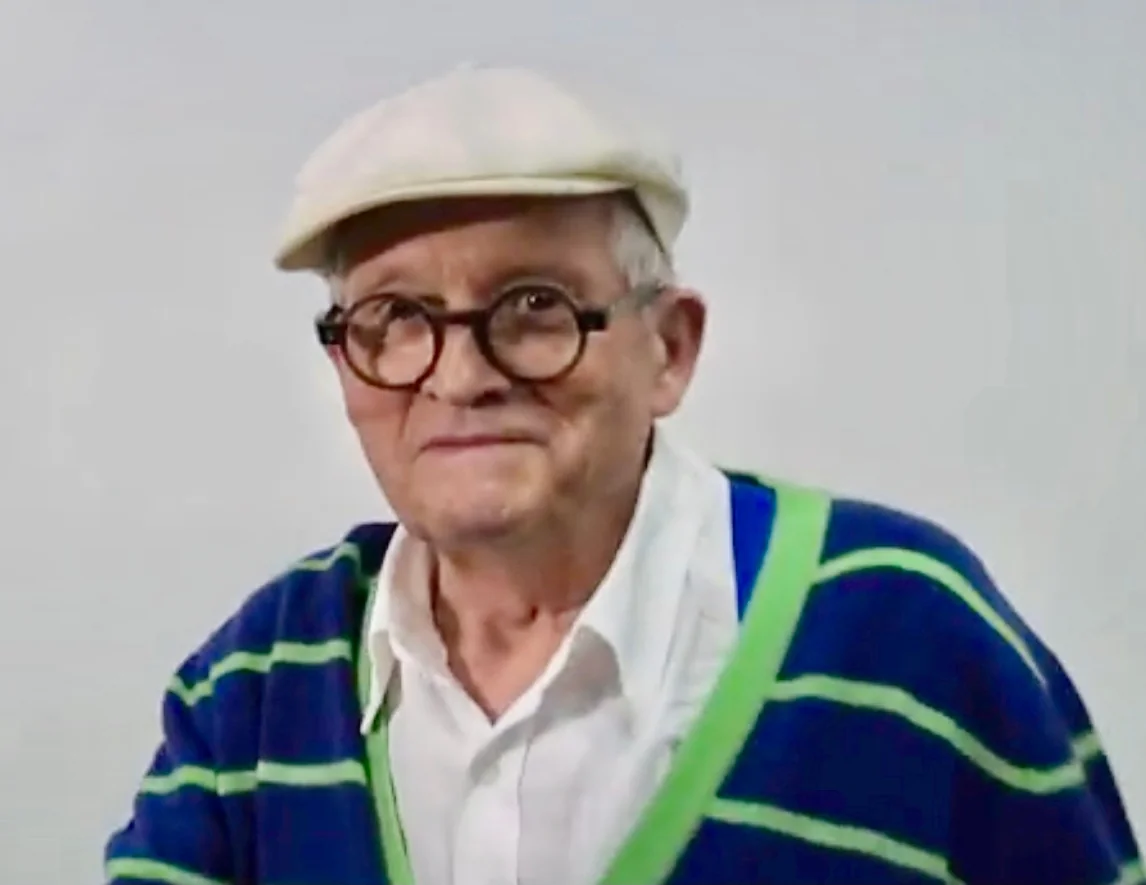
Image from Wikipedia
Image from Wikipedia
David Hockney: The Great Stylist of Color, Light, and Modern Perception
A British Exceptional Artist between Pop Art, Landscape, and Portrait
David Hockney was one of the defining artists of the 20th and 21st centuries. Born on July 9, 1937, in Bradford, he developed an early visual language oscillating between radical clarity, sensual color, and analytical observation. His work encompasses painting, graphic arts, stage design, photography, and digital works; his name represents an artistic evolution that could never be confined to a single style. Hockney passed away on June 11, 2026, in London, leaving behind a body of work of extraordinary range and impact. (de.wikipedia.org)
Early Years in Bradford: The Beginning of a Distinct Visual World
Hockney grew up in Yorkshire, studied at the Bradford School of Art, and later at the Royal College of Art in London. There, in the early 1960s, he was part of a generation that rethought British art, blending international movements, particularly Pop Art, with a unique signature. Even during this early phase, his interest in the representation of everyday life, body language, intimacy, and the interplay of surface and depth was evident. The years of training laid the foundation for a career marked by technical precision and intellectual curiosity. (guggenheim-bilbao.eus)
The Breakthrough in the 1960s: California, Pools, and the New Way of Seeing
In the 1960s, Hockney became an international figure. Especially his time in California fundamentally changed his work: the bright light, the architecture, the swimming pools, and the open lifestyle inspired paintings that have long since become icons of modern art. Works like Portrait of an Artist (Pool with Two Figures) from 1972 exemplify his ability to combine narrative precision with formal elegance and an almost cinematic sense of space. The fact that this work achieved $90.3 million at Christie’s in 2018 demonstrates the extraordinary market position Hockney held even while he was alive. (de.wikipedia.org)
Portrait Art, Friendship, and the Perspective on the Private
A central part of Hockney's artistic development lies in his portraits and double portraits. He painted friends, partners, collectors, and people from his personal circle with a mix of psychological distance and great familiarity. These images are never mere likenesses; they are finely orchestrated compositions about closeness, gaze relationships, and social tension. This is precisely where a core of his authority lies: Hockney turned the private into a universal visual language without slipping into psychologization or kitsch. (hockney2022.ch)
Landscape as a Laboratory of Seeing
Hockney was not only the painter of Californian light but also a radical innovator of landscape painting. His later landscapes from Yorkshire and Normandy show how consistently he made seeing itself a subject of his work. He created large-format series of images, iPad drawings, and layered perspectives to make time, movement, and changing light conditions visible. These works connect tradition and modernity in a way that characterizes his artistic development as experimental and open up to old age. (hockney.com)
Technical Openness: From Printmaking to iPad
Hockney was an artist who viewed new media not as a break but as an expansion. In addition to painting and drawing, printmaking played an important role, as well as photo collages and digital image production. The official catalog of his archive lists works from the early 1950s to the present, thereby documenting an astonishing stylistic and technical continuity. Particularly his digital image series show how deeply Hockney was interested in perception, surface, and the conditions of modern image production. (hockney.com)
Exhibitions, Recognitions, and International Reception
The reception of Hockney's work remained exceptionally intense over the decades. Tate Britain dedicated a major retrospective to him in 2017, regarded as the most visited exhibition in the gallery's history. In 2025 and 2026, major presentations in Paris, London, and Bradford dominated the international debate surrounding his work. The press page of his foundation documents how strongly Hockney was perceived as a living legend until the end: as an artist who looked at the present with the same alertness as his early subjects. (en.wikipedia.org)
Cultural Influence: Between Pop Art, British Identity, and Modern Icon
Hockney was often described as a leading representative of a Pop Art-related art, yet he always remained independent. His works influenced not only painting but also photography, stage design, and visual culture as a whole. His approach to color, space, and staging shaped generations of artists, curators, and collectors. At the same time, he was a central figure of British artistic identity: international, stylish, modern, and yet deeply rooted in observing his own origins. (de.wikipedia.org)
Later Years and Lasting Presence
In his later years, Hockney remained productive, curious, and publicly visible. In 2025, he was at the center of major exhibitions and discussions, including projects around Bradford as UK City of Culture and comprehensive retrospectives in Paris. His late creative phase showed no retreat but rather a concentration: less repetition and more deepening, less gesture and more concentrated presence. This very continuity made him so fascinating to the public and critics alike. (hockney.com)
Conclusion: An Artist Who Reinvented Seeing
David Hockney remains compelling because his work is more than a stylistic success story. It is a lifelong investigation into how images work, how spaces open up, and how color structures emotions. His art combines joy of life, analytical sharpness, and formal sovereignty into an unmistakable signature. Those who experience Hockney live in an exhibition encounter not just a century artist but an entire school of seeing. (moma.org)
Official Channels of David Hockney:
- Instagram: no official profile found
- Facebook: no official profile found
- YouTube: no official profile found
- Spotify: no official profile found
- TikTok: no official profile found